KDPBuilder vs Canva for KDP: Covers or Full Books

Skip the theory? Generate a free book preview in about a minute — no signup, no card.
Try it freeKDPBuilder vs Canva is not a debate about which tool has nicer templates. It is a workflow decision: do you need a design canvas for a cover, or do you need a complete KDP book package with the manuscript, interior, cover, metadata, and files built together?
Canva is useful when you already know the publishing job and only need help designing assets. KDPBuilder is built for authors who want the production responsibility handled as a studio workflow, so the book does not come together as a patched mix of template pages, guessed trim sizes, and last-minute metadata.
If you are already comparing options and want the fastest map of where each tool fits, start with the Compare Publishing Tools page, then use this guide to decide whether DIY design is enough or whether a finished package makes more sense.
KDPBuilder vs Canva: the short answer
If you already understand KDP production, Canva can be enough for specific tasks like cover design, mockups, or simple interiors. If you want one connected workflow from idea to manuscript, cover, interior, metadata, and upload-ready files, KDPBuilder is the stronger fit.
| Area | Canva | KDPBuilder |
|---|---|---|
| Cover design | Strong for layout and visuals | Delivered as part of a full book package |
| Interior layout | Possible for simple books | Built to match the book type and print specs |
| Manuscript creation | Not the main use | Included in the publishing workflow |
| Metadata | You prepare it separately | Built with the book strategy |
| KDP specs | You must verify them yourself | Handled as part of production |
| Originality | Depends on your design choices | Designed to avoid a generic assembled look |
| Support | Software help and tutorials | Publishing support across the package |
| Publish-ready delivery | No, not by default | Yes, that is the point |
Best for DIY design: Canva works best for authors who already understand trim size, margins, bleed, spine setup, export settings, and KDP upload requirements. It is a design platform, so the author still owns the production checklist.
Best for full book packages: KDPBuilder is a better fit when you want a cohesive product, not loose assets. That matters when the title promise, cover, interior, and metadata all need to match one publishing plan.
Best for DIY design
Choose Canva if you want control over each design decision and you are comfortable making publishing calls yourself. A simple example is an author with a finished planner manuscript who only needs to create a front cover, a few interior pages, and a PDF export.
Best for full book packages
Choose KDPBuilder if you want the production responsibility handled as a system. Instead of assembling cover, interior, and listing assets separately, the book is developed as one package with a single output standard.
For a deeper side-by-side view of tool scope, see the Compare Publishing Tools page.
Canva book cover KDP workflow: where it works
Canva can be effective for front-cover concepts, social graphics, mockups, and authors comfortable with layout decisions. It is especially useful when you want to test a visual direction quickly before you commit to a final cover.
The realistic canva book cover kdp workflow looks like this: choose dimensions, design the front, back, and spine, export the PDF, check margins and bleed, then upload to KDP. That sequence is manageable, but it still requires you to understand the publishing specs before the file is truly ready.
Front cover design
Canva is strongest when you need to move fast on the visible part of the book. You can combine text, images, shapes, and hierarchy without needing advanced software. For example, a nonfiction cover with a bold title, subtitle, and centered image can be built quickly if you already know the market style you want.
Paperback wraparound cover
For paperbacks, the cover is not just a front image. You must account for the back cover, spine, and front cover as one wraparound file. That means spine width changes with page count, and the final dimensions depend on trim size, paper type, and bleed.
Important fact: for KDP print books, cover dimensions depend on trim size, page count, paper type, and bleed; a paperback cover is uploaded as one full-wrap PDF including back cover, spine, and front cover.
Proof block: KDPBuilder covers are produced as full wraps at 300 DPI with spine width computed from the actual page count and paper type, then checked visually before delivery. See the real output examples on Real Book Examples.
One practical example: a 120-page cream-paper paperback will not use the same cover setup as a 200-page white-paper paperback, even if the trim size is identical.
Exporting files for KDP
Canva can export print-ready files, but export does not equal publish-ready by default. You still need to inspect the PDF for image quality, safe zones, spine text placement, and whether the file matches KDP’s current requirements before you upload it.
- Set the correct trim size.
- Build the full wrap cover with bleed.
- Check spine width against page count.
- Export as PDF print.
- Review the PDF before KDP upload.
Canva KDP templates limitations authors should know
Templates are useful, but they can also create a sameness problem. In crowded niches like low-content books, puzzle books, journals, coloring books, and workbooks, a widely used layout can make the book feel generic even when the design is technically clean.
Template sameness
One of the biggest canva kdp templates limitations is that the same base layout may be used across many books. If your cover or interior looks too close to what readers have already seen, the book can lose distinctiveness before someone even opens the listing.
A practical example is a journal cover built from a common font pair and stock icon with only the title changed. It may look acceptable, but it may not feel ownable or memorable.
Interior quality control
Templates do not solve content quality. A puzzle book still needs puzzle logic, answer accuracy, and a sensible difficulty progression. A workbook still needs a sequence that teaches or guides the reader in a clear order. A children’s interior still needs pacing, page rhythm, and age-appropriate layout decisions.
This is where many DIY projects stall: the pages are filled, but the book does not yet read like a finished product. Layout alone is not the same as publishing judgment.
Licensing and asset reuse
Canva users should review the current licensing terms and use assets in a way that fits the platform rules and the book’s intended value. The key point is not that Canva is unsafe; it is that authors should not rely on unchanged template assets as the main value of the book.
That matters when your book’s selling point is supposed to be originality, utility, or a professional finish. A design tool can support that goal, but it cannot decide it for you.
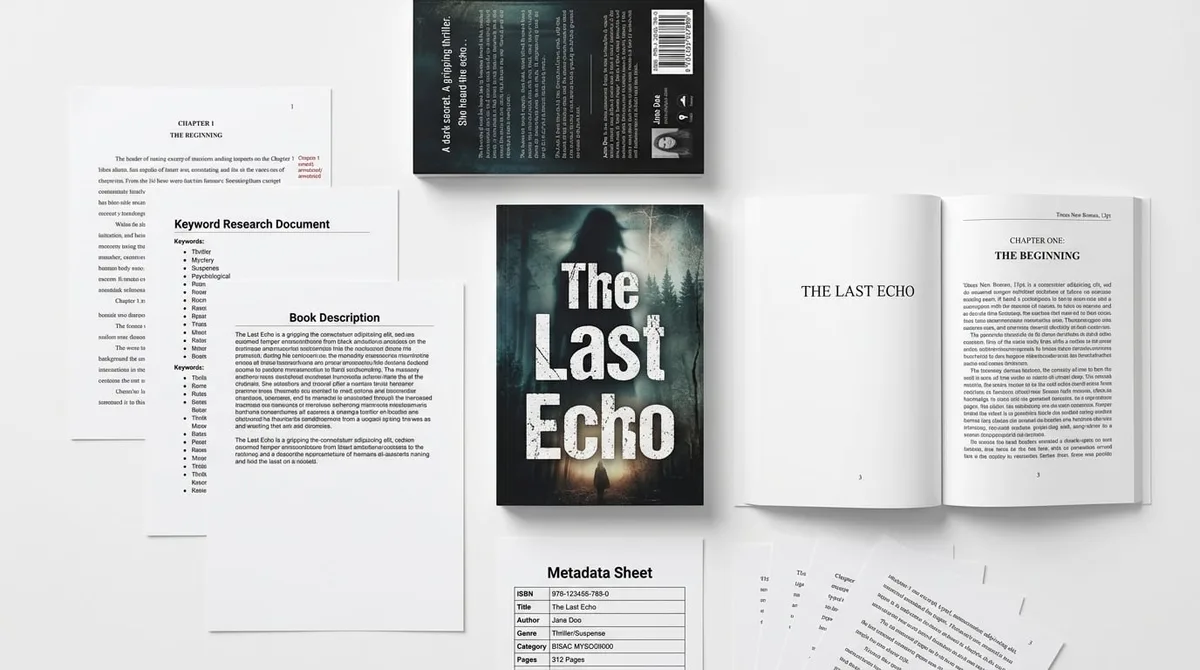
Proof block: KDPBuilder’s publishing package includes the print-ready interior PDF, full-wrap cover at 300 DPI, ebook file, and a metadata sheet with title, subtitle, description, 7 keywords, and category picks — the same core inputs KDP’s upload flow asks for. See what’s in a publishing package.
For a related workflow comparison, the AI Book Generator vs AI Publishing Studio article explains why asset creation and publishing production are not the same job.
Common mistakes to avoid with Canva templates:
- Using a cover layout without checking final trim and bleed.
- Leaving spine width unverified after page-count changes.
- Relying on a template interior without proofreading the actual page flow.
- Assuming export settings automatically make a file KDP-ready.
- Using a generic design as if it were a differentiating feature.
Insider pro-tip: before you lock a Canva template, print one test page at actual size and check the margins with a ruler. If the inner gutter or trim boundary looks crowded on paper, it will feel crowded to a buyer too.
Why KDPBuilder is not just another design tool
KDPBuilder is built around the studio model, not the asset-only model. The work starts with the book concept and ends with a connected package: manuscript or activity content, cover, interior, metadata, and publish-ready files.
That is the difference between assembling pieces and producing a book. The first can leave gaps between the title promise, the design, and the actual reader experience. The second is meant to close those gaps before upload.
Idea to manuscript
A publishing studio thinks about the book before the cover. What is the promise, who is the reader, what category does it belong in, and what content structure makes sense? That matters because the manuscript or activity content should support the listing, not fight it.
For example, a guided journal for burnout recovery needs a different flow than a generic daily journal. The difference is not just visual; it is structural.
Cover plus interior
When the cover and interior are created together, the book feels more deliberate. Fonts, spacing, page density, and visual tone can match the content type instead of feeling borrowed from unrelated templates.
That is why KDPBuilder focuses on output quality and production responsibility. The goal is not to make a book that merely looks designed; it is to build a book that feels intentional throughout.
Metadata and listing assets
Metadata is part of production, not an afterthought. Title, subtitle, keywords, category fit, and listing assets all influence whether the book is presented clearly. If the metadata says one thing and the interior delivers another, the reader notices the mismatch.
For that reason, cohesive production reduces the common DIY gap where covers look decent but interiors, margins, sizing, and market positioning still feel generated or amateur.
If you want to inspect the actual deliverables before choosing a plan, review what’s included in a publishing package. If you want to judge the finish level first, browse Real Book Examples.
Amazon cover template generator vs a finished cover package
Searches for an amazon cover template generator usually start with one practical need: get the cover dimensions right. That is a good starting point, but a template generator is only a measurement tool, not a finished sales asset.
KDP’s cover calculator logic tells you what size the wrap file should be based on trim, page count, paper type, and bleed. Canva gives you a blank design space where you can place the art. KDPBuilder goes further and delivers a finished cover package that is aligned to the book, not just the measurements.
What a template generator gives you
A calculator or template generator helps you determine the technical frame. It answers questions like: how wide is the spine, where do the margins go, and what total dimensions should the wrap file use?
That is useful, especially when you are building a paperback or hardcover and need to avoid basic sizing mistakes.
What it does not check
A generator does not evaluate whether the title hierarchy is readable, the image resolution is strong enough, the spine text is centered, or the back cover copy is positioned well. It also does not tell you whether the book concept itself feels consistent with the market.
This is why a book cover size calculator and KDP cover calculator are helpful, but incomplete. They solve measurement, not presentation quality.
Why finished cover review matters
A finished cover review checks the parts that templates miss: spine width changes, bleed safety, print contrast, barcode space, and whether the cover still looks balanced when viewed as a thumbnail. A technically correct file can still look weak if the visual hierarchy is off.
Important fact: KDP permits spine text on print books only when the book has at least 79 pages; otherwise the spine should be left blank.
That one rule alone shows why a template generator is not the whole solution. The spine is not just decoration; it is part of the production specification.
Interiors: Canva layouts vs KDPBuilder production
Interiors are where DIY Canva projects often break. Common issues include inconsistent margins, repeated pages, weak content progression, low perceived value, or print-readability problems that do not show up until the file is proofed.
Low-content books
For simple journals and planners, Canva can be enough if the interior structure is basic and the author understands the required page setup. For example, a ruled journal with a clean title page and repeated writing pages is manageable when the author controls the spacing and formatting carefully.
But even low-content books need consistency. If the page numbers shift, spacing changes, or the interior feels uneven, the book can seem unfinished.
Puzzle and activity books
Puzzle books are more demanding than they first appear. Anyone searching for a puzzle generator for KDP or a free puzzle generator for KDP still needs polished interiors, answer keys, difficulty progression, and a professional cover.
That means the puzzle content itself matters as much as the page design. A crossword or word search book needs logic checks, clean numbering, and enough variation to keep the reader engaged.
Workbooks and guided interiors
Workbooks and guided journals need stronger production judgment because the reader is following a sequence. If the pages do not build in the right order, the book feels disjointed even if every page is visually clean.
That is where KDPBuilder’s studio approach can save time and reduce rework. Instead of making the author solve layout, content flow, and print readiness separately, the production is handled as one system.
- Check that every page follows the intended sequence.
- Verify that margins are consistent across the full interior.
- Confirm that images and line art print clearly.
- Make sure answer keys or reference pages are complete.
- Review the PDF at actual size before upload.
Pricing: Canva subscription vs KDPBuilder package cost
Canva is cheaper as software, but software cost is only one part of the equation. It does not include strategy, writing, layout QA, metadata, or publishing readiness. If you handle those yourself, the package may still be affordable in money but expensive in time.
Software cost
With Canva, you pay for access to the platform and then do the publishing work yourself. That can be a smart choice if you already have the skills and only need a design environment.
For authors who already know KDP rules, this can be efficient. For authors learning as they go, the platform fee is only the starting point.
Production cost
DIY production often includes stock assets, fonts, plugins, extra software, freelancers, proof copies, and revisions. A book that starts simple can become a multi-step project once you account for cover iterations, interior fixes, and file re-exports.
If you are comparing total cost, it helps to use a KDP calculator to estimate royalty and printing cost before deciding whether a full package is worth it. That gives you a clearer view of the economics behind the book, not just the design subscription.
Opportunity cost
Time is a real cost. If you spend hours learning trim specs, revising margins, and rebuilding interiors, that time has value even if no invoice is attached. KDPBuilder is designed for authors who would rather pay for a connected production workflow than spend that time managing each step separately.
To see the plan structure and what each option includes, review KDPBuilder Pricing.
| Decision point | Canva | KDPBuilder |
|---|---|---|
| Need only a cover or simple asset | Good fit | More than you may need |
| Need manuscript, cover, interior, metadata, and files | You manage each part yourself | Included in one workflow |
| Comfort with KDP specs and QA | Required | Handled as part of production |
| Want to avoid template sameness | Depends on your skill | Built around a finished package |
| Want to review plan options before starting | N/A | See pricing |
When Canva is enough and when KDPBuilder is the better choice
Canva is enough when the author has a finished manuscript, knows KDP specs, understands design, and only needs simple visual assets. KDPBuilder is better when the author wants a coherent book package, has no time for production details, or wants to avoid a generic template look.
Choose Canva if
Choose Canva if you can answer yes to most of these:
- You already have a finished manuscript or final content plan.
- You know your trim size, bleed, and spine requirements.
- You can create or check a cover without guessing.
- You are comfortable formatting interiors yourself.
- You can write and QA your own metadata.
Choose KDPBuilder if
Choose KDPBuilder if you want the book built as a package instead of as separate parts. That is a better fit when you want the title, cover, interior, and listing assets to feel aligned from the start.
It is also a practical choice if you do not want to manage the common DIY risk points: wrong margins, weak file preparation, mismatched positioning, or a cover that looks fine but does not support the book’s market role.
Decision checklist
Use this quick checklist before you decide:
- Do you have a finished manuscript?
- Do you know your trim specs?
- Can you make metadata that matches the book?
- Can you QA the interior for print readability?
- Can you prepare files against KDP’s required specifications?
- Do you want a design tool or a publishing studio?
If you answer no to several of those, KDPBuilder is likely the better choice. If you answer yes to most of them, Canva may be enough for the asset work you need.
For related guidance, see KDPBuilder Alternatives: Use Us or Use DIY? and AI Book Generator vs AI Publishing Studio.
FAQ
Is Canva good for KDP book covers?
Yes, Canva is good for creating KDP covers if you understand the required dimensions, bleed, spine width, and export settings. It is especially useful for authors who want fast visual editing and already know how to prepare the file for upload. The main limitation is not design ability; it is that you still have to manage the publishing details yourself.
What are the main Canva KDP templates limitations?
The main limitations are template sameness, limited help with content quality, and the need for you to validate all print specs. Templates can make a book look clean, but they do not solve originality, puzzle logic, teaching flow, or market positioning. You should also review the current Canva licensing terms and avoid relying on unchanged template assets as the book’s main value.
Do I need an amazon cover template generator if I use Canva?
You do not need one in every case, but a calculator or template generator is still useful for sizing. Canva gives you the design space, while a cover calculator helps you confirm the technical measurements before export. Think of the generator as the setup step and Canva as the design step.
What is the difference between a book cover size calculator and a finished KDP cover?
A book cover size calculator tells you the correct dimensions based on trim size, page count, paper type, and bleed. A finished KDP cover is the complete wrap file with the front cover, back cover, spine, barcode area, and safe layout already prepared. In other words, the calculator gives you the frame, but the finished cover is the actual asset.
Can I create puzzle books for free with Canva or other KDP tools?
You can create parts of a puzzle book with free tools, but the full result still needs careful production. Puzzle books need clean logic, answer verification, difficulty progression, and a professional cover, so the tool is only one part of the process. Free software can help you start, but it does not replace editorial and layout judgment.
Is KDPBuilder a Book Bolt or Canva alternative?
KDPBuilder is best understood as a publishing studio alternative, not just another template tool. Canva is for design creation, while KDPBuilder is built to handle the connected workflow that turns an idea into a publish-ready book package. If you want one place to manage the manuscript, cover, interior, metadata, and files, that is the bigger difference.
Final verdict: covers or complete book production?
If the job is a cover concept, a mockup, or a simple template edit, Canva is a sensible tool. If the job is a finished book package where the manuscript, interior, cover, metadata, and files need to work together, KDPBuilder is the more complete workflow.
To move from comparison to action, look at Real Book Examples, review KDPBuilder Pricing, or register here when you are ready to build the book as a package instead of wrestling with separate assets.