KDPBuilder Alternatives: Use Us or Use DIY?

Skip the theory? Generate a free book preview in about a minute — no signup, no card.
Try it freeKDPBuilder alternatives are the right choice when you only need one cheap piece of the publishing process: a cover draft, a puzzle interior, a keyword list, or a simple journal template. KDPBuilder is the better fit when the real problem is not one file, but the whole package: manuscript, cover, interior, metadata, and files prepared for KDP upload that look like they belong to the same book.
That distinction matters. A stack of tools can produce assets. A publishing workflow has to make decisions: trim size, cover hierarchy, interior pacing, back-cover copy, metadata, file setup, and whether the finished book feels intentional instead of assembled.
KDPBuilder alternatives: the short answer
Use a single-purpose alternative if your project is narrow and you are comfortable doing the production checks yourself. Use KDPBuilder if you want a coordinated studio-style package and you would rather inspect one finished output than manage five disconnected tools.
Most kdpbuilder alternatives solve one slice of the process: research, writing, design, puzzle generation, or interiors. That can be useful. It can also create gaps. A keyword tool does not design a cover. A cover generator does not fix interior margins. A writing tool does not build a paperback-ready package.
KDPBuilder is for authors, entrepreneurs, educators, and publishers who want a designed book package rather than a folder of separate AI outputs. It is not the best fit for people who want the cheapest possible DIY workflow, enjoy learning every tool themselves, or only need one isolated asset.
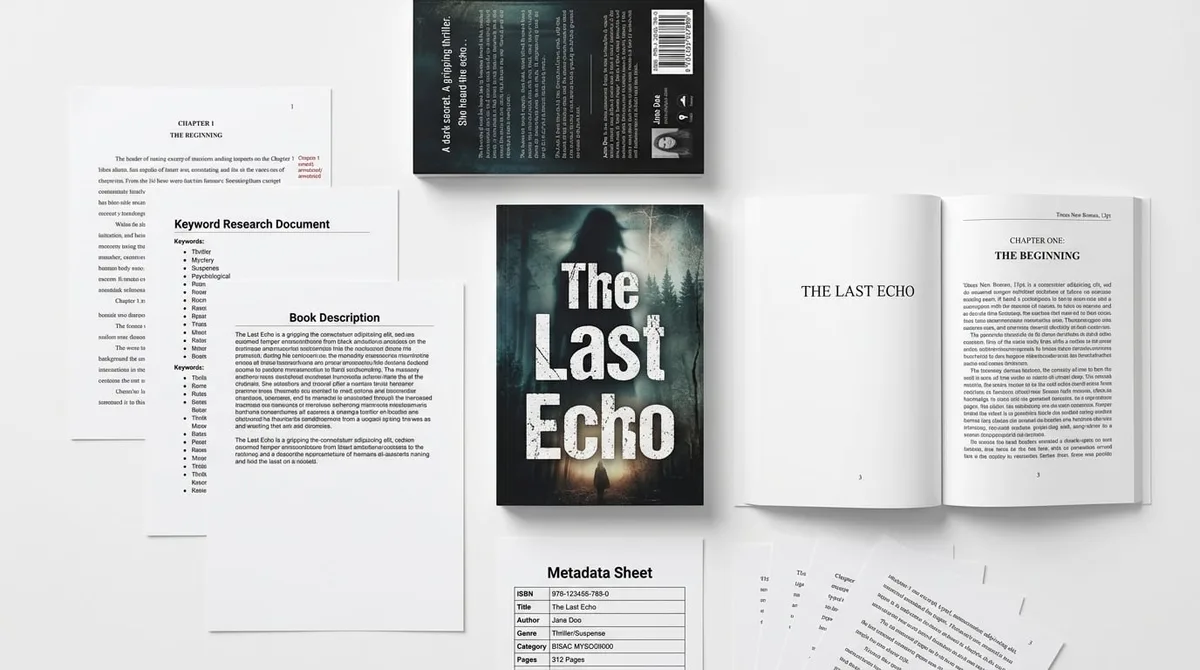
Product proof: KDPBuilder publishes a complete, unedited sample package with a manuscript PDF, full-wrap cover, interior, and metadata sheet, so you can inspect real output before creating an account. Inspect the complete sample package.
The main types of KDPBuilder alternatives
The cleanest way to compare alternatives is by job, not by brand name. A research platform, a design app, a puzzle generator, and a publishing studio are not really selling the same outcome. They may all be useful, but they create different levels of responsibility for the publisher.
If you want a broader side-by-side view, use the Compare Publishing Tools page to sort tools by what they actually produce: one asset, a partial workflow, or a coordinated book package.
DIY design tools
Canva and similar design tools are strong when you want hands-on control over covers, interiors, and marketing graphics. They are flexible, fast, and familiar. The tradeoff is that layout judgment stays with you. If the subtitle disappears at thumbnail size, the spine is mismeasured, or the interior hierarchy feels amateur, the tool will not stop you.
For a deeper look at that tradeoff, see KDPBuilder vs Canva: Best KDP Publishing Fit.
Research and keyword tools
Publisher Rocket-style tools are useful for market research, keyword discovery, and category thinking. They can help you understand demand and positioning. They do not produce the book. A research tool can point toward an opportunity; it will not write the manuscript, design the cover, format the interior, or prepare metadata as part of one package.
AI writing tools
ChatGPT and similar AI writing tools can help with outlines, drafts, rewrites, recipes, journals, activity concepts, and metadata brainstorming. The risk is mistaking speed for finished quality. Raw AI output still needs editing, fact-checking, voice control, rights review, and design direction. Text alone is not a book package.
If you are weighing AI writing against a packaged workflow, read KDPBuilder vs ChatGPT for KDP Publishing.
Puzzle and interior generators
BookBolt-style tools and puzzle generators are popular for low-content workflows, niche research, and repeatable activity pages. They work best when the format is simple and the publisher is willing to check page repetition, answer keys, bleed, margins, and print settings by hand.
Done-for-you publishing studios
A publishing studio such as KDPBuilder is built for a different buyer: someone who wants the manuscript, cover, interior, metadata, and upload-ready files aligned around the same concept. Generators make parts. A studio workflow is supposed to make the parts feel like one product.
Practical checklist for comparing tool types:
- Does the tool create one asset or the whole book package?
- Will you need separate tools for the manuscript, cover, interior, and metadata?
- Who checks trim size, bleed, margins, spine width, and typography?
- Can you inspect real output before paying for a larger plan?
- Does the finished book look coordinated or pieced together?
- Will you still need a designer, editor, or formatter after using the tool?
| What you need | Single-purpose tool | KDPBuilder studio package |
|---|---|---|
| One cover, one interior, or one keyword list | Usually enough | More than you need |
| Fast low-content testing | Often the cheapest route | Not built for bulk clone-style output |
| Trim, bleed, spine, and thumbnail consistency | You manage the checks manually | Built to keep the package aligned |
| Manuscript, cover, interior, and metadata together | Requires multiple tools | Built as one workflow |
| Brand-quality presentation | Possible, but depends on your skill | The main reason to use a studio workflow |
When a KDP interior generator is enough
A KDP interior generator can be enough for lined journals, log books, basic planners, trackers, notebooks, and other repeatable low-content interiors. If the product is intentionally minimal, a generator can save time by producing a usable page pattern without manually building every spread.
It is usually not enough when the book needs custom structure, visual consistency, recipes, educational content, workbook logic, section pacing, or a branded design system. Once the interior needs a table of contents, page hierarchy, instructional flow, or intentional progression, the interior becomes part of the product experience, not just a PDF.
For paperback production, KDP files still need the right trim size, bleed, margins, page count, and print-ready PDF setup. Common trim sizes include 6 x 9 inches and 8.5 x 11 inches, but the correct size depends on the book’s use case. A recipe book, a children’s activity book, a business workbook, and a pocket journal should not all be forced into the same template just because a generator makes that convenient.
Use the generator if the interior is simple and the risk is low. Use a studio workflow if the interior has to carry the quality of the product.
When a KDP puzzle generator or BookBolt-style tool wins
A KDP puzzle generator or BookBolt-style tool wins when speed matters more than custom presentation. The best use case is a simple activity product where you want to create puzzles quickly and you are willing to inspect every page before upload.
That manual review step is not optional. Puzzle books can fail at the production level because of duplicate pages, unreadable answer keys, bad spacing, inconsistent difficulty, incorrect bleed settings, or solution pages that do not match the puzzle order. A generator can accelerate creation, but it does not remove the publisher’s responsibility to proof the file.
A BookBolt-style workflow can also make sense if you want to learn low-content publishing personally, test niches at low cost, and make many production decisions yourself. The tradeoff is that template-driven output can look template-driven unless you add design judgment and quality control.
KDPBuilder is stronger when the product needs to feel branded, structured, and deliberately packaged rather than generated from the same building blocks as hundreds of similar listings.
Step-by-step: when the puzzle route makes sense
- Choose a simple format such as word search, Sudoku, maze, crossword, or basic activity pages.
- Set a trim size that fits how the buyer will actually use the book.
- Check for duplicate puzzles, cramped layouts, and inconsistent difficulty.
- Verify every answer key or solution page by hand.
- Export with the correct trim, bleed, and margin settings.
- Review the cover, metadata, and KDP preview separately before publishing.
Product proof: New KDPBuilder accounts start with 75 free credits and no credit card requirement, so you can test a first project before choosing a plan. Start with 75 free credits.
When a free AI book cover generator is the wrong comparison
A free AI book cover generator can be useful for brainstorming image directions. It is often the wrong comparison for KDPBuilder because a cover is not just an image. A real paperback cover also needs typography, genre signaling, title hierarchy, subtitle legibility, spine layout, back-cover copy, barcode space, trim, bleed, and a design that still works as a small Amazon thumbnail.
Here is the practical truth: many weak covers do not look unfinished because the image is bad. They look unfinished because the design is unpositioned. The title fights the background. The subtitle is too small. The author name floats. The spine does not match the front. The back cover reads like filler. Those are design problems, not image-generation problems.
Insider cover check: shrink the cover to thumbnail size and give it two seconds. Can you read the title, understand the genre, and tell what the book promises? If not, the cover needs stronger hierarchy before it needs better artwork.
A free generator can help you explore concepts. It should not be treated as a finished publishing system unless you also know how to handle print specifications, typography, and marketplace presentation.
KDPBuilder review: where we are the right fit
The strongest reason to use KDPBuilder is coordination. The workflow is built for buyers who want one package from idea to manuscript, cover, interior, metadata, and files prepared for KDP upload. If the pieces need to look and read like they belong together, that is where a studio approach earns its place.
KDPBuilder is a fit for authors building a serious backlist, entrepreneurs creating branded books, educators making instructional content, agencies producing client books, and publishers who want quality control across the full product instead of a collection of separate exports.
It is especially relevant when the book depends on positioning and packaging. A keyword list alone does not make a book ready. A cover file alone does not make a book ready. A manuscript draft alone does not make a book ready. The complete package is what reduces the assembled-from-random-tools look.
One useful test: if you are buying decisions, not just files, KDPBuilder is the more natural fit.
When KDPBuilder is not the right fit
KDPBuilder is not ideal if you only want a free tool, a one-click generator, or the lowest-cost way to create one isolated asset. If your only goal is a single cover mockup, a simple journal interior, or a quick keyword export, a focused tool is usually the smarter choice.
It is also not ideal if you want to personally control every design choice inside Canva, BookBolt, ChatGPT, or another DIY stack. Some publishers enjoy the learning curve and want to make every decision themselves. If that is you, the extra control may be worth the time.
KDPBuilder is not designed for publishing hundreds of near-identical low-quality books as fast as possible. Bulk duplication is a weak long-term publishing strategy, and a studio package is not built to support clone-style output.
Finally, KDPBuilder does not replace the publisher’s responsibility to review rights, factual accuracy, and Amazon KDP compliance. Amazon currently asks publishers to disclose AI-generated text, images, or translations during title setup. Under KDP’s wording, AI-assisted content that is materially created or edited by a human is treated differently from fully AI-generated content, but publishers should always review the current KDP questions before submission.
Before choosing DIY or studio-built, compare the actual deliverables on KDPBuilder Pricing against the time, tools, and revisions you would need to manage separately.
Is KDPBuilder worth it compared with alternatives?
KDPBuilder is worth it when coordination, time, and presentation matter more than maximum manual control. It is not worth it when you have more time than budget, want to learn every step yourself, or only need one component.
| Your goal | Best alternative | When KDPBuilder is better |
|---|---|---|
| Need one cover concept | Canva or a cover generator | When the cover must match the interior, metadata, and full package |
| Need research only | Publisher Rocket-style tool | When you also need production assets, not just keywords |
| Need a simple journal | KDP interior generator | When the interior needs custom structure or brand consistency |
| Need a puzzle book | BookBolt-style tool or puzzle generator | When the product needs a polished, non-template feel |
| Need a complete book package | DIY stack if you want full control | When you want manuscript, cover, interior, metadata, and files aligned |
Amazon KDP paperback royalties are commonly calculated as 60% of list price minus printing costs for standard distribution and 40% minus printing costs for expanded distribution where available. That means production decisions are not cosmetic. Trim size, page count, print cost, cover presentation, and pricing all affect the economics of the final book.
A cheaper tool can save money up front. But if the finished product needs rework, looks generic, or requires extra help from a designer, editor, or formatter, the real cost changes. The better question is not “What is the cheapest tool?” It is “What level of finished book am I trying to create?”
If the answer is “a quick generated asset,” use a focused alternative. If the answer is “a designed book package,” a studio workflow is usually the better fit. To decide with less guesswork, review the sample package first, then compare plans on KDPBuilder Pricing.
Final recommendation
Choose a KDPBuilder alternative when you need one narrow deliverable and you are comfortable owning the rest of the workflow. A cover tool, interior generator, puzzle platform, AI writer, or keyword tool can be the right answer when the project is simple and the quality risk is manageable.
Choose KDPBuilder when you need the book to feel designed as one product. That is the better path when the manuscript, cover, interior, metadata, and files prepared for KDP upload need to support the same concept instead of being patched together across multiple platforms.
The decision should be made by inspecting output, not feature lists. Start with the real sample package. If it matches the standard you want for your own book, test the workflow before committing to a paid plan.
Start with 75 free credits and run a first project without entering a credit card. If the studio approach fits your publishing process, you will know from the output, not from a sales promise.
FAQ
What are the best KDPBuilder alternatives?
The best alternatives depend on the task. Canva is useful for design control, BookBolt-style tools are useful for low-content research and puzzle workflows, ChatGPT is useful for drafting and metadata ideas, and Publisher Rocket-style tools are useful for keyword research. If you need one coordinated book package instead of separate tools, KDPBuilder is the stronger fit.
Is KDPBuilder worth it for a first-time KDP author?
It can be worth it if you want a guided path to a complete package and do not want to manage multiple tools. If your main goal is learning every production step yourself, a DIY stack may teach you more. The best choice depends on whether your priority is speed, learning, control, or coordination.
Is there a BookBolt free alternative for KDP publishing?
There are free or lower-cost tools that cover parts of the workflow, but they usually do not replace the full BookBolt-style research and generation process. A free tool may help with one task, such as layout or brainstorming, but you still have to manage formatting, quality checks, and KDP compliance yourself. In practice, “free alternative” usually means partial substitute, not equal replacement.
When should I use a KDP interior generator instead of KDPBuilder?
Use an interior generator when the interior is simple and repeatable, such as a lined journal, log book, tracker, or basic planner. Use KDPBuilder when the interior needs custom structure, brand consistency, or coordination with cover, metadata, and print specs. The more the interior affects the identity of the book, the more a studio workflow makes sense.
Can I use a free AI book cover generator for Amazon KDP?
Yes, if the result meets KDP requirements and actually works as a cover. A usable cover must handle typography, trim, spine, bleed, back-cover layout, and thumbnail readability, not just image generation. A free generator can help with concepts, but the final design still needs human judgment and proper file setup.
How does the Amazon KDP AI policy affect AI-generated books?
KDP asks publishers to disclose AI-generated text, images, or translations during title setup. AI-assisted content that is materially created or edited by a human is treated differently from fully AI-generated content under KDP’s current wording. If you use AI in any part of the workflow, review the current KDP disclosure questions carefully and make sure your files and listing match the content you actually produced.
Turn this idea into a book — free sample
Type a book idea and we'll generate a real cover preview in about a minute. No signup, no card.