KDPBuilder vs ChatGPT for KDP Publishing

Skip the theory? Generate a free book preview in about a minute — no signup, no card.
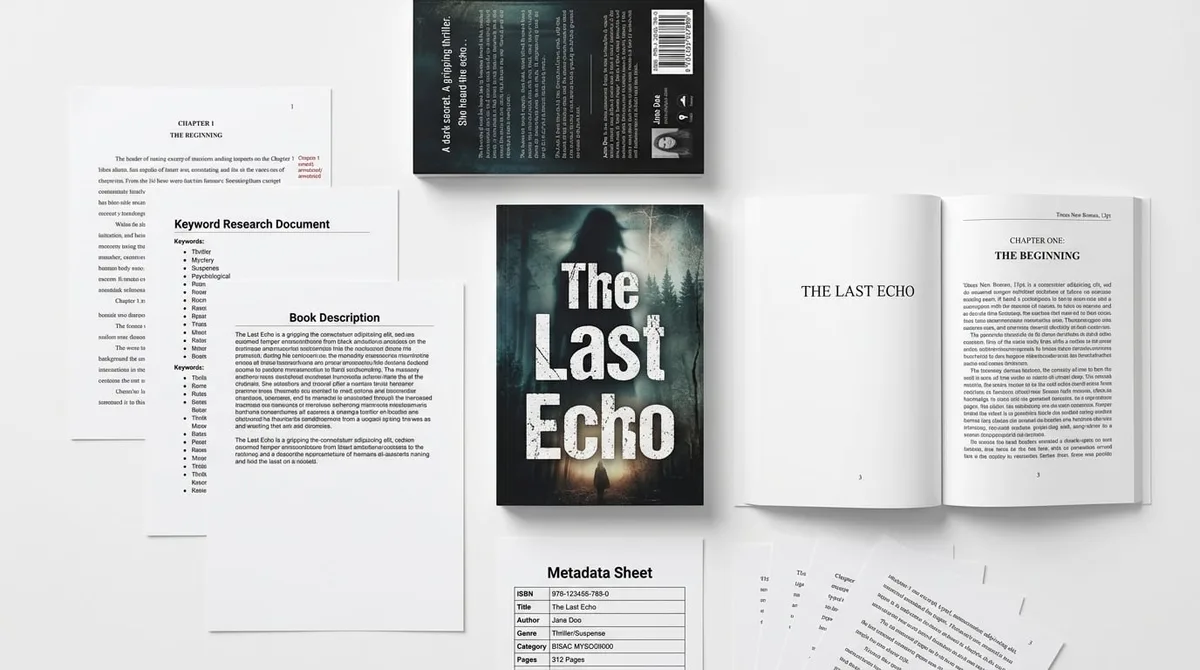
Try it freeKDPBuilder vs ChatGPT is the wrong comparison if you only ask which one can write faster. ChatGPT can help you generate text. KDPBuilder is built to assemble a KDP publishing package: manuscript, cover direction, interior layout, metadata, and organized files for the Amazon KDP workflow. The difference is not speed. The difference is whether you want a pile of draft copy or a book product that has been shaped, checked, and packaged.
If you already know KDP positioning, trim sizes, interiors, cover specs, metadata, and quality control, ChatGPT can be a useful assistant. If you want a coordinated publishing workflow that reduces the gap between idea and upload-ready assets, KDPBuilder is the stronger fit.
Start with the deliverables, not the hype. You can compare the workflow directly on the Compare Publishing Tools page, then inspect what a completed package looks like before you choose.
KDPBuilder vs ChatGPT: the honest short answer
KDPBuilder vs ChatGPT is not a battle between AI and no AI. It is a choice between a general-purpose text assistant and a publishing studio workflow. ChatGPT can brainstorm, outline, draft, rewrite, and summarize. KDPBuilder is designed to help creators move from idea to a finished KDP package where the manuscript, cover, interior, and metadata support the same reader promise.
Here is the clean decision rule:
- Use ChatGPT if you need drafting help and you are comfortable managing the publishing process yourself.
- Use KDPBuilder if you need a complete book package and want the production pieces handled in one coordinated workflow.
The practical question is simple: do you need help writing, or do you need help publishing? ChatGPT is strongest at the first job. KDPBuilder is built for the second.
KDPBuilder runs every book through a six-phase studio pipeline: Discovery, Writing, Editing, Design, Covers, and Publishing. That is a different operating model from a single prompt-and-response session. Walk through the pipeline free.
Choose ChatGPT if you want drafting help
ChatGPT is useful when the job is narrow: generate 10 niche ideas, outline a 12-chapter structure, rewrite a stiff section, turn notes into a chapter draft, or create alternate versions of a subtitle. It is fast, flexible, and helpful when you know exactly what to ask for.
A strong ChatGPT workflow usually looks like this:
- Define the reader and the book promise yourself.
- Ask for outline options, not a final manuscript on the first pass.
- Draft in sections so you can control tone and accuracy.
- Rewrite manually where the output sounds repetitive or vague.
- Verify every factual, legal, policy, and market claim before using it.
- Move the text into a separate publishing workflow for formatting, cover design, metadata, and file checks.
ChatGPT works best when the publisher remains the publisher. The tool can produce language, but you still have to make the real book decisions: category fit, trim size, interior type, cover positioning, metadata, and final quality control.
Choose KDPBuilder if you want a publish-ready package
KDPBuilder is the better match when the goal is not just text, but a finished publishing package. A KDP book is not a document with a cover slapped on top. It is a product made from connected parts: concept, title, manuscript, design, format, metadata, and files.
That is where many DIY ChatGPT projects stall. The draft exists, but the book is not ready. The cover does not match the promise. The interior has spacing problems. The metadata reads like a keyword dump. The description sounds generic. KDPBuilder is built to close those gaps inside one workflow.
For a concrete look at the deliverables, review the complete sample package. It shows how the parts are assembled into a KDP-ready project instead of leaving you with disconnected outputs.
What ChatGPT for KDP books does well
ChatGPT can be valuable in the early and middle stages of a KDP project. Used carefully, it removes the blank-page problem and gives you raw material to evaluate. Used carelessly, it can make a book sound polished while still being shallow.
Ideation and outlining
ChatGPT is strong for idea expansion. For example, you can ask it to generate 20 subtopics inside a broad niche, group them by reader intent, and suggest which ones might support a short guide, workbook, journal, or full nonfiction book.
It can also help turn a book promise into a chapter map. If your promise is to help first-time managers run better one-on-one meetings, ChatGPT can suggest a 10-chapter structure, possible exercises, and reader objections to address. That is useful raw planning material.
Drafting and rewriting
ChatGPT can create first-draft sections, rewrite awkward paragraphs, simplify dense explanations, and generate multiple tone options. A practical workflow is to write a rough paragraph yourself, ask for three rewrites, then keep only the strongest lines and edit them into your own voice.
The mistake is treating the first clean draft as the final manuscript. Smooth language is not the same as strong publishing. You still need examples, specificity, transitions, pacing, and a structure that rewards the reader for continuing.
Metadata brainstorming
ChatGPT can help generate keyword seeds, back cover copy, subtitle directions, and description angles. It is especially useful for exploring wording before you commit to a final title package.
But metadata is not just a writing task. A good description must match reader intent, category expectations, the actual contents of the book, and the promise made on the cover. Treat ChatGPT metadata as a draft, not as a final upload decision.
ChatGPT book publishing limitations most beginners miss
The most expensive beginner mistake is assuming that good text automatically becomes a good book. It does not. A KDP book is a bundle of decisions, and those decisions have to work together.
Text is not a book package
ChatGPT does not automatically create a differentiated concept, polished manuscript, print-ready interior, commercial cover, correct metadata, and organized upload files as one unified product. It can produce pieces of the puzzle. It does not finish the puzzle for you.
Readers experience the whole book. If the cover says practical workbook but the interior reads like a generic article, the product feels mismatched. If the description promises a step-by-step system but the chapters wander, the trust breaks. That is a publishing problem, not a prompting problem.
Prompts do not replace publishing judgment
Generic prompting produces generic books: repeated phrasing, obvious transitions, shallow examples, and advice that sounds like it could belong in any niche. The tool is only as sharp as the strategy behind it.
ChatGPT can also invent facts, citations, policy details, keyword volume, category logic, or formatting requirements. Anything that affects rights, compliance, KDP setup, pricing, royalties, or reader safety needs to be verified outside the model before it reaches the final book.
Generic AI output creates trust problems
Buyers may not know exactly how a book was made, but they notice when it feels thin. The signs are familiar: vague examples, padded chapters, no real point of view, identical paragraph rhythms, and content that explains the obvious without adding useful judgment.
The real question is not whether AI can write sentences. It is whether the finished book is worth a reader's money and attention.
Insider quality check: read three pages out loud without stopping. If the rhythm starts to feel repetitive, the same problem will usually show up in the Amazon sample. Fix the pattern before you format the book.
KDP AI disclosure rules in 2026: what matters here
Anyone comparing KDPBuilder vs ChatGPT should understand KDP's current AI-content disclosure requirements before uploading. Workflow choice matters, but disclosure, rights, and quality control matter too.
Amazon KDP requires publishers to disclose AI-generated content during title setup when applicable, including AI-generated text, images, or translations. AI-assisted content is treated differently from AI-generated content, but publishers should always verify the current official KDP guidance inside KDP before upload because policies can change.
What to check before upload
Before you publish, confirm these items:
- Whether any text, image, or translation element was AI-generated.
- Whether your KDP disclosure matches the actual production process.
- Whether you have the rights needed for all text, images, and design assets.
- Whether the manuscript has been edited for accuracy, originality, and usefulness.
- Whether the metadata is accurate and not misleading.
A simple rule: disclose accurately, not defensively. Disclosure is a setup requirement. It does not replace editing, design, formatting, or rights review.
AI-generated vs AI-assisted content
In practical terms, AI-generated content is content created by a model. AI-assisted content is content where AI helped the author or publisher shape, revise, or improve work that remains meaningfully directed by a human. The distinction matters because it affects what you disclose and how you document your production process.
If you are unsure where your project falls, slow down and verify the current KDP rules before uploading. Guessing is not a publishing strategy.
Disclosure does not fix a low-quality book
Even perfect disclosure will not rescue a weak book. Use this mini checklist before finalizing any AI-assisted KDP project:
- Disclose AI-generated content accurately when applicable.
- Confirm rights for text, images, translations, and design assets.
- Edit for clarity, originality, and usefulness.
- Check formatting against the selected trim size and file type.
- Avoid duplicated, padded, or low-effort content.
- Make sure the description, categories, and keywords match the actual book.
Compliance is the floor. A book still has to be worth reading.
Side-by-side comparison: ChatGPT vs KDPBuilder
The fastest way to compare the tools is to compare outputs. ChatGPT produces responses. KDPBuilder produces a coordinated publishing package.
| Area | ChatGPT | KDPBuilder |
|---|---|---|
| Idea development | Brainstorms concepts and angles | Refines a publishable concept around a clear reader outcome |
| Niche positioning | Suggests positioning options | Builds a coherent market-facing package |
| Manuscript creation | Drafts and rewrites text when prompted | Develops the manuscript as part of the full book system |
| Editing workflow | Can revise sections on request | Supports a coordinated editorial process across the project |
| Cover direction | Can suggest ideas but does not deliver a commercial cover by itself | Aligns cover direction with the book promise and package |
| Interior formatting | Does not validate print layout or trim requirements | Prepares interior output around KDP production needs |
| Metadata | Can brainstorm keywords, blurbs, and descriptions | Builds metadata as part of the complete package |
| KDP file readiness | User must assemble and check files manually | Organizes files for the KDP upload workflow |
| Best user | Experienced DIY publisher who wants a text assistant | Creator who wants studio-style guidance from concept to files |
ChatGPT gives you flexibility, but that flexibility comes with responsibility. You become the strategist, editor, designer, formatter, metadata writer, and file checker. KDPBuilder is aimed at creators who want those steps connected instead of scattered across separate tools.
Output quality
With ChatGPT, output quality depends heavily on the prompt, the user's judgment, and the amount of revision work done afterward. A weak prompt can produce a readable but forgettable book.
KDPBuilder is built to keep the deliverables aligned, so the manuscript, cover, interior, and metadata feel like one product rather than separate AI outputs stitched together at the end.
Workflow complexity
With ChatGPT, the workflow is modular but manual. You still have to choose the concept, draft the content, check the facts, format the interior, coordinate the cover, write the metadata, and package the files correctly.
With KDPBuilder, the workflow is organized around output readiness. That means fewer disconnected handoffs between writing, design, formatting, and upload preparation.
Time to publish
ChatGPT can speed up drafting, but that does not automatically speed up publishing. New KDP creators often lose the time they saved on writing when they hit formatting fixes, cover sizing, metadata cleanup, and file troubleshooting.
KDPBuilder is the better option when you want to reduce the gap between a draft and a usable publishing package.
Risk of looking generated
The more generic the prompting, the more generic the book can feel. Repeated structures, bland examples, and shallow transitions are common signs that a manuscript was built without enough editorial direction.
A studio workflow reduces that risk by treating the book as a reader experience, not just a text file.
Where KDPBuilder adds value beyond a prompt
KDPBuilder adds value by connecting the parts that ChatGPT leaves separate. That is the difference between generating content and building a book.
A publishable concept
A good KDP book starts with a concept that is specific enough to be useful and broad enough to be understandable in the marketplace. KDPBuilder helps shape the idea around a reader need instead of a word count target.
The title, subtitle, chapter structure, interior, and cover should all point to the same promise. If they do not, the book feels confused even when the writing is clean.
A designed reader experience
The reader experience is affected by chapter flow, visual hierarchy, spacing, prompts, worksheets, page rhythm, and how the book feels in print or on screen. KDPBuilder's studio workflow is meant to keep those choices aligned.
For example, a workbook needs room to write and a clear exercise structure. A short tactical guide needs fast navigation and strong section headers. A low-content-style book needs spacing and repetition that feel intentional rather than empty. Design choices should match the content type.
Files and metadata built for KDP
KDP print books require properly formatted interior and cover files. Trim size, bleed, margins, page count, spine width, and cover dimensions have to match the production setup before upload. That is a technical publishing step, not a writing step.
KDPBuilder helps translate the concept into the actual file package and metadata structure needed for the KDP workflow, which is where many DIY projects slow down or stall.
The publishing package is built around the items KDP asks you to prepare: a print-ready interior PDF, a full-wrap cover with front, spine, and back at 300 DPI, an ebook file, and a metadata sheet with title, subtitle, description, 7 keywords, and category picks. To review that structure directly, see what is in a publishing package.
If you want to test the workflow before committing, try KDPBuilder free and walk through the pipeline.
A practical KDP workflow checklist
Whether you use ChatGPT, KDPBuilder, or both, the publishing checklist should be concrete. Do not move to upload until each item has been handled.
- Define the reader, problem, and outcome in one sentence.
- Choose the book type: guide, workbook, journal, planner, short nonfiction, or ebook-first product.
- Build the outline before drafting full chapters.
- Check every factual claim, policy reference, and rights-sensitive asset.
- Edit the manuscript for repetition, specificity, and flow.
- Match the cover direction to the category and book promise.
- Format the interior to the correct trim size, bleed, and margin requirements.
- Prepare a description that accurately sells the book without exaggeration.
- Select 7 keyword fields that fit reader intent instead of stuffing phrases.
- Review the final manuscript, cover, interior, ebook file, and metadata together before upload.
Mistakes to avoid when choosing a KDP workflow
- Using ChatGPT for drafting but skipping the final publishing checklist.
- Treating metadata as a keyword dump instead of a positioning decision.
- Uploading a cover or interior that has not been checked against KDP specs.
- Assuming AI-generated text is automatically ready for readers.
- Mixing AI-assisted and AI-generated assets without checking disclosure requirements.
- Choosing the cheapest tool and then losing weeks to production fixes.
Pricing and ROI: is KDPBuilder worth it over ChatGPT?
ChatGPT is usually cheaper upfront, and that should be stated plainly. A free plan or subscription can cost less than a studio workflow, especially if all you need is help drafting a few sections.
The better question is not which tool costs less today. The better question is which workflow reduces rework, confusion, and abandoned projects.
When ChatGPT is enough
ChatGPT can be enough when you already know how to publish, format, design, and package the book yourself. It is also a good option when the task is narrow: brainstorming a subtitle, rewriting a chapter, creating outline variations, or polishing a description draft.
If you are comfortable owning the production stack, ChatGPT can be a cost-effective assistant.
When a studio workflow makes more sense
A studio workflow makes more sense when you want fewer moving parts. Cheap text can become expensive if the cover looks amateur, the interior fails file checks, the manuscript reads generic, or the project gets abandoned halfway through.
That is the hidden cost many beginners miss: time spent rescuing a half-finished product. If the goal is a complete book package, the workflow matters as much as the writing tool.
For current plan details, review the KDPBuilder Pricing page. Then compare what is included against the work you would need to handle yourself with ChatGPT.
One planning note on royalties: KDP paperback royalties are generally 60% of list price minus printing costs for standard Amazon marketplaces, while expanded distribution is generally 40% minus printing costs. Those numbers affect pricing decisions, but they do not change the need for a well-made book.
Final verdict: which should you use for your next KDP book?
Use ChatGPT when you need a smart drafting partner. It is useful for ideas, outlines, rewrites, descriptions, and rough manuscript sections. For experienced publishers who already understand the production side, it can fit neatly into a DIY workflow.
Use KDPBuilder when you want the book treated as a product, not just a document. If you need the manuscript, cover direction, interior, metadata, and file package to work together, KDPBuilder is the more direct fit.
The final decision is not AI versus no AI. It is raw prompting versus a publishing workflow. If you are still comparing, do not decide from promises alone. Inspect the sample package, check current pricing, and then create your account when you are ready to move from comparison to setup.
FAQ
Is KDPBuilder better than ChatGPT for KDP publishing?
It depends on what you need. ChatGPT is strong for brainstorming, outlining, drafting, and rewriting. KDPBuilder is built for a more complete publishing workflow. If you want a publish-ready package rather than text help alone, KDPBuilder is the better fit.
Can I use ChatGPT for KDP books and still publish on Amazon?
Yes. You can use ChatGPT as part of a KDP workflow as long as you follow current KDP requirements, disclose AI-generated content when applicable, verify rights, and produce a book that meets quality and formatting expectations. The tool is not the issue by itself. The final product and setup choices matter.
What are the biggest ChatGPT book publishing limitations?
The biggest limitations are that ChatGPT does not automatically build a full book package, validate print specs, design a commercial cover, or make final editorial and metadata decisions for you. It can also produce generic language or incorrect details if the output is not checked carefully.
What is the official Amazon KDP AI-generated content disclosure guidance?
Amazon KDP requires publishers to disclose AI-generated content during title setup when applicable, including AI-generated text, images, or translations. AI-assisted content is treated differently, but you should check the current official KDP guidance before upload because policies can change.
Do I need to disclose AI-generated content on KDP in 2026?
If your title includes AI-generated content, disclosure may be required during the KDP setup process. The safest approach is to review the current official guidance, disclose accurately when needed, and make sure your rights and quality checks are complete before publishing.
Does KDPBuilder replace ChatGPT?
It works differently. ChatGPT is a general-purpose text assistant. KDPBuilder is a publishing studio workflow focused on the full book package. You may use both, but they solve different parts of the process.
Ready to compare the actual workflow? Review KDPBuilder Pricing or register to get started.
Turn this idea into a book — free sample
Type a book idea and we'll generate a real cover preview in about a minute. No signup, no card.