KDPBuilder vs Canva: Best KDP Publishing Fit

Skip the theory? Generate a free book preview in about a minute — no signup, no card.
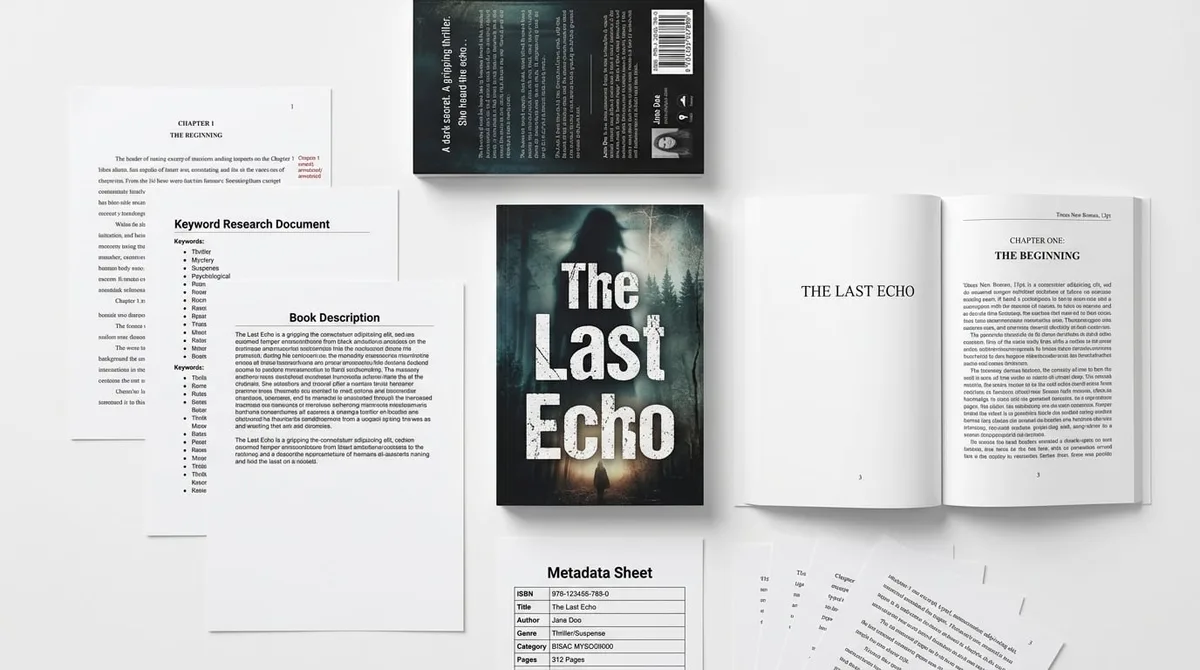
Try it freeKDPBuilder vs Canva is the decision between building KDP assets yourself and hiring a studio workflow to assemble the whole book. Canva can be a smart tool for simple covers, planners, journals, and fast template edits. KDPBuilder is the better fit when the deliverable is not just a nice-looking design, but a coordinated KDP package: manuscript structure, full-wrap cover, interior, ebook file, metadata, AI-use review, and final files prepared for the upload workflow.
If you are choosing at the bottom of the funnel, ask one question first: do you want to manage the production specs yourself, or do you want the book package built for you? That answer will make the comparison much clearer.
KDPBuilder vs Canva: the quick verdict
KDPBuilder vs Canva is not a like-for-like software comparison. Canva is a general design workspace. KDPBuilder is a publishing studio process built around the actual pieces a KDP book needs before upload. If you already understand trim size, bleed, page count, spine width, image resolution, margins, export settings, metadata, and disclosure questions, Canva can work well. If those details are the part you want handled, KDPBuilder is the stronger choice.
| Category | Canva | KDPBuilder |
|---|---|---|
| Covers | You design from templates and manually size the KDP wrap | Full-wrap cover produced as part of the book package |
| Interiors | Possible, but manual for long or structured books | Interior created as part of the publishing workflow |
| Manuscript support | No manuscript development system | Manuscript and structure support included in the package workflow |
| Metadata | You create title, subtitle, description, keywords, and category choices separately | Metadata sheet included with title, subtitle, description, 7 keywords, and category picks |
| KDP file readiness | You are responsible for specs, export settings, and print preview checks | Files are prepared for the KDP upload workflow, without any approval guarantee |
| Revisions | Easy to edit assets, but consistency is on you | Revisions fit inside a coordinated studio process |
| AI policy handling | Depends on the assets you use and disclose | AI-use review can be built into the workflow before upload |
| Pricing model | Lower software cost if you do the production work | Higher-touch package for authors who want more of the work handled |
Primary recommendation: choose Canva if you are an experienced DIY publisher who can confidently produce the correct files. Choose KDPBuilder if you want the manuscript, cover, interior, metadata, and final exports handled as one coherent package. For a side-by-side view of the workflow, start with our Compare Publishing Tools page.
Best for DIY cover design
Canva is best for authors who want hands-on control over typography, image placement, and quick visual iteration. It works especially well when the project is simple and you know the technical setup before you start.
Best for full KDP packages
KDPBuilder is better when the goal is a book package rather than one isolated cover file. The manuscript, front cover, back cover, spine, interior pages, ebook file, metadata, and export decisions need to work together. You can see the structure of that deliverable on the KDP publishing package page.
Best for avoiding the template-made look
A template can be clean and still feel generic. The real test is whether the book looks intentionally published: cover hierarchy, interior rhythm, back-cover copy, spine, description, keywords, and category positioning all pointing in the same direction. That is where a studio workflow has a clear advantage.
Canva book cover KDP: where Canva works well
Canva has real strengths in a KDP workflow. It is fast, familiar, affordable, and easy to use for simple visual assets. Its template library, typography controls, image tools, and PDF export options make it practical for straightforward projects, especially when the publisher already understands Amazon KDP file requirements.
It can be enough for lined journals, basic planners, simple low-content books, lead magnets, and quick branded worksheets where the visual system is intentionally minimal. If you have a good design eye and know how to build the exact cover dimensions, Canva can move a project from concept to export quickly.
KDPBuilder covers are produced as full wraps — front, spine, and back — at 300 DPI, with spine width computed from the actual page count and paper type, then checked with a vision-based quality review before delivery. Browse real cover output
When Canva is enough
Canva is enough when the book is simple and the publisher is experienced. A lined notebook, dated planner, or basic workbook with repeating pages can often be assembled without a full studio workflow. In those cases, the main job is to match the design to the trim size, keep the layout readable, and export the file correctly.
Canva book cover KDP setup checklist
Before exporting a Canva book cover KDP file, check these items in order:
- Choose the exact trim size you plan to use on KDP.
- Confirm whether the cover artwork needs bleed.
- Calculate spine width from page count, paper type, and trim size after the interior is finalized.
- Build one full-cover layout that includes front cover, spine, and back cover.
- Reserve clean barcode space on the back cover.
- Keep critical text away from trim and fold areas.
- Export as a print-ready PDF at the correct size and resolution.
- Review the KDP print preview carefully before ordering a proof copy or publishing.
This is where the responsibility shifts back to the publisher. Canva gives you the canvas, but KDP still expects exact file preparation. If trim, bleed, margins, or spine width are wrong, the file can create print problems even when the design looks fine on screen.
Where Canva starts to look templated
The issue is not that Canva is weak. The issue is that many Canva templates are recognizable. In a crowded Amazon category, a familiar layout can make a book feel assembled instead of authored. Readers often judge a cover in a second, and a template-heavy look can lower perceived quality before they ever read the description.
Insider pro-tip: if you use Canva, change at least three visible template cues at once — font pairing, image treatment, and layout balance — so the final cover does not feel like a stock template with only the title swapped in.
Canva KDP templates limitations for interiors
The phrase Canva KDP templates limitations becomes most obvious inside the book. Interiors depend on page flow, margins, gutters, chapter hierarchy, repeated elements, and readability over dozens or hundreds of pages. A cover can hide weak production for a moment; the interior exposes it quickly.
Canva is not a book-development system. It does not validate the niche, develop the manuscript, structure chapters, create metadata, or package the complete publishing asset set. It is a design tool, not a publishing workflow.
Template interiors versus designed interiors
Template interiors are usually best for low-content books, simple notebooks, and basic planners where the pages repeat. Designed interiors matter when the reader needs clear hierarchy and sustained readability: recipe books, how-to guides, children’s books, workbooks, illustrated nonfiction, and brand-building nonfiction.
For example, a workbook may need alternating lesson pages, exercise pages, reflection prompts, section dividers, and note pages. A recipe book may need consistent ingredient spacing, method formatting, serving notes, and callout boxes. A children’s book may need exact image placement and text flow that supports the illustrations. Those details go beyond dragging shapes onto a page.
The hidden cost of manual formatting
Manual formatting becomes expensive in time. If you are building 80 pages one by one, then revising font sizes, page numbers, and spacing across the file, each edit compounds. A small change in the middle of the book can force you to re-check large sections for consistency.
That is why interior work is often where DIY projects slow down. The challenge is not making one page look good; it is keeping the whole book consistent through revisions.
Why interiors reveal amateur production
Readers notice repeated patterns. If headings drift, margins vary, line spacing changes, or page numbers feel inconsistent, the book looks unfinished even when the content is useful. For long-form books, the interior is often the clearest sign of whether the project was built like a book or assembled like a file.
What KDPBuilder adds beyond Canva
KDPBuilder is positioned as a studio process: idea, market direction, manuscript, cover, interior, metadata, ebook file, and final exports. That matters because most authors do not only need separate assets. They need those assets to work together as one coherent product.
The real difference in kdpbuilder vs canva is production ownership. Canva gives you tools. KDPBuilder gives you a workflow for turning a book concept into a coordinated package.
Cover design
KDPBuilder handles the cover as part of the full book package. The cover is not treated as an isolated graphic. It has to match the trim size, spine width, back cover layout, genre expectations, and interior direction while still feeling visually distinct.
Because the cover is produced as a full wrap, authors do not have to guess at front, spine, and back alignment or rebuild the wrap after page-count changes.
Interior design
The interior is where a studio approach adds major value. Instead of building every page manually in a general design tool, the interior is created within a workflow that accounts for layout consistency, print readability, and the structure of the book type.
That matters for workbooks, guides, recipe books, and illustrated books where page design is not decoration; it is part of how the reader uses the book.
Manuscript and structure
KDPBuilder also adds manuscript and structure support. A good book is more than a cover and a PDF. It needs a clear flow, chapter logic, reader promise, and format that matches the topic. This is especially useful for authors who have notes, ideas, or source material but still need the book shaped into a coherent manuscript.
Metadata and launch assets
Metadata includes the title, subtitle, description, keywords, and category choices that frame the book for the marketplace. Weak metadata can make a polished book feel disconnected from its intended reader. Strong metadata makes the package easier to understand at a glance.
A KDPBuilder publishing package includes the print-ready interior PDF, full-wrap cover at 300 DPI, ebook file, and a metadata sheet with title, subtitle, description, 7 keywords, and category picks — the practical set authors need when working through KDP’s upload flow. See what’s in a publishing package
If you want to judge the output rather than the promise, review real KDPBuilder book examples and compare the finished packages to a template-first approach. You can also compare publishing workflows to see where the studio model reduces tool-switching.
Pricing: free design tool versus full publishing package
Cost should be judged honestly. Canva can be cheaper upfront, especially if you already have the design skill and KDP knowledge to use it properly. If you only need a few assets and are comfortable building the rest yourself, the free-or-low-cost route can make sense.
But hidden costs matter. Revisions take time. Wrong exports create rework. Template-heavy designs may need extra customization. If you later hire someone to repair formatting or redesign the cover, the real project cost changes. The opportunity cost of publishing a weak-looking book is also real, even if it never appears on a software invoice.
When Canva is cheaper
Canva is cheaper when the publisher can do the work efficiently. If you can size the cover, calculate the spine, format the interior, and export correctly the first time, the tool itself is low cost. That makes it appealing for hands-on publishers who already understand KDP requirements.
When Canva becomes expensive
Canva becomes expensive when the project keeps getting revised. If you are learning trim sizes, spine width, bleed, PDF export, and print-preview troubleshooting at the same time, the time cost rises quickly. A one-hour design job can turn into a day of repairs if the file has to be rebuilt.
When a full package makes more sense
A full package makes more sense when the book is meant to look like a real product, not a stitched-together asset set. If manuscript, design, metadata, and formatting all need to match, a publishing studio workflow is often more efficient than assembling the pieces separately.
For current package structure, compare options at KDPBuilder Pricing before deciding whether DIY production or a studio route fits your book.
| Common mistake | Why it causes problems | Better approach |
|---|---|---|
| Using a cover template without changing the layout system | The book looks generic in a crowded category | Change fonts, image treatment, hierarchy, and spacing so the design feels original |
| Guessing spine width | The wrap may not align after the interior page count changes | Finalize the interior first, then calculate the full wrap from the actual specs |
| Formatting interiors page by page without a style system | Margins, spacing, headings, and page numbers become inconsistent | Use a consistent interior structure that fits the book type |
| Leaving metadata until the end | The book package can feel disconnected from the target reader | Build title, subtitle, description, keywords, and category picks into the workflow |
Amazon KDP AI generated books policy 2026: what matters
Authors comparing tools should understand the Amazon KDP AI generated books policy before using AI images, AI text, or AI-assisted workflows. The practical issue is not whether you used Canva or KDPBuilder. It is what the finished book contains and what you disclose during setup.
KDP’s current guidance requires publishers to disclose AI-generated text, images, or translations during book setup. AI-assisted content is treated differently when the author created or substantially edited the final content. Because policies can change, the safest habit is to review the final book carefully and check Amazon’s current help documentation before upload.
AI-generated versus AI-assisted
AI-generated content is content created by an AI-based tool, even if you later edit it. AI-assisted content generally means a human created the final work while using AI for support, such as brainstorming, grammar checks, or editing suggestions. The disclosure question should be answered from the final manuscript and images, not from the software brand used to create them.
Covers, images, and disclosure
This applies to covers as well as interiors. If you use AI-generated images in a cover, that can affect disclosure. If AI helped draft text and a human substantially rewrote it, the analysis is different. The right workflow is to identify what is in the final book, document your process, and disclose according to KDP’s current instructions.
Why compliance belongs in the publishing workflow
Compliance should be part of production, not an afterthought. Whether you use Canva or KDPBuilder, the upload process still requires you to assess the book honestly and follow KDP’s current rules. For official guidance, check Amazon KDP Help before publishing.
Also remember the basic royalty structure: Amazon KDP paperback royalties are generally 60% of list price minus printing costs for standard Amazon marketplaces, while Expanded Distribution uses a 40% royalty rate minus printing costs. That is not an earnings promise; it is the formula authors should understand when choosing format, trim, paper type, and list price.
If AI is part of your workflow, compare how different approaches handle drafting and editing decisions. For a related breakdown, see KDPBuilder vs ChatGPT for KDP Publishing.
Which should you choose?
Choose based on the job you need done. Canva is a strong choice if you want direct control, have design skill, understand KDP specs, and only need individual assets. KDPBuilder is the better choice if you want a cohesive book package that looks intentionally designed rather than assembled from separate tools.
Choose Canva if...
- You already know KDP trim sizes, bleed, margins, and spine calculations.
- You want to design a cover or simple interior yourself.
- You are comfortable handling revisions and export checks manually.
- You need flexible design software more than a done-for-you publishing workflow.
Choose KDPBuilder if...
- You want manuscript, cover, interior, ebook file, metadata, and final exports handled together.
- You want a polished package that looks designed, not template-made.
- You want less tool-switching across writing, formatting, design, and keyword tasks.
- You need a publishing studio process rather than only a design workspace.
Final recommendation by book type
| Book type | Best fit | Why |
|---|---|---|
| Low-content book | Canva | Simple repeated pages can be built efficiently if you know the specs |
| Nonfiction guide | KDPBuilder | Structure, manuscript flow, interior hierarchy, and metadata matter |
| Recipe book | KDPBuilder | Layout consistency and interior readability are critical |
| Children’s book | KDPBuilder | Cover and interior need coordinated design and precise pagination |
| Workbook | KDPBuilder | Exercises, sections, and page flow are easier to manage in a studio workflow |
| Brand-building book | KDPBuilder | The book has to feel intentional, credible, and premium |
Bottom line: Canva is useful when you only need a design tool and you know how to manage production. KDPBuilder is the stronger fit when you want the full book package handled together. If you are ready to compare the actual deliverables, review KDPBuilder Pricing. If the package matches the amount of work you want off your plate, register here and start with the book type that fits your project.
FAQ
Is KDPBuilder vs Canva better for a first KDP book?
For a first book, the better choice depends on how much of the publishing process you want to learn at once. Canva is fine if you already understand trim size, spine width, bleed, margins, and export settings. KDPBuilder is often better if you want a more guided path to a complete KDP package.
Can I use a Canva book cover KDP project commercially?
Many creators use Canva to build commercial book covers, but you should review Canva’s terms and KDP requirements before publishing. The practical question is whether your final cover meets Amazon’s technical specs and whether you have appropriate rights to every asset used in the design.
What are the biggest Canva KDP templates limitations?
The biggest limitations show up in interiors and production consistency. Canva does not manage manuscript development, chapter flow, metadata, KDP positioning, or long-book formatting systems. It also puts the burden on you to keep margins, gutters, numbering, headings, and revisions consistent.
How does the Amazon KDP AI generated books policy affect Canva or KDPBuilder?
The policy affects both workflows the same way: what matters is the final content, not the tool name. If your book includes AI-generated text, images, or translations, KDP requires disclosure during setup. If AI was only used to assist human-created or substantially edited content, review the current guidance and disclose accordingly.
Where can I find the Amazon KDP AI generated content disclosure policy official guidance?
You can find the official guidance in Amazon KDP’s Help documentation. Check the current help page before publishing so you are working from Amazon’s latest wording rather than a third-party summary.
Does KDPBuilder replace Canva, ChatGPT, and formatting tools?
KDPBuilder is best understood as a publishing studio workflow, not just another design app. Depending on the project, it can reduce the need to jump between Canva, writing tools, formatting software, and keyword tools because more of the process is handled as one package. The value is the coordinated book deliverable, not isolated software features.
Turn this idea into a book — free sample
Type a book idea and we'll generate a real cover preview in about a minute. No signup, no card.