KDP Keyword Research: Fill All 7 Slots

Skip the theory? Generate a free book preview in about a minute — no signup, no card.
Try it freeMost weak KDP keyword lists fail for the same reason: they describe the publisher’s hope, not the reader’s search. A shopper types “large print word search for seniors” because they already know the kind of book they want. Your seven backend keyword slots should help Amazon connect that buyer intent to a book that genuinely matches it.
KDP keyword research is the process of finding those reader search phrases and assigning them to Amazon’s seven backend keyword fields with discipline. Use one clear buyer intent per slot, avoid repetition, skip misleading terms, and choose phrases that match the book’s title, subtitle, cover, category, and actual interior. Keywords can support discoverability; they cannot rescue a confusing book concept or a low-quality product.
In 2026, the winning approach is not stuffing every variation you can imagine into the backend boxes. It is building metadata like a publishing studio: clear visible positioning first, then seven accurate search angles behind the listing.
Why KDP Keyword Research Still Matters in 2026
Amazon search is shopper-intent driven. A reader searching for “large print word search for seniors” is signaling a purchase need, not just browsing for information. That is why kdp keyword research is still one of the most practical parts of publishing metadata: it helps Amazon connect a specific book to a specific buyer intent.
At the same time, keywords do not work in isolation. A strong keyword set cannot fix a title that says too little, a cover that suggests the wrong genre, or an interior that fails to deliver on the promise. The goal is to support the book’s positioning, not to mask weak publishing choices.
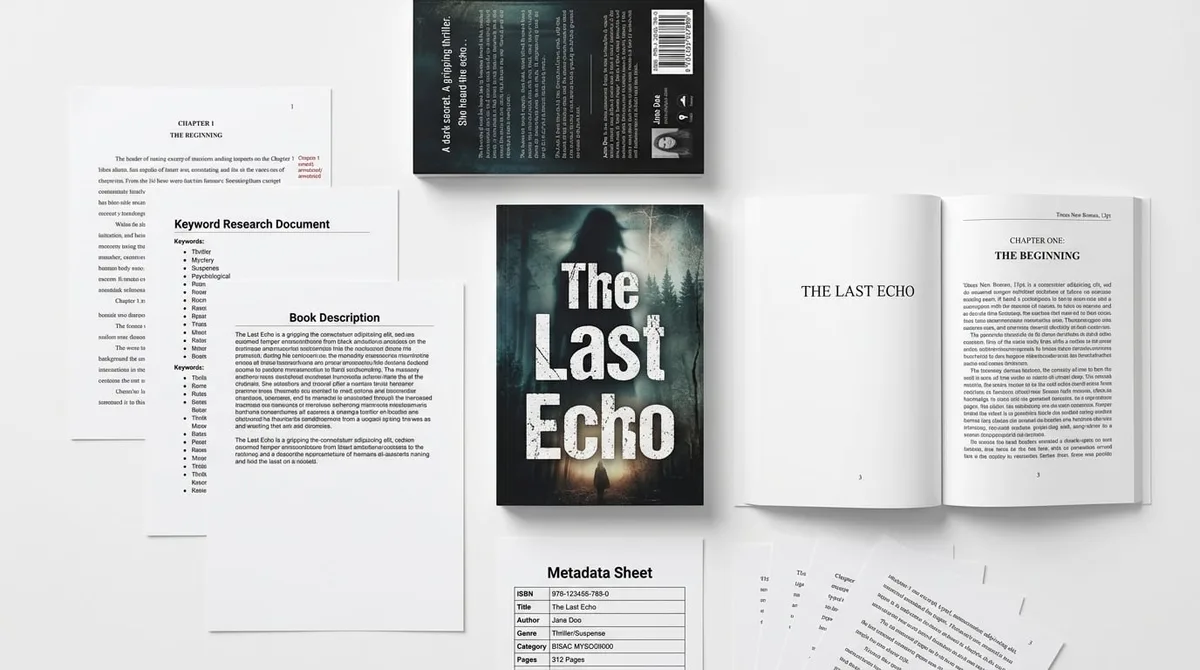
The metadata step produces a filled-in KDP listing: title, subtitle, HTML-formatted description, all 7 backend keyword slots, and category recommendations — not just a blob of text. See a finished metadata sheet.
KDP keywords are relevance signals, not magic ranking buttons
Think of backend keywords as signals that help Amazon classify your book more accurately. They tell the system, “This book is also relevant for these search phrases,” but only when those phrases truthfully reflect the content. That means the best strategy is not volume hunting; it is fit.
For example, a beginner meal planning cookbook may benefit from keywords like “easy meal prep for beginners” or “simple weekly meal planner cookbook,” but not from broad, vague, or unrelated terms. The stronger the match between the phrase and the book, the cleaner the relevance signal.
The goal is discoverability plus conversion
Discoverability gets the book seen. Conversion gets the book chosen. If a keyword drives the wrong reader, it can create clicks without sales, which is not progress. The better path is to choose phrases that match the reader, the promise, and the format so the listing feels consistent from search result to product page.
Practical test: if a customer clicked your listing because of one keyword phrase, would the cover, title, subtitle, and interior immediately confirm that they found the right book? If not, the keyword is probably too loose.
What the KDP 7 Keyword Slots Are For
Amazon KDP provides seven backend keyword boxes during setup, and each field allows up to 50 characters. KDP guidance recommends using keywords or short phrases that accurately describe the book, while avoiding repetition, quotation marks, and unnecessary punctuation. These boxes are not seven places to repeat the same root term; they are seven opportunities to cover distinct buyer angles.
Each slot should hold a short phrase or phrase cluster with one intent. The best approach is to map each slot to a different way a real buyer might search for the book. That is how the metadata starts to look designed rather than generated.
Visible metadata vs. backend keywords
Visible metadata includes the title, subtitle, cover copy, and category presentation the shopper sees immediately. Backend keywords are hidden fields that help Amazon understand additional relevance. The title should carry the main promise. The subtitle should clarify the format, audience, or benefit. The backend slots should extend that positioning with accurate long-tail phrases.
This distinction matters because backend keywords should not do the title’s job. If the title is vague and the keywords are overworked, the listing looks improvised. A professional listing has clear visible branding first, then supporting metadata behind it. If you are still clarifying the book’s positioning, the Book Title Generator can help you test cleaner title and subtitle options before you allocate keyword space.
Why one intent per slot works better than stuffing
Stuffing seven boxes with near-duplicates wastes available space. If one slot says “large print word search seniors” and another says “word search books for seniors” and another says “seniors word search large print,” Amazon is not getting seven ideas; it is getting one repeated idea. A better system is to assign a different intent to each field.
That also makes review and revision easier. When you can explain why each slot exists, you can refine the listing with less guesswork.
| Decision check | Use it? | Why |
|---|---|---|
| Truthfully describes the book | Yes | KDP metadata should match the actual content |
| Matches buyer intent | Yes | Searchers use phrase patterns tied to what they want to buy |
| Repeats the title word-for-word in multiple slots | No | It wastes keyword space |
| Targets publisher/tool searches | No | Backend keywords should describe customers, not creators |
| Uses a close alternate phrasing | Yes | Helps capture a second, valid way a buyer might search |
The Pro Framework for Filling All 7 Slots
Do not open the KDP dashboard and improvise seven phrases under pressure. Build a keyword map first, then paste only the phrases that survive the fit test. The most reliable framework is to map the buyer, the format, the outcome, the audience, the occasion, the niche modifier, and one alternate phrasing.
- Write the book’s core promise in one line. Example: “A large print word search book for seniors who want relaxing, easy-to-read puzzles.”
- List 10 to 20 reader phrases. Include the way a shopper would describe the book, not the way a publisher would describe a tool.
- Group those phrases by intent. Separate format, audience, benefit, occasion, niche theme, and alternate wording.
- Remove duplicates and weak overlaps. Each slot should add new relevance, not repeat the same idea.
- Match the final seven to your title, subtitle, cover, and interior. If a phrase feels out of place on the product page, it probably does not belong in the keywords either.
Slot 1: primary buyer intent
This is the most important search phrase, the one closest to the main reason someone would buy the book. For a gratitude journal, that might be “gratitude journal for women” or “daily gratitude journal.” For a puzzle book, it might be “large print word search for seniors.”
Rule: one clear reader intent per slot. Do not cram in extra descriptors that dilute the phrase.
Slot 2: book type or format
This slot captures format language such as guided journal, workbook, devotional, cookbook, activity book, or puzzle book. The point is to help Amazon recognize what kind of product the shopper expects to receive.
Example: a meal planning title could use a format phrase like “meal prep cookbook,” while a self-help book might use “guided workbook for habit building.”
Slot 3: reader outcome
Many shoppers search by result, not by format. They want to relax, organize meals, reduce stress, improve focus, or build a routine. Slot 3 is where you can encode that outcome truthfully.
Example: “stress relief puzzles,” “weekly meal planning,” or “mindfulness prompts” are outcome-led phrases that can match the book’s purpose if the content actually delivers that result.
Slot 4: audience
This slot covers the intended reader group, but only if it is accurate. Useful audience terms include beginners, teens, seniors, teachers, moms, entrepreneurs, or students. Do not use an audience just because it seems broad or popular.
For example, a workbook for first-time planners can use “for beginners,” while a book designed for older adults can use “for seniors” or “large print for seniors.”
Slot 5: occasion or use case
Use this slot to capture when or how the book will be used. Strong examples include gift, classroom, travel, meal planning, habit tracking, holiday, or quiet time. Occasion phrases are useful because many purchases are practical rather than purely topic-driven.
A recipe journal for family cooks might fit “meal planning gift” or “kitchen organization.” A puzzle book might fit “travel activity book” if the trim size, page design, and content truly support that use.
Slot 6: niche modifier
This slot narrows the audience or theme. Examples include cozy mystery cats, diabetic meal prep, mindfulness prompts, or large print word search. The modifier should add specificity, not just fluff.
This is often where Amazon book keywords in 2026 become more competitive: not because the market is new, but because buyers increasingly search in narrower, more specific phrases that match a precise need.
Slot 7: alternate phrasing
Use the final slot for a synonym, long-tail variation, or second way a buyer might describe the same book. If one shopper searches “guided journal,” another may search “prompt journal.” If one searches “meal prep book,” another may search “weekly meal planner.”
The point is coverage, not repetition. Slot 7 should give you a second doorway into the same product, not a duplicate of Slot 1.
How the seven slots should work together
Example structure:
- Slot 1: core buyer intent
- Slot 2: format
- Slot 3: outcome
- Slot 4: audience
- Slot 5: occasion or use case
- Slot 6: niche modifier
- Slot 7: alternate phrasing
This gives you seven distinct search angles without stuffing the same root keyword everywhere.
Use KDP Tools to Find Amazon Book Keywords in 2026
Good kdp tools should help you collect, sort, and judge phrase ideas faster, but they should never replace editorial judgment. The workflow is simple: start with seed phrases, expand through Amazon autocomplete, group results by intent, remove phrases that attract the wrong audience, and shortlist the best seven.
If you want a structured starting point, use the KDP Keyword Research Tool as the first pass for collecting and organizing ideas. Use it to build the rough list; then apply the editorial filter below before anything goes into your KDP dashboard.
Start with seed phrases
Begin with 5 to 10 seed phrases that describe the book honestly. Use the title concept, format, audience, and use case. For a large print puzzle book, seed phrases might include “large print word search,” “easy puzzles for seniors,” and “relaxing puzzle book.”
Seed phrases should come from the book itself, not from random market buzzwords. That keeps your keyword set aligned with the actual product.
Expand with Amazon autocomplete
Type your seed phrases into Amazon and note the suggestions that appear in autocomplete. These suggestions show how shoppers are already phrasing their searches. Use them to expand your list, then compare each phrase against your book’s content and packaging.
Important: autocomplete gives you language ideas, not permission to use every suggestion. If a phrase does not fit the book, leave it out.
Group keywords by buyer intent
When you sort phrases by intent, the best seven become obvious. Put format phrases together, audience phrases together, outcome phrases together, and use-case phrases together. Then select one strong phrase from each group.
This step prevents keyword overlap. It also helps you see whether your book is overfocused on one angle and missing another important buyer perspective.
Remove keywords that attract the wrong audience
Some phrases may look promising but actually draw publisher searches, not reader searches. For example, “free puzzle generator for kdp” is a search by creators and tool shoppers, not by puzzle book customers. It may be useful for product development research, but it is not a good backend keyword for a customer-facing puzzle book.
Use the same logic for any creator-intent phrase. If the shopper wants to make books rather than buy them, the phrase does not belong in your backend metadata.
The finished workflow is designed to produce more than keyword ideas: it helps you move toward a complete KDP listing with title, subtitle, HTML description, seven keyword slots, and category recommendations. See a finished metadata sheet.
Insider pro-tip: Before locking your seven slots, read each phrase as if it were a promise on the product page. If it sounds better for a publisher than for a buyer, remove it. The right keyword should feel natural to a customer, not clever to an author.
What Not to Put in Your KDP Keyword Slots
KDP metadata rules prohibit misleading or irrelevant keywords, including terms that reference other authors, competing book titles, sales rank, promotional claims, availability, or information that does not accurately describe the book. Amazon’s guidance is simple: use accurate keywords or short phrases, avoid repetition, and skip quotation marks and unnecessary punctuation.
That means the safest keyword strategy is also the most professional one. The phrase must truthfully describe the book a customer will receive.
Avoid prohibited and misleading metadata
- Do not use competitor author names.
- Do not use trademarks or brand names you do not own or have permission to use.
- Do not use famous book titles to borrow relevance.
- Do not use sales rank claims such as “bestseller.”
- Do not use promotional claims like “free,” “discounted,” or “new release” unless the context is explicitly appropriate and allowed.
- Do not use terms that are unrelated to the actual book content.
These mistakes do not improve discoverability; they create metadata risk. If the keyword cannot be defended as an honest description of the book, it should not be used.
Separate publisher searches from reader searches
One of the easiest ways to make a keyword list look amateurish is to mix creator-intent phrases with buyer-intent phrases. “KDP puzzle generator,” “free puzzle generator for KDP,” and similar searches may help a publisher find tools, but they do not describe what a customer wants to buy.
For a puzzle book, the shopper is searching for the puzzle experience: large print, easy level, themed puzzles, travel size, or senior-friendly layouts. That is the language that belongs in backend keywords.
Do not chase volume at the expense of fit
The best keyword is not the highest-volume phrase; it is the phrase most likely to match a real buyer for this specific book. A broad term may attract more impressions, but if it does not match the book’s promise, it can reduce conversion.
Fit beats vanity every time. This is especially true when the rest of the listing is built well and the book itself is designed to satisfy the searcher’s intent.
How Keywords Work With Your Title, Subtitle, and Cover
Backend keywords should extend the title and subtitle rather than duplicate them. If your visible metadata already says “Large Print Word Search for Seniors,” you do not need to spend multiple backend slots repeating the same exact phrase. Instead, use the backend fields to capture secondary audiences, use cases, and closely related long-tail searches.
If you are still refining the title, use the Book Title Generator to test clearer title and subtitle options before finalizing keyword slots. A clearer title often makes the keyword strategy easier because it removes the need for backend fields to carry too much of the message.
Do not make backend keywords do the title’s job
The title should carry the primary promise. The subtitle should clarify what the book is, who it is for, or what outcome it supports. Backend keywords should not compensate for unclear visible metadata.
For example, a guided journal should not hide its identity behind clever keywords. The cover, title, and subtitle should already tell the shopper what kind of book it is.
Use keywords to support the promise on the cover
The strongest listings feel consistent from top to bottom. The cover sets the expectation, the title names the promise, the subtitle adds context, and the keywords expand reach without changing the product story. That consistency is what makes a book look intentionally designed.
Publishing mindset: stop publishing books that look generated. Build books where the idea, title, cover, interior, and metadata all point to the same reader.
Example: Turning a Messy Keyword List Into 7 Clean Slots
Here is a simple before-and-after example using a large print word search book for seniors. The first list shows a messy approach. The second list shows a clean slot-by-slot framework.
Before: repeated and unfocused keywords
Messy list: large print word search, senior word search, word search for seniors, easy puzzles, puzzle book, large print puzzles, KDP puzzle generator, free puzzle generator for KDP, senior activity book, word search for adults, word search book, word search large print.
What is wrong here?
- Several phrases repeat the same root idea.
- Some phrases are too vague to describe the exact book.
- “KDP puzzle generator” and “free puzzle generator for KDP” are creator-intent searches, not customer intent.
- The list does not clearly separate audience, format, benefit, or use case.
After: seven slots with distinct intent
| Slot | Clean phrase | Why it earns the slot |
|---|---|---|
| 1 | large print word search for seniors | Primary buyer intent and exact audience match |
| 2 | easy word search puzzle book | Format plus accessibility level |
| 3 | relaxing brain games | Reader outcome without exaggeration |
| 4 | activity book for older adults | Audience variation in different wording |
| 5 | travel puzzle book gift | Use case and purchase context |
| 6 | large print puzzles for seniors | Niche modifier that reinforces the format |
| 7 | easy puzzles for adults | Alternate phrasing that captures a nearby search |
This version is cleaner because each slot covers a different buyer angle. It does not repeat the same exact idea, and it avoids phrases that belong to publishers rather than readers. The result is a metadata set that feels purposeful.
Next Step: Optimize the Rest of Your KDP Metadata
Seven clean keyword slots are a strong start, but they are not the whole listing. Before you publish, check that your category choices, description, cover promise, and sample pages all point to the same reader. If one part of the listing promises “beginner-friendly” and another signals “advanced,” the keyword work loses power.
For the full workflow, read KDP Metadata Optimization: Titles, Keywords & Categories. That guide shows how title, keywords, categories, and packaging reinforce one buyer promise instead of competing with each other.
If you only need the keyword pass today, start with the KDP Keyword Research Tool and sort your phrases into the seven-slot framework above. If you want to see how KDPBuilder turns metadata into a complete publishing workflow, try free and build from the listing outward.
Professional publishing is an integrated system, not a stack of disconnected generators. When the book idea, title, cover, interior, categories, and keywords all point to the same reader, the listing feels intentional before the shopper ever reads the first page.
FAQ
How do I fill the kdp 7 keyword slots?
Start by writing the book’s core promise in one sentence, then split your keyword ideas into seven different buyer intents: primary intent, format, outcome, audience, occasion, niche modifier, and alternate phrasing. Each slot should hold one short phrase or phrase cluster that truthfully describes the book. Do not repeat the same root term in every field.
How many characters can I use in each KDP keyword box?
KDP provides seven backend keyword boxes, and each field allows up to 50 characters. Keep phrases short enough to stay readable and specific enough to describe a real buyer search. A compact, accurate phrase usually works better than a long, crowded one.
Should I repeat keywords that are already in my book title or subtitle?
Usually no. If the title and subtitle already cover the main promise, use backend keywords for secondary audiences, use cases, and alternate search phrasing. Repeating the same phrase across multiple places wastes valuable metadata space.
What are the best kdp tools for keyword research?
The best kdp tools are the ones that help you generate and organize reader phrases without making final decisions for you. A good workflow starts with seed ideas, expands through Amazon autocomplete, and then sorts phrases by intent. The KDP Keyword Research Tool is useful because it supports that process instead of replacing judgment.
Are amazon book keywords 2026 different from older KDP keyword strategies?
The core rules are the same, but the market is more competitive and more specific. That means broad, sloppy keyword lists are less useful than well-matched phrases tied to a clear reader, promise, and format. In 2026, the strongest strategy is still accuracy plus clean positioning.
Should I use phrases like “free puzzle generator for kdp” as keywords for a puzzle book?
No. That is a creator-intent phrase, which means it is useful to publishers looking for tools, not to customers looking to buy a puzzle book. Backend keywords should describe the reader’s search, not the publisher’s workflow. Use customer language like large print, easy puzzles, seniors, travel, or gift instead.
Turn this idea into a book — free sample
Type a book idea and we'll generate a real cover preview in about a minute. No signup, no card.