KDP Metadata Optimization: Titles, Keywords & Categories

Skip the theory? Generate a free book preview in about a minute — no signup, no card.
Try it freeMost weak KDP listings do not fail because the author forgot a magic keyword. They fail because the product page sends mixed signals: a vague title, a subtitle trying to do three jobs, backend keywords that repeat the obvious, categories chosen for loopholes instead of reader fit, and a description that reads like a chapter summary. KDP metadata optimization is the disciplined work of making every listing field point to the same reader, promise, and shelf.
Done well, metadata helps Amazon understand the book and helps shoppers trust it faster. It should make a professionally built book feel easy to place: who it is for, what it delivers, why it belongs in that category, and what the reader can expect after opening it. This guide shows how to optimize titles, subtitles, backend keywords, categories, and descriptions without stuffing terms or making the book look generated.
What KDP Metadata Optimization Actually Means
KDP metadata is every book-detail field Amazon and shoppers use to understand what your book is, who it is for, and why it deserves attention. That includes the title, subtitle, series name, author name, contributors, description, backend keywords, categories, age range, and format details. In a practical Amazon book metadata workflow, this is the stage where a manuscript becomes a clear product page.
Metadata has two jobs. First, it helps Amazon index your book for relevant search queries and browse paths. Second, it helps human readers decide whether the book matches what they want. If the metadata is vague, crowded with repeated phrases, or inconsistent with the cover and interior, both jobs suffer.
Think of metadata as packaging, not decoration. The book, cover, interior, and listing should all say the same thing in different ways. If the cover promises a beginner-friendly workbook, the title, subtitle, description, and categories should support that promise. If the book is advanced, practical, or niche-specific, the metadata should make that clear before the reader has to guess.
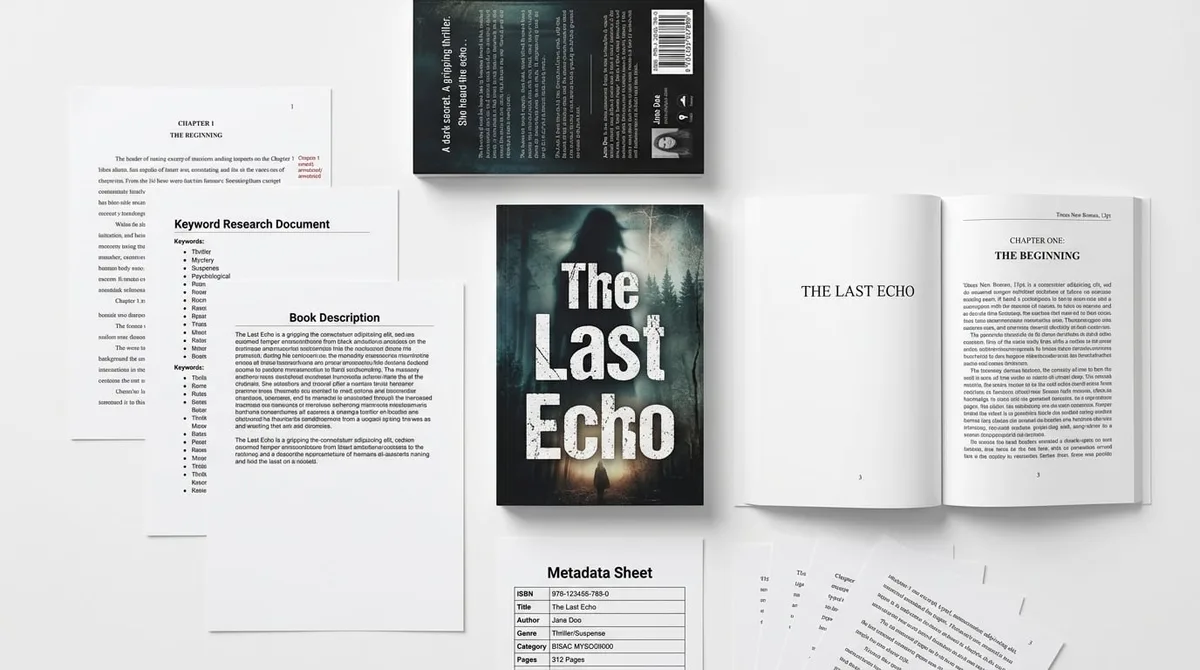
Product fact: KDPBuilder’s metadata step produces a filled-in KDP listing, including the title, subtitle, HTML-formatted description, all 7 backend keyword slots, and category recommendations — not just a loose list of phrases. See a Complete Sample Package
Discovery metadata vs. conversion metadata
Discovery metadata helps readers find the book. That includes backend keywords, categories, and the parts of the title and subtitle that match natural search language. Conversion metadata helps readers choose the book after they land on the page. That includes the title’s clarity, the subtitle’s context, the description’s structure, and the trust created by consistency.
A practical way to separate the two is this: discovery answers, “Can the right reader find this?” Conversion answers, “Will the right reader click this specific book instead of the next one?” A strong listing needs both. If you want to pressure-test wording before publishing, start with the Book Title Generator for clarity-first options and pair that with the Book Description Generator to see how the promise reads on the page.
Why metadata cannot save a weak book concept
Metadata can sharpen positioning, but it cannot rescue a book that is poorly planned, thin on value, or mismatched to the market. If the concept is too broad, the title and keywords will feel forced. If the interior does not deliver on the promise, the description may attract clicks but not trust.
The best metadata works when the manuscript, cover, and positioning are already solid. That is why this guide is not just a list of fields. It is a publishing workflow for making the product page match the book you actually built.
Start With Positioning Before You Touch Keywords
Before you write a title or choose backend phrases, define the reader, the problem, the outcome, and the shelf you want to stand on. Metadata should begin with positioning. If you know who the book is for and what change it promises, the right title language and category choices become easier.
This is where many authors go wrong: they start with keywords, then force the book to fit the search term. That creates titles that sound assembled instead of authored. It also leads to mismatched expectations, where the listing promises one thing and the content delivers another.
Market research should inform the book, not replace book quality. A niche can point you toward demand, but the manuscript still needs a clear angle, a useful promise, and a readable product page. If you need a structured way to find reader language before you lock the metadata, use the KDP Keyword Research Tool to turn rough ideas into search phrases that fit the actual book.
Reader promise
The reader promise is the specific change the buyer expects. For nonfiction, it may be learning a skill, solving a problem, saving time, or building a repeatable habit. For fiction, it may be emotional satisfaction, a genre experience, a certain pace, or a particular tone. Write that promise in one sentence before you draft metadata.
Shelf promise
The shelf promise is where the book belongs relative to competing titles. Ask which books a shopper would compare it with and what language those books use. That is how you decide whether the book belongs in a beginner how-to lane, a specialized niche lane, a workbook lane, or a broader mainstream lane.
Outcome promise
The outcome promise is the result the reader wants after finishing the book. A workbook may promise a completed plan. A guide may promise a repeatable process. A cookbook may promise faster weeknight decisions. A novel may promise a satisfying arc and genre payoff. Your title and subtitle should support that outcome without exaggeration.
A quick positioning worksheet
| Question | Weak answer | Stronger answer |
|---|---|---|
| Who is the book for? | Everyone who wants to save money | First-time budgeters who need a simple weekly reset |
| What does the reader want? | Better finances | A repeatable way to plan bills, spending, and savings each week |
| Where does it belong? | Business or self-help | Personal finance budgeting, beginner money management, workbook-style planning |
| What should the listing promise? | Change your life with money | Build a 30-day budget reset using short weekly planning exercises |
How to Write a KDP Title That Sells Without Looking Generated
A good title is clear, specific, and memorable before it is keyword-rich. If readers cannot understand what the book is in a few words, no amount of backend optimization will fix it. The strongest titles usually combine topic clarity with a natural tone that feels written for people, not search bots.
Use the main search phrase only when it fits the real book and reads naturally. A title should not look like a stitched-together string of terms. It should feel like a real publishing decision. That is especially important because KDP metadata must accurately represent the book; titles, subtitles, contributors, and descriptive claims should not be misleading, keyword-stuffed, or inconsistent with the book file and cover.
Weak AI-looking examples include: “The Weight Loss Motivation Success Guide for Women and Men” or “Budget Planner for Finance Money Savings Tracking.” Better-positioned alternatives sound more intentional, such as “The 30-Day Budget Reset” or “The Weekly Meal Plan Method.” The stronger versions give readers a cleaner promise and a more believable shelf identity.
Title vs. subtitle: what each should do
The title carries the main identity of the book. The subtitle adds context, audience, format, or outcome. If the title is already specific, the subtitle can explain the reader level or use case. If the title is more branded, the subtitle should make the practical promise unmistakable.
A practical rule is to let the title do one job and the subtitle do another. Do not cram every possible keyword into both. That makes the listing look assembled and reduces trust.
When to use a keyword in the title
Use a keyword in the title only if it is central to the actual book and sounds natural to a human reader. If your topic is a known term buyers search for, including it can help clarity. If the phrase feels forced, leave it for the subtitle, description, or backend keywords instead.
For example, “watercolor for beginners” may fit naturally in a subtitle if the book truly teaches that subject. But forcing “best watercolor techniques for beginners 2026” into a title would look manufactured and may confuse readers.
Title mistakes that make books look generated
Common mistakes include repeating the same noun twice, adding trendy words that do not match the content, stuffing every audience segment into one title, and using generic phrases that could apply to any book in the category. Another mistake is borrowing a competitor’s wording too closely. That can make the book feel derivative and may blur its identity.
Insider pro-tip: Draft three title directions before picking one: one clarity-first, one audience-first, and one outcome-first. Then choose the one that sounds most like a real published book when spoken out loud.
Bad vs. better metadata examples
| Book type | Weak title/subtitle | Better direction | Why it works |
|---|---|---|---|
| Budget workbook | Money Savings Budget Planner Finance Tracker | The 30-Day Budget Reset Simple Weekly Pages for Bills, Spending, and Savings | The promise is specific, the format is clear, and the language sounds like a real book. |
| Beginner art guide | Watercolor Painting Techniques for Beginners Easy Lessons | First Watercolors A Step-by-Step Beginner Guide to Simple Painting Practice | The title has identity; the subtitle carries the searchable context. |
| Cozy mystery | Small Town Cozy Mystery Murder Book | Death at the Bookshop Door A Small-Town Cozy Mystery | The genre is obvious without turning the title into a keyword list. |
How to Use KDP Backend Keywords Correctly
KDP backend keywords are the hidden search terms entered inside the KDP book setup dashboard. Amazon provides seven backend keyword fields during book setup, and each field should be used for relevant search phrases rather than repeated words, competitor names, or unrelated terms. These fields are for coverage, not decoration.
The best backend keywords add search visibility that is not already obvious from the title, subtitle, author name, or description. Use phrases readers actually search: synonyms, use cases, audience terms, and problem-based language. If the title already says “beginner watercolor guide,” do not waste a keyword box repeating “beginner watercolor.” Use that space for a related phrase a reader might type, such as “easy painting lessons” or “step by step art practice,” if those phrases truly fit the book.
What to put in the seven keyword boxes
Think in groups. Each box should represent a distinct search idea or reader intent. A useful method is to map the seven fields like this:
- One box for the main use case.
- One box for a synonym or alternate phrasing.
- One box for audience language.
- One box for a problem or pain point.
- One box for a format term, if relevant.
- One box for a subtopic or related concept.
- One box for a narrow, high-fit long-tail phrase.
For example, a cookbook might use one field for “meal prep,” another for “quick dinners,” another for “family-friendly recipes,” and another for “healthy lunch ideas,” provided those phrases match the content. The goal is breadth with relevance. If you are comparing phrase ideas before filling the boxes, a KDP keyword research workflow can help you separate useful search language from terms that only look busy on paper.
What not to put in backend keywords
Do not repeat the same phrase across every field. Do not add competitor authors, trademarked brand names, or unrelated trends. Do not stuff in categories, claims, or vague popular terms that do not match the manuscript. That kind of misuse wastes your search coverage and can create policy risk.
Also avoid writing keywords as a list of disconnected single words when a real search phrase would be more useful. Amazon indexing works best when the terms reflect how readers actually search, not how a spreadsheet looks.
Keyword relevance beats keyword volume
More keywords is not better if they are vague or irrelevant. One precise search phrase that matches the book’s real value is stronger than five crowded phrases that do not. The job of backend keywords is to connect the listing to a reader’s intent, not to maximize raw term count.
If you want help finding those phrases before filling the boxes, use a keyword research workflow that starts with reader language and competitor patterns. The point is to choose terms, not to imitate what other books are doing blindly.
Choosing Amazon KDP Categories Without Gaming the System
Categories define where the book is shelved and what competing books it will be judged against. That means category choice is not just a visibility decision; it is a positioning decision. The wrong category can make a good book look misplaced. The right category can make the listing feel immediately understandable.
Choose categories based on reader expectation, format, content depth, and comparable books. If the book is a slim beginner guide, do not place it beside dense reference manuals unless it truly belongs there. If it is a practical workbook, pick a category that reflects that format and reader intent.
Chasing low-competition categories can backfire when readers feel the book is not where it belongs. Relevance matters more than trying to trick the shelf. In the long run, misplaced positioning can reduce trust more than it helps discoverability.
Relevance first, competition second
The best order is simple: first choose a category that genuinely fits, then compare how competitive it is. A relevant category with moderate competition is often better than an artificially narrow category that attracts the wrong audience. Reader fit should lead the decision.
How to compare category fit
Look at three things: what other books in the category promise, how detailed those books are, and what kind of reader they target. If your book is a beginner guide but the category is dominated by advanced technical titles, the mismatch will be obvious. Compare format, tone, depth, and promise.
Why category manipulation hurts trust
Category manipulation is a short-term tactic with long-term downsides. If the category implies one kind of book and the content delivers another, readers notice. That hurts review quality, click satisfaction, and brand trust. A category should help the right reader find the right book, not act as a disguise.
For July 2026, confirm current category options inside the KDP dashboard before publishing because Amazon category paths and availability can change. Always check the live setup screen rather than relying on an old category list.
Product fact: Category recommendations are part of KDPBuilder’s metadata step, so the output is a complete KDP listing package rather than just keyword suggestions. See a Complete Sample Package
Mistakes to avoid when choosing categories
| Mistake | Why it hurts | Better approach |
|---|---|---|
| Picking a category just because it is less crowded | The book may appear out of place to shoppers | Start with relevance, then assess competition |
| Using advanced categories for a beginner book | Readers expect a different depth and tone | Match the category to the actual content level |
| Trying to force a book into a trendy shelf | Positioning becomes unclear and less believable | Choose the shelf that fits the reader promise |
| Ignoring how comparable books are framed | The listing may feel disconnected from shopper expectations | Compare promise, format, and audience language |
Writing a KDP Book Description That Converts
The book description is a sales page, not a summary of every chapter. Its job is to help the right reader understand the promise quickly and feel confident that the book matches what they want. A strong description reinforces the title and cover; it does not introduce a new angle that competes with them.
Amazon KDP book descriptions can be up to 4,000 characters and may use limited supported HTML formatting, so descriptions should be structured for scanning. That means short paragraphs, clear breaks, and purposeful formatting. Readers should be able to grasp the offer in seconds, especially on mobile.
Use this structure: hook, reader problem or desire, book promise, bullets for benefits or contents, credibility signal, and call to action. That gives the page a logical flow without overexplaining. If you want a fast draft that follows that structure, the Book Description Generator can help turn a plain summary into product-page copy you can refine.
Nonfiction description formula
For nonfiction, start with the problem or goal, then explain what the reader will gain. Follow with 3 to 5 benefit bullets that are concrete and specific. End with a confidence-building line that tells the reader what kind of result the book is designed to support.
Example structure:
- One sentence that names the challenge.
- One sentence that states the book’s method or promise.
- Three bullets that show practical outcomes.
- One line that makes the reader feel the book is relevant now.
Fiction description formula
For fiction, focus on tension, stakes, character desire, and genre promise. Introduce the central conflict, the emotional question, and the tone readers can expect. Avoid summarizing every plot point. Instead, create momentum and clarity about what kind of story this is.
A fiction description should make the genre obvious and reinforce the emotional experience promised by the cover and title. If the book is a thriller, the copy should feel tense. If it is a cozy mystery, it should feel inviting and puzzle-focused.
Description formatting that improves scanning
Use short paragraphs, selective bolding if available, and line breaks between key ideas. Do not bury the hook in a block of text. The most important sentence should be easy to spot on mobile. Keep the opening tight, because the first visible lines do the most work.
If you are drafting the first version, start from a structure rather than staring at a blank page. A good template keeps the listing aligned with the book instead of drifting into generic promotional language.
Before-and-after description hook
| Weak hook | Better hook |
|---|---|
| This book is about budgeting and will teach you many useful things about money. | If your budget only works for the first week of the month, this 30-day reset gives you a simpler way to plan bills, spending, and savings without tracking every penny. |
| This cozy mystery follows a woman who solves a crime in a small town. | When a rare-book dealer is found dead outside the village bookshop, one retired librarian has three days to solve the case before the wrong neighbor takes the blame. |
Metadata for AI-Assisted KDP Books in 2026
AI involvement is not a marketing keyword to force into titles or descriptions unless it is genuinely part of the reader value proposition. If the book is about using AI tools, learning AI workflows, or comparing AI methods, then the term may belong in the metadata. If not, it should stay out of the title and subtitle.
Authors often confuse AI disclosure with sales copy. The key point is simple: disclosure is handled in KDP’s publishing workflow when required, not by hiding or overexplaining it in product-page metadata. Metadata should stay focused on the reader-facing promise of the book.
The right standard is consistency. If a book is AI-assisted, its metadata should still be truthful, reader-centered, and aligned with Amazon’s current content and metadata rules. Do not use metadata to disguise the production process or to make the book look hand-crafted if that would misrepresent the work. KDPBuilder’s position is straightforward: stop publishing books that look generated; start building books that look designed.
AI disclosure is not the same as sales metadata
Disclosure rules, when applicable, belong in the publishing process. Sales metadata belongs on the product page. Mixing the two creates clutter and weakens the listing. Keep the description focused on the reader benefit, not the production method, unless that method is directly relevant to buyer expectations.
Do not use AI as a shortcut for reader trust
Readers trust books that feel deliberate. That means a coherent title, a relevant subtitle, a believable description, and content that matches the promise. AI can help draft or organize, but it cannot replace positioning, editorial judgment, or honest packaging.
A Studio-Grade KDP Metadata Workflow
A studio-grade workflow keeps metadata tied to the full book package. It is not just about filling fields; it is about making sure the title, keywords, categories, description, cover, and interior all point to the same reader and promise. Here is a practical seven-step process.
- Define the reader, promise, and shelf. Write one sentence for who the book is for, what it helps them do, and where it belongs.
- Research search language and competing listings. Collect real phrases readers use and note how similar books position themselves.
- Draft title and subtitle options. Create at least three options and keep the one that reads cleanly and matches the book.
- Build backend keyword groups by intent. Use the seven backend fields for distinct search ideas, not repeats.
- Select categories by relevance and competitive fit. Choose shelves that match the content and reader expectation.
- Write the book description to match the cover and interior. Make the sales copy reinforce the same promise the design suggests.
- Review all metadata for policy compliance, clarity, and conversion. Check for misleading terms, missing context, and anything that looks stuffed or generic.
Use this checklist before publishing:
- Does the title match the book content exactly?
- Does the subtitle add useful context without repeating the title?
- Do all seven keyword fields contain relevant search phrases?
- Are the chosen categories true to the reader expectation?
- Does the description scan well on mobile?
- Does the cover promise the same thing the metadata does?
- Would a real buyer feel clear, not confused, after reading the page?
If you want to see how the full package fits together, treat metadata as one piece of a larger publishing system. A professional manuscript, cover, interior, and listing should work together rather than compete for attention. See a Complete Sample Package if you want to compare a finished metadata sheet with the page-building workflow described here.
The metadata checklist before publishing
Before you hit publish, read the product page as if you were a shopper. Check for duplicate phrasing, overly broad claims, forced keywords, and any mismatch between the book’s actual value and the way it is described. One careful pass through the checklist can catch the small inconsistencies that make a listing feel amateur.
How KDPBuilder packages metadata with the full book
Studio-grade publishing treats metadata as one part of a complete package. That means the positioning choice informs the title, the title informs the cover, the cover informs the description, and all of it points back to the interior. When those parts align, the book feels intentional instead of assembled.
That alignment is what separates polished publishing from cheap-generator output. The goal is not to trick the algorithm. The goal is to present a book that a reader can understand, trust, and want to open.
Next best step: If your metadata is the only weak point, use the free tools below. If your title, cover, interior, and listing are all still being shaped, review the Complete Sample Package first so you can see how the pieces should line up.
FAQ
What is KDP metadata optimization?
KDP metadata optimization is the process of improving the title, subtitle, backend keywords, categories, and description so Amazon can index the book accurately and readers can understand its value quickly. It is both a discovery task and a conversion task. Done well, it makes the listing clearer, more relevant, and more trustworthy.
How many KDP backend keywords should I use?
KDP provides seven backend keyword fields during book setup, and each field should be used with a relevant search phrase. Do not repeat the same words across the fields or fill them with competitor names and unrelated terms. The best approach is to use each box for a different search intent.
Should I put my main keyword in my Amazon book title?
Only if it fits naturally and accurately describes the book. The title should be clear and memorable first, then keyword-relevant second. If the phrase feels forced, put it in the subtitle or backend keywords instead.
What is the difference between KDP backend keywords and categories?
Backend keywords are hidden search terms that help Amazon understand what the book is about. Categories are the shelves where the book is placed and the competitors it is compared against. Keywords help with search coverage; categories help with browse positioning.
Does Amazon’s AI-generated content disclosure affect my metadata?
The disclosure requirement is part of the publishing workflow, not something to hide or explain away in sales metadata. Your title, subtitle, keywords, categories, and description should still be truthful and reader-focused. If AI is relevant to the book’s value proposition, mention it honestly; if not, keep metadata centered on the reader benefit.
Can changing my KDP metadata improve book sales?
It can improve clarity, discoverability, and conversion if the changes make the listing more relevant and trustworthy. But metadata is not a guarantee of rankings or sales. It works best when the concept, cover, and interior are already strong and aligned.
Next step: Work through the listing fields in order. Start with the KDP free tools, then use the specific helper that matches your bottleneck: title, description, or keyword research. If you want to move faster from rough concept to a cleaner publishing package, try KDPBuilder free and build from there — no card required.
Turn this idea into a book — free sample
Type a book idea and we'll generate a real cover preview in about a minute. No signup, no card.