AI Book Publishing Quality: Why Most Fail

Skip the theory? Generate a free book preview in about a minute — no signup, no card.
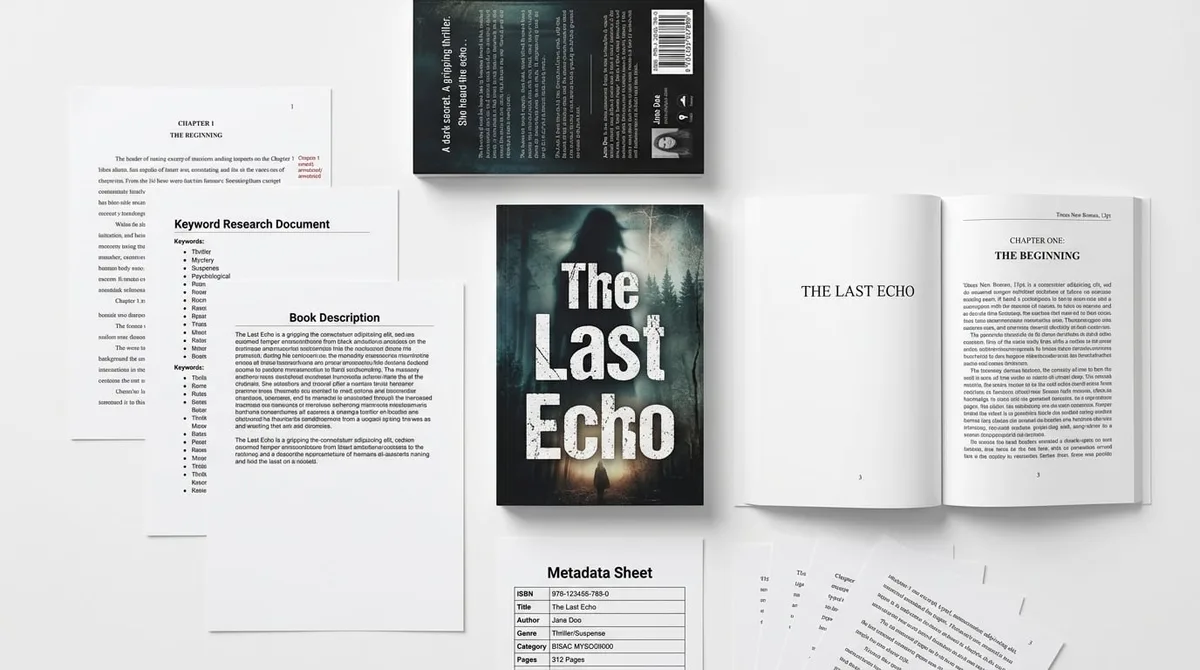
Try it freeThe fastest way to spot weak ai book publishing quality is not to read chapter five. It is to look at the whole package for thirty seconds: cover thumbnail, title promise, sample pages, formatting, metadata, and whether the book feels built for a real reader or assembled from raw output.
Most AI-assisted books do not fail because AI was involved. They fail because the author stops at generation. A draft is not a product. A prompt is not an editorial process. A technically valid PDF is not automatically a publishable book. The fix is a studio workflow: shape the idea, edit the manuscript, design the cover and interior, verify the files, and package the book so it can stand next to real competitors on Amazon KDP.
Product proof: KDPBuilder is built around one standard: stop publishing books that look generated; start building books that look designed. The workflow runs through Discovery, Writing, Editing, Design, Covers, and Publishing instead of a single generate-and-upload step. Judge a complete sample package before you publish your own.
Why AI book publishing quality fails
The core problem is simple: most weak AI books look generated, not designed. A buyer does not evaluate a manuscript in isolation. They evaluate a product package that has to signal trust, relevance, and usefulness before the first chapter is read.
Writing quality and publishing quality are related, but they are not the same thing. A readable draft can still feel amateur if the cover looks generic, the trim size is awkward, the margins are cramped, the metadata is vague, or the book description promises more than the content delivers. On Amazon KDP, presentation is part of the product.
Raw output is not a book product
Raw AI output usually lacks the layers that make a book feel intentional. It may contain information, but it often has no sharp reader promise, no editorial progression, no original examples, and no visual system. A real book needs a market position, a clear structure, a designed interior, and files prepared around KDP requirements.
That is why two books can cover the same subject and feel completely different. One reads like a polished resource made for a specific reader. The other reads like a generated document with a cover attached at the end. If you want to see the difference in practice, review real book examples and compare the structure, hierarchy, and finish.
Readers judge quality before the first page
Most readers form a quality opinion before they reach the manuscript. They scan the cover, title, subtitle, thumbnail readability, description, categories, and sample pages. If those elements feel vague, cheap, or mismatched, the book starts at a disadvantage even when the underlying information is useful.
This is where many AI-assisted books lose credibility. The problem is not only the prose. It is the total signal the book sends about care, expertise, and relevance. Strong ai book publishing quality means every visible element supports the same promise.
Editorial rule: if the book only looks acceptable when you explain the workflow behind it, it is not ready. The reader sees the product, not the prompt history.
The most common AI generated book problems
Most AI generated book problems fall into three buckets: manuscript problems, design and formatting problems, and trust and compliance problems. Fixing only one bucket is not enough. A strong manuscript can still look low-value if the cover and interior are weak, and a polished cover cannot rescue thin content.
Manuscript problems
The most common manuscript issue is a thin promise. The book claims to help a broad audience but does not solve one specific problem for one specific reader. That creates vague chapters, repeated advice, weak examples, and conclusions that sound like summaries instead of outcomes.
Repetition is another major issue. AI often restates the same idea in different language across multiple chapters. That makes the book longer without making it more useful. A clean manuscript should move forward: each chapter should add a new step, decision, framework, example, or warning.
Generic voice is just as damaging. If the text sounds like a digest of common internet advice, it will not feel authored. Readers want judgment. They want examples, trade-offs, decision rules, and a point of view that helps them act.
Factual drift is the highest-risk problem. AI can invent details, steps, citations, statistics, legal statements, health recommendations, financial advice, or technical instructions. Any book in a sensitive category needs human fact-checking and careful claim control. Accuracy is not decoration; it is part of the product.
Design and formatting problems
Formatting issues can make a decent manuscript look amateur. Common failures include inconsistent heading styles, awkward page breaks, missing front matter, missing back matter, widows and orphans, low-resolution images, weak captions, and pages with too little or too much white space.
Cover design carries even more weight because it is the first quality signal. A commodity-looking cover tells the market the book was made quickly and cheaply. If the typography, color system, image treatment, and genre cues do not match the promise, the book loses trust before the reader opens the sample.
Interior design problems often begin with the wrong trim size or poor margin planning. If the layout is cramped, the reader feels fatigue. If the layout is too sparse, the book can look thin or padded. In both cases, the presentation weakens the perceived value.
Trust and compliance problems
Trust problems are not only visual. They include disclosure, accuracy, file readiness, and alignment between the promise and the content. Amazon KDP requires publishers to disclose AI-generated content during title setup. AI-assisted content does not need to be disclosed when a human substantially created or edited the final work. That distinction matters because transparency and editorial control both affect how the book should be prepared.
Compliance also includes file fundamentals. KDP print files must match trim size, bleed, and margin requirements. Paperback interiors generally need at least 24 pages. Bleed interiors require extra bleed area on the outside edges. If those basics are ignored, the upload can fail or the printed book can look unprofessional.
Studio proof: KDPBuilder runs projects through a six-phase studio pipeline: Discovery, Writing, Editing, Design, Covers, and Publishing. That is the practical difference between generating text and building a KDP-ready package. Walk through the pipeline free.
Do AI books sell?
Yes, AI-assisted books can sell on Amazon KDP. But buyers do not reward the tool used to create a book. They reward usefulness, specificity, presentation, reader fit, pricing, reviews, traffic, and perceived value. Low-effort AI-generated books are weak products in competitive KDP markets because they are easy to compare and easy to ignore.
Sales depend on demand, competition, quality, metadata, reviews, pricing, and traffic. That means even a strong manuscript can underperform if the cover misses the niche, the keywords are vague, or the product page fails to explain why the book matters. If you are deciding whether to keep refining the book or rebuild it with a cleaner workflow, compare publishing tools against the actual production steps you need.
AI-assisted is not the same as unedited AI-generated
AI-assisted publishing works when the human makes the important publishing decisions. That includes choosing the reader, sharpening the promise, removing filler, adding original examples, checking facts, and shaping the final package. The machine can accelerate production, but the publisher still has to make the book coherent and valuable.
Unedited AI-generated publishing is different. It usually produces something average, repetitive, and interchangeable. In a crowded marketplace, interchangeable books rarely survive comparison.
Quality determines whether the book survives comparison
Every book gets compared. Readers compare your title against the other books in search results, the category page, the product carousel, and the sample preview. If your book looks generic, another title can win the comparison before your content has a chance.
That is why quality is not a luxury layer added at the end. Quality is the factor that gives the reader enough confidence to keep looking.
| Decision point | What weak books do | What designed books do |
|---|---|---|
| Promise | Target everyone with a broad topic | Target one reader with one clear outcome |
| Cover | Use a generic template or stock image | Match the niche, hierarchy, and thumbnail test |
| Interior | Ignore trim, spacing, page flow, and readability | Format for reader comfort and KDP specs |
| Metadata | Use vague keywords and inflated claims | Align title, subtitle, categories, and search intent |
| Proof | Rely on generic advice | Add examples, checklists, frameworks, and verifiable steps |
The KDP quality checklist most AI publishers skip
Use this checklist before you upload anything. It covers the parts that usually break when authors treat AI like a generator instead of a publishing workflow.
- Manuscript: clear reader promise, original structure, human edit, fact check, consistent terminology, no filler, and no unsupported claims.
- Cover: readable thumbnail, genre match, visual hierarchy, compliant dimensions, and no cheap template look.
- Interior: correct trim, margins, bleed, page count, fonts, image resolution, and appropriate front/back matter.
- Metadata: title and subtitle alignment, keyword relevance, category fit, and a description that sells the outcome without exaggeration.
- Files: validated PDF or EPUB, print preview review, no placeholder text, no broken images, and no obvious AI artifacts.
KDP tools can make the production process more reliable when they are used as checks, not shortcuts. A kdp cover creator can help with sizing. A kdp template generator can speed repeatable layouts. A kdp book size calculator can reduce trim-size mistakes. A kdp margin calculator can prevent cramped pages. But tools only work when the underlying publishing decisions are strong.
Manuscript checklist
- Define the reader in one sentence.
- State the problem the book solves in one sentence.
- Outline chapters so each one adds a new step, decision, example, or framework.
- Remove repeated points, generic summaries, and unsupported claims.
- Add examples that could not be copied into any book in the category.
- Read for clarity, sequence, and usefulness, not only grammar.
Cover and interior checklist
- Test the cover at thumbnail size before judging it full-screen.
- Match the design to the category, price point, and reader promise.
- Check trim size before formatting the interior.
- Confirm margins, bleed, and page count against KDP specs.
- Review sample pages for spacing, heading hierarchy, image placement, and page flow.
- Export a final print PDF or EPUB only after the layout has been reviewed as a finished product.
Metadata and upload checklist
- Make the title and subtitle match the book’s actual outcome.
- Choose keywords that reflect reader intent, not tool names or hype terms.
- Pick categories that match the content and audience.
- Write a description that explains value, structure, and who the book is for.
- Confirm AI-generated content disclosure requirements during title setup.
- Run the final file through preview checks before publishing.
Why a kdp cover creator is not enough
A kdp cover creator is useful, but it is not a complete publishing strategy. It can help you build the correct dimensions, but it cannot create positioning, market fit, visual hierarchy, or buyer trust by itself.
The difference between a tool-driven cover and a studio-designed cover is easy to see. A studio-designed cover starts with the reader and the market. It uses typography, contrast, image choice, and genre cues to communicate exactly what kind of book this is. It also considers spine and back cover logic for print, plus consistency if the book belongs to a series.
Amazon KDP cover creator tools can handle utility tasks, but they do not decide whether your design looks premium, credible, or appropriate for the niche. That judgment still has to come from the publisher. If you want a practical benchmark, see a complete sample package and judge the cover, interior, and metadata as one unit.
A compliant cover can still look amateur
A cover can be the correct size and still fail the market test. Common mistakes include weak title contrast, crowded layouts, mismatched fonts, images that look stock-like, and subtitles too small to read in search results.
Compliance is the floor. Design is what lifts the book above the floor.
Design is not the same as dimensioning
Dimensioning answers the technical question: will the file fit? Design answers the commercial question: will the reader trust it? Both matter, but only one makes the book feel like a real publication.
Insider pro-tip: judge the cover at two sizes: full-screen and thumbnail. If the title, subtitle, and core image are not readable in thumbnail view, the design is not ready for KDP.
Why a kdp template generator cannot fix weak publishing strategy
A kdp template generator speeds layout, but it does not make the book better. Templates are useful for consistent interiors, activity books, journals, planners, low-content books, and illustrated formats where repeatable structure matters.
Templates fail when the concept is weak. If the trim choice is wrong, the reader flow is awkward, the content repeats, or the styling has been overused, the template only makes the problem faster to produce. Speed is not differentiation.
Templates speed production
Templates help when the content structure is already clear. A planner needs repeated weekly pages. A journal needs clean writing space. An activity book needs reliable grids or prompts. In those cases, a template reduces layout errors and saves time.
Templates are also helpful when you want consistent chapter opening pages, headings, callout boxes, or image placement across a series. Repetition can be a feature when it improves usability.
Templates do not create differentiation
A template cannot decide whether your book has a strong reason to exist. It cannot create a sharper promise, a smarter outline, or a more valuable example set. It also cannot rescue a concept that is too broad, too generic, or too close to dozens of existing books.
If you want a deeper view of the writing side, compare the AI-assisted writing process with the publishing workflow in the sibling guide on AI Assisted Book Writing Workflow for KDP.
The studio workflow that fixes AI book quality
KDPBuilder works best as a publishing studio, not a cheap generator. The process starts with the idea and ends with a complete KDP-ready package. The goal is not to create more content. The goal is to create a book that looks designed from start to finish.
The studio workflow is straightforward:
- Discovery: validate the idea, reader, market angle, and outcome.
- Writing: build a structured outline and draft with AI assistance where it helps.
- Editing: remove filler, strengthen examples, check facts, and improve flow.
- Design: choose trim, page hierarchy, typography, and interior structure.
- Covers: create a cover that works at full size and thumbnail size.
- Publishing: prepare metadata, export files, and run final checks before upload.
That process transforms a generated asset into a publish-ready book package. The difference shows up in the manuscript, the cover, the interior, the metadata, and the upload experience.
Idea to manuscript
Start by defining one reader, one outcome, and one reason the book exists. Then write an outline that progresses logically from problem to solution. AI can help draft sections, but the outline must be clear enough that each chapter earns its place.
A strong idea stage prevents the most common failure: a book that is technically long enough but strategically too vague.
Manuscript to designed book
After the draft, the human edit should do more than correct grammar. It should remove repetition, sharpen transitions, add examples, check facts, and make the voice consistent. Then the cover and interior should be designed together so the book feels like one product rather than disconnected parts.
This is also where trim size, margins, and image handling matter. A designed book respects the reading experience from the first page to the last.
Designed book to KDP-ready package
The final stage is packaging. That means metadata that matches the book, print files that match KDP requirements, and a preview review that catches problems before upload. It also means checking the title, subtitle, keywords, category, and description for alignment.
When the package is finished correctly, the book reads as intentional. That is what makes it look like a real publication instead of an output file.
For a side-by-side comparison of this approach, review AI Book Generator vs Publishing Studio: Before/After. If you want to inspect a finished workflow faster, open the complete sample package and evaluate the cover, interior, and metadata together.
How to audit your AI book before publishing
Before you upload, run a direct audit: would the book still feel valuable if the reader knew AI helped create it? If the answer is not clearly yes, the book needs more work.
Use six quality gates: originality, usefulness, cover trust, interior professionalism, KDP compliance, and metadata fit. Each one is a separate pass/fail check, not a vague feeling.
The five-minute thumbnail test
Shrink the cover to thumbnail size. Can you still read the title, identify the topic, and understand the genre? If not, adjust contrast, typography, or image hierarchy before publishing.
This test catches problems that look fine at full size but fail in real search results.
The sample-page test
Open three sample spreads: the opening pages, a middle chapter, and a page with the hardest layout element, such as an image, table, checklist, or callout box. Look for spacing, widow lines, page flow, and visual balance.
If one spread looks awkward, assume readers will notice it too.
The KDP preview test
Run the file through the KDP preview workflow and check for trim issues, bleed problems, missing text, and awkward page breaks. KDP print files must match trim size, bleed, and margin requirements, and paperback interiors generally need at least 24 pages. If your file does not meet those basics, fix the file before upload.
Also confirm the royalty setup before you publish. For paperbacks, KDP pays a 60% royalty rate on the list price minus printing costs for books sold through Amazon marketplaces; expanded distribution uses a lower royalty rate. That is not a quality shortcut, but it is part of understanding how the product is packaged and sold.
| Audit area | What to check | Common failure |
|---|---|---|
| Cover | Thumbnail readability, genre match, spine logic | Generic template look |
| Interior | Trim, margins, bleed, page flow | Crowded or broken pages |
| Manuscript | Original structure, examples, factual accuracy | Repetition and generic advice |
| Metadata | Title, subtitle, keywords, categories | Mismatch with reader intent |
| Files | PDF/EPUB validation and preview review | Hidden errors or placeholder text |
If you want to test your workflow before committing to a full upload, Try KDPBuilder Free and run a build pass first. KDPBuilder gives you 75 free credits so you can inspect the pipeline, check the output, and decide whether the process fits your project. No card is required for the free start.
FAQ
Do AI books sell on Amazon KDP? Yes, AI-assisted books can sell on Amazon KDP, but only when they are useful, specific, well designed, and properly packaged. The market does not reward raw AI output by itself. It responds to books that solve a problem, look professional, and match reader expectations.
What are the biggest ai generated book problems? The biggest problems are thin ideas, repetition, generic voice, factual drift, bad formatting, and commodity packaging. Many books also fail because the metadata does not match the actual audience. A good manuscript can still underperform if the cover and interior look rushed.
Can I use a kdp cover creator for an AI book? Yes, but treat it as a production utility, not a full strategy. It can help with dimensions and basic setup, but it will not create strong positioning, trust, or genre fit on its own. You still need a cover that reads well as a thumbnail and matches the book’s promise.
Do I need a kdp template generator to publish faster? Not always. Templates are useful for repetitive layouts like journals, planners, activity books, and some illustrated formats. They speed production, but they do not fix weak concepts, weak writing, or poor reader flow.
What kdp tools help improve book quality? The most useful kdp tools are the ones that support checks, not shortcuts. A kdp book size calculator helps you choose the right trim. A kdp margin calculator helps protect the layout. A kdp cover creator can help with sizing, and other kdp tools can help validate files before upload.
Should I use a kdp book size calculator or kdp margin calculator before uploading? Yes. Trim size and margins affect the final print result. A mismatch can create cramped pages, layout failures, or preview problems. Use the size calculator first, then verify the margins against the final page count and bleed requirements.
What is the fastest honest next step? If you want to see whether your current idea passes a studio-style quality check, start with Try KDPBuilder Free. If you want to judge the finished result first, review a complete sample package before you upload your own file. You can also compare the workflow in AI Book Generator vs Publishing Studio: Before/After if you want the before-and-after view.
Final quality standard
AI can help you produce a draft faster. It cannot, by itself, decide whether the book deserves a reader’s time. That decision comes from the publishing work: sharper positioning, stronger editing, cleaner design, accurate files, and metadata that matches the real promise of the book.
If your book still looks generated, do not upload it yet. Run it through a studio workflow first. Start with the free KDPBuilder walkthrough, use the 75 free credits to test the pipeline, and judge the output like a publisher before asking readers to judge it like buyers.
Turn this idea into a book — free sample
Type a book idea and we'll generate a real cover preview in about a minute. No signup, no card.