AI Book Generator vs Publishing Studio: Before/After

Skip the theory? Generate a free book preview in about a minute — no signup, no card.
Try it freeMost AI book generators can hand you pages. That is not the hard part anymore. The hard part is turning those pages into a book a shopper can understand in three seconds: a clear promise, a credible cover, a readable interior, accurate metadata, and files that do not create avoidable KDP production headaches.
If you are comparing an ai book generator vs publishing studio, do not ask, “Can this tool make content?” Ask, “Will the finished book look like a product, or will it look like a prompt export?” That gap is where a studio earns its place: editorial judgment, design direction, metadata planning, and QA before files are delivered.
The Core Difference: Generated Output vs Designed Package
Stop publishing books that look generated; start building books that look designed. A generic AI book generator is useful for producing text, prompts, images, outlines, or basic templates quickly. A publishing studio is an end-to-end system that turns a concept into a coherent KDP package: refined structure, cover direction, interior layout, metadata, and final files prepared to KDP specifications.
Proof point: KDPBuilder’s operating standard is simple: stop publishing books that look generated, start building books that look designed. The difference is a studio pipeline with editing, design, and QA gates — not a bigger prompt. Judge the output yourself.
What a generic AI book gives you
A generic generator gives you speed first. You can ask for a draft chapter, a brainstormed outline, a cover idea, or a basic page template in minutes. That is helpful when you need a starting point, an idea test, or rough material to react to.
The limitation is that the tool usually does not understand the whole publishing job. It will not automatically decide whether the reader promise is sharp, whether the audience is specific, whether the interior supports actual use, or whether the listing, cover, and manuscript all make the same promise. It gives you raw material, not a finished book product.
What a publishing studio adds
A publishing studio adds judgment around the raw material. It evaluates the concept, organizes the manuscript into a readable structure, designs the cover for the niche, formats the interior for print or ebook use, writes or refines metadata, and prepares final files for upload. The result is not simply more content. It is a package where the parts support each other.
That matters because KDP shoppers do not buy isolated files. They see a title, cover, description, category placement, preview, and price. If those signals feel mismatched, the book feels unfinished before anyone reads chapter one.
Before/After: Generic AI Book vs Professional Package
Here is a practical generic AI book vs professional comparison. The same idea can look cheap or credible depending on whether it is treated as a prompt output or a designed publishing product.
| Element | Before: Generic AI Output | After: Professional Package |
|---|---|---|
| Concept | Broad topic with a vague audience | Defined reader promise and niche fit |
| Title/Subtitle | Keyword-heavy, generic wording | Clear benefit, genre signal, and market positioning |
| Manuscript | Repetitive chapters and filler | Structured sections with a clean reading flow |
| Visual Style | Mixed or inconsistent style cues | Consistent design system across cover and interior |
| Cover | Stock-looking or overly literal | Genre-appropriate and thumbnail-readable |
| Interior | Basic layout, weak hierarchy, inconsistent spacing | Purposeful typography, page rhythm, and print-ready formatting |
| Metadata | Weak keywords and broad categories | Optimized title data, description direction, and category fit |
| KDP Readiness | Missing file checks and preview surprises | PDFs prepared to production specs with QA checks |
Example: one idea, two very different books
Take a simple idea: a stress relief journal for nurses. A generic AI version might produce a title like Stress Relief Journal for Nurses, a soft blue cover with a stethoscope icon, and 120 repeated prompt pages such as “What made you stressed today?” Technically, it is a book. Commercially, it feels interchangeable.
A studio version would sharpen the promise and packaging. The title might become After Shift Reset, with a subtitle that signals the exact use case: A 10-Minute Decompression Journal for Nurses After Long Shifts. The interior could include a repeating but useful rhythm: shift check-in, body tension scan, one hard moment, one recovery action, gratitude, and next-shift reset. The cover would be designed for thumbnail clarity, not just decorative relevance.
That is the difference in practice. The generator creates pages about a topic. The studio builds a product around a reader moment.
Before: the book looks generated
The before version is usually easy to spot. Chapters repeat the same point with slightly different wording. Examples feel generic. The audience is unclear. The cover may meet dimensions but fail to communicate genre, quality, or trust. The interior often has awkward spacing, repetitive headings, or page elements that feel placed rather than designed.
Common signs of a low-quality before version include:
- Vague reader promise in the title and subtitle
- Repetitive chapters that say the same thing in different words
- Stock-looking cover art with weak hierarchy
- Inconsistent formatting across sections
- Pages that exist to add count, not usefulness
- Weak keywords and broad, unfocused categories
After: the book looks designed
The after version feels intentional. The title matches a specific promise, the cover signals the correct niche, the interior has a repeatable visual system, and the manuscript follows a reader-friendly sequence. The book feels complete before the buyer even opens it.
Insider pro-tip: Judge the cover thumbnail, first three interior pages, and product description together. If those three elements do not make the same promise, the book feels fragmented even when the writing is acceptable.
Why a KDP Template Generator Is Not a Publishing Strategy
A kdp template generator can help with layout speed, but it cannot decide whether the book has a differentiated concept, readable flow, or credible sales page. Templates solve structure. They do not solve strategy.
In practice, a template tool is useful for page organization, repeating elements, margins, and faster formatting. It can help create a consistent shell for journals, workbooks, planners, or simple nonfiction. But the shell alone does not make the book competitive.
Templates can format pages
Templates are helpful when you already know what the book should be. They can place headings, prompts, page numbers, and margins consistently. They can also reduce formatting errors when the interior is simple and repeated across many pages.
However, a template cannot tell you whether the prompt sequence is useful, whether the page order supports the reader, or whether the product deserves to exist in its category. It handles form, not publishing judgment.
They cannot design the offer
The offer is what the reader is really buying: clarity, usefulness, niche fit, and trust. A template does not sharpen the audience, improve the angle, or make the sales page more believable. That is why KDPBuilder treats templates as one component inside a larger publishing package, not the product itself.
If you want the workflow side of this process, read the sibling guide on AI Assisted Book Writing Workflow for KDP.
Cover Quality: Beyond an Amazon Cover Template Generator
An amazon cover template generator can help with dimensions, but correct sizing is only the floor. A cover also has to persuade in a thumbnail, communicate genre quickly, and support the book’s positioning. The same is true for an amazon kdp cover creator: it can assist with assembly, but it does not guarantee a design that builds buyer trust.
A professional cover review looks at title hierarchy, thumbnail readability, spine eligibility, back-cover copy, contrast, bleed, trim size, and paper type. Those details matter because a cover can be technically valid and still look amateur.
Correct dimensions are the floor
For paperback publishing, KDP uses print-ready PDF files for both the interior and the cover. Cover dimensions depend on trim size, page count, paper type, and whether the book uses bleed. The same front-cover concept can require different full-wrap files once the final production specs change.
A calculator or generator may confirm size, but it will not choose the strongest visual hierarchy, decide whether the design fits the niche, or make the back-cover copy reinforce the front-cover promise. If you want to compare options directly, compare publishing tools before choosing a workflow.
Visual trust is the goal
Visual trust happens when a shopper sees the book and assumes it belongs in the category. That trust comes from genre cues, clean typography, balanced contrast, and a cover that feels intentional rather than assembled from parts.
In a professional package, the cover is designed to fit the niche before the shopper reads the description. That is how the package starts to feel publishable instead of merely printable.
Interior Quality: Where AI Books Usually Fail
This is where ai book before after comparisons become obvious. The before version often contains repetitive AI filler. The after version uses purposeful sections, callouts, exercises, prompts, page rhythm, and readable typography.
Tools like an ai workbook generator or an ai coloring book generator can create raw pages, but a professional publishing package still needs consistency, print margins, pagination, and a reader experience that feels designed from the first page to the last.
What the studio checks: Books pass through automated quality gates — grid and layout QA for puzzles, vision checks for covers, formatting validation for interiors — and anything that fails is repaired or regenerated before delivery. See gated output quality.
The manuscript needs an editorial pass
The most common interior problem is not that content is missing. It is that the content repeats without advancing. AI can produce paragraphs that sound acceptable individually but fail as a chapter sequence. An editorial pass checks whether each section earns its place.
Low-quality AI interiors often show these signs:
- Uneven tone from section to section
- Generic examples that do not support the topic
- Duplicated page structures that feel mechanical
- Orphaned headings with too little body text
- Poor image resolution in image-based books
- Inconsistent instructions across pages
The interior needs a reader experience
The interior should guide the reader, not just fill paper. That means choosing spacing, heading levels, callout placement, and page breaks with purpose. A workbook needs enough room to write. A nonfiction book needs a readable rhythm. A low-content book needs page structure that feels intentional rather than repetitive.
When the interior is designed well, the book feels usable. When it is not, the reader notices awkward flow long before the end of the first section.
For a deeper look at failure points, read AI Book Publishing Quality: Why AI Books Fail.
KDP Readiness: Calculators Help, Packaging Prevents Mistakes
Tools like a kdp calculator, kdp book size calculator, book page calculator, and book cover size calculator are useful for checking production numbers. They help confirm royalties, page count, trim size, spine width, and cover dimensions. But calculators do not produce a polished publishing package.
For context, KDP ebook royalties are typically offered at 35% or 70% depending on price, marketplace, delivery fees, and eligibility requirements. Print royalties are calculated after printing costs. Those numbers matter, but they are only one part of the preparation process.
What calculators can confirm
Calculators can help you avoid math errors and obvious spec problems. They are especially useful when you need to confirm:
- Trim size and page count
- Approximate spine width
- Cover dimensions for the final file
- Royalty scenarios for ebook pricing
- File planning before export
What a studio still has to judge
A studio still has to review the decisions calculators cannot make. That includes whether the trim size matches the genre, whether the margins feel comfortable, whether bleed is needed, whether the metadata supports the concept, and whether the KDP previewer reveals layout issues.
A studio also checks for Amazon KDP disclosure requirements. Amazon KDP requires publishers to disclose AI-generated text, images, or translations during title setup. AI-assisted content that was substantially edited by a human is treated differently from fully AI-generated content, so compliance depends on how the content was created and revised.
That is why a good package is not just numerically correct. It is production-ready, disclosure-aware, and visually coherent.
Mistakes to avoid when using AI tools for KDP
| Mistake | Why it hurts | Better approach |
|---|---|---|
| Treating a draft as a finished book | Leaves gaps in structure, design, and metadata | Run the draft through editorial, design, and QA steps |
| Using a template without audience fit | Creates a book that is formatted but not differentiated | Validate niche, promise, and reader use case first |
| Relying on cover dimensions alone | Technical fit does not equal thumbnail trust | Review hierarchy, genre cues, and back-cover messaging |
| Skipping file checks | Creates upload delays and preview surprises | Validate interior, cover, and print specs before export |
| Ignoring disclosure requirements | Can create compliance problems at setup | Track what was AI-generated, edited, or translated |
What You Actually Receive in a Publishing Studio Package
A publishing studio package should hand you a complete product, not a loose collection of files. The deliverable typically includes concept refinement, manuscript structure, cover, interior, metadata, and files prepared for upload. By contrast, a generator usually gives you prompt output, draft text, image files, or a basic template.
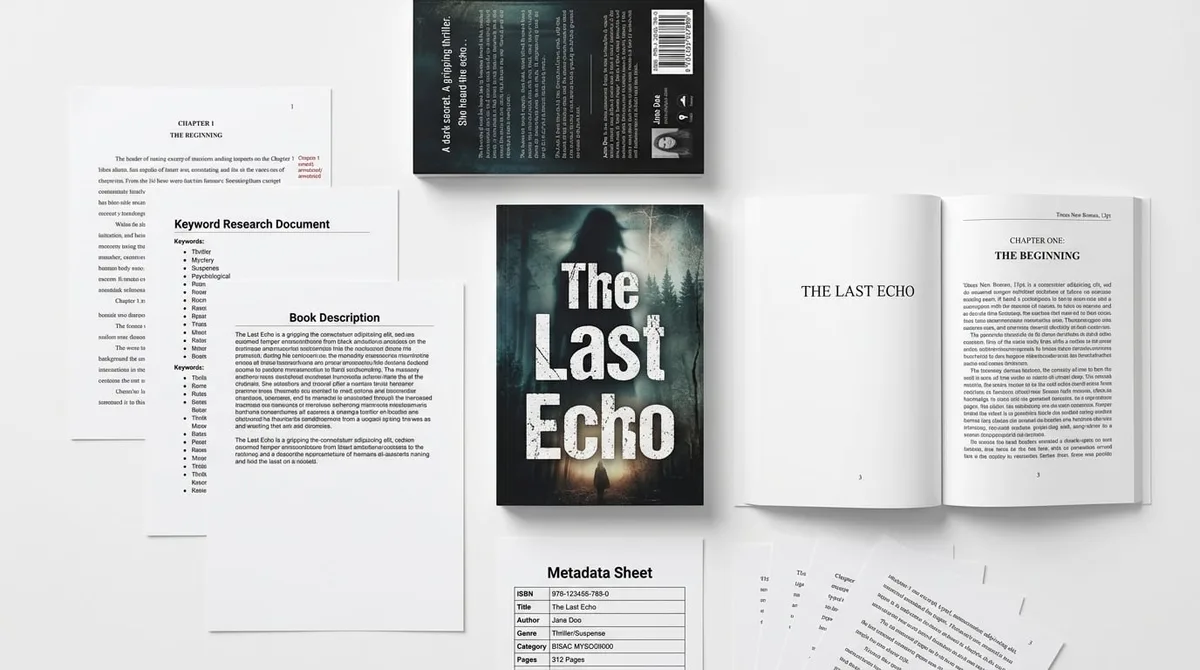
For a direct view of the difference, see a complete sample package and inspect the output before you create an account. The sample includes the manuscript PDF, full-wrap cover, interior, and metadata sheet so you can judge the package as a whole.
Manuscript package
The manuscript package starts by refining the core idea so the book has a clear purpose. It then organizes the content into sections that make sense to the reader. The final manuscript is not just longer; it is structured to support the promise on the cover and in the listing.
Design package
The design package includes cover direction and interior layout. This is where the book becomes recognizable as a real product rather than a file export. Cover style, typography, spacing, and page structure work together instead of competing for attention.
Metadata and upload package
The metadata and upload package covers listing details that help the book present cleanly inside KDP. This includes title data, description direction, keywords, categories, and final file checks. It also means the files are prepared in a way that reduces last-minute formatting surprises.
Review KDPBuilder pricing to compare what a finished package includes versus what a basic generator leaves for you to handle manually.
When a Generator Is Enough — and When You Need a Studio
A generator is fine for brainstorming, outlines, rough drafts, low-risk experiments, and personal-use projects. It is especially useful when you want to test an idea quickly or create a starting point before investing in more polished production.
A publishing studio is better when the book will carry a brand, sell on Amazon, compete in a real niche, or needs professional presentation. If the book represents a business, creator brand, coaching offer, or serious category position, the packaging has to do more than exist.
Use a generator for drafts
Use a generator when the goal is speed and ideation. It can help you move from blank page to rough outline, from idea to draft section, or from concept to early experiment. That is the right role for a cheap AI tool: draft support.
Use a studio for products
Use a studio when the goal is a finished product. If you need a book that looks intentional, reads cleanly, and is prepared for upload, you need more than raw generation. You need an editorial workflow, a design system, and KDP-aware file preparation.
Here is a simple decision matrix:
| If your priority is... | Choose... | Why |
|---|---|---|
| Fast ideation | Generator | You need a draft, not a complete product |
| Reader trust | Studio | Cover, interior, and metadata need to work together |
| Upload readiness | Studio | Files need QA, spec checks, and KDP-aware prep |
| Simple internal testing | Generator | A rough concept is enough for early validation |
| Brand-sensitive publishing | Studio | The book represents your name, offer, or business |
The practical takeaway is simple: cheap AI tools are useful when you want input. A publishing studio is useful when you want a finished package.
If you are still deciding which path fits your book, compare publishing tools against the level of finish you actually need.
Pre-Publish Quality Checklist
Before you upload an AI-assisted book to KDP, run the package through this quick check. If any answer is weak, the book is not ready yet.
- Promise: Can a shopper understand the reader benefit from the title and cover in three seconds?
- Audience: Is the book for a specific reader, not a vague market?
- Cover: Does the thumbnail still work at small size?
- Interior: Are margins, spacing, headings, and page rhythm consistent?
- Usefulness: Does every chapter, prompt, puzzle, or page earn its place?
- Metadata: Do the description, keywords, and categories match the actual book?
- Files: Are the cover and interior exported to the correct final specs?
- Disclosure: Have you tracked what was AI-generated, AI-assisted, edited, or translated?
FAQ
What is the difference between an AI book generator vs publishing studio?
An AI book generator produces raw text, images, prompts, or simple templates. A publishing studio turns that raw material into a complete product with edited manuscript structure, cover direction, interior layout, metadata, and files prepared for KDP.
The difference is not only quality; it is packaging. One gives you content to work with, and the other gives you a publishable system.
Can a kdp template generator create a publish-ready book?
It can help with layout, but not by itself. A kdp template generator can speed up page structure and formatting, yet it does not decide whether the concept is differentiated, the flow is readable, or the sales page is credible.
For publish-ready results, the template has to be supported by editorial judgment, cover strategy, and KDP file checks.
Do I still need an amazon cover template generator if a studio designs my cover?
Usually no, because the studio should handle both sizing and design judgment. An amazon cover template generator may be useful for rough planning or understanding basic dimensions, but it is not a substitute for a genre-right cover.
Technical correctness is only one part of the job. The design still has to build trust and match the market.
What does an ai book before after comparison usually show?
It usually shows the difference between a rough draft and a structured product. Before, you may see repetitive chapters, vague audience targeting, weak visual consistency, and basic formatting. After, you see a defined reader promise, clearer organization, stronger cover hierarchy, and a more intentional interior.
That comparison is useful because it reveals why a book can be generated without being ready to publish.
Is an ai workbook generator enough for selling workbooks on KDP?
Not on its own. An ai workbook generator can create raw pages and prompt structures, but a sellable workbook needs consistency, enough writing space, clear instructions, page rhythm, and a design that feels deliberate.
If the workbook is going to compete in a real category, it also needs strong packaging and proper KDP file preparation.
Do I need a kdp calculator or kdp book size calculator before publishing?
Yes. These tools are useful before publishing because they help confirm size, page count, cover dimensions, and royalty planning. A kdp calculator or kdp book size calculator can prevent basic spec mistakes.
Still, they are support tools, not publishing strategy. You also need design judgment, metadata planning, and a final compliance review before upload.
Conclusion: Do Not Confuse a Draft With a Product
An AI generator can start the work. It cannot replace the publishing judgment that makes a book feel credible: a sharp concept, useful manuscript, genre-right cover, readable interior, accurate metadata, and clean final files.
If your goal is brainstorming, use a generator. If your goal is a book that represents your brand or competes in a real KDP category, treat the package like a product from the beginning.
Ready to evaluate the difference without creating an account? Start with try free to get 75 free credits, no card required. Then review a complete sample package so you can inspect the manuscript, cover, interior, and metadata before you commit.
Turn this idea into a book — free sample
Type a book idea and we'll generate a real cover preview in about a minute. No signup, no card.