AI Assisted Book Writing Workflow for KDP

Skip the theory? Generate a free book preview in about a minute — no signup, no card.
Try it freeMost AI book projects do not fail because the model is weak. They fail because the publisher treats the manuscript as the product. On KDP, the product is the full package: a specific reader promise, useful content, clean editing, a printable interior, a cover that signals the right category, honest metadata, and a compliance record you can defend.
An ai assisted book writing workflow uses AI for research support, outlining, drafting, editing, design prep, metadata, and quality checks while keeping human control over positioning, accuracy, voice, structure, rights, and publishing decisions. The goal is not faster text. The goal is a book package a real buyer can understand, trust, and use.
If you want a practical ai assisted book writing workflow for KDP, think like a publishing studio, not a prompt factory. The best results come from managing the whole build: concept, manuscript, cover, interior, metadata, and compliance. To see that studio-style process instead of guessing from prompts, Try KDPBuilder Free (no signup).
What an AI Assisted Book Writing Workflow Should Actually Produce
The difference between generated text and a finished book
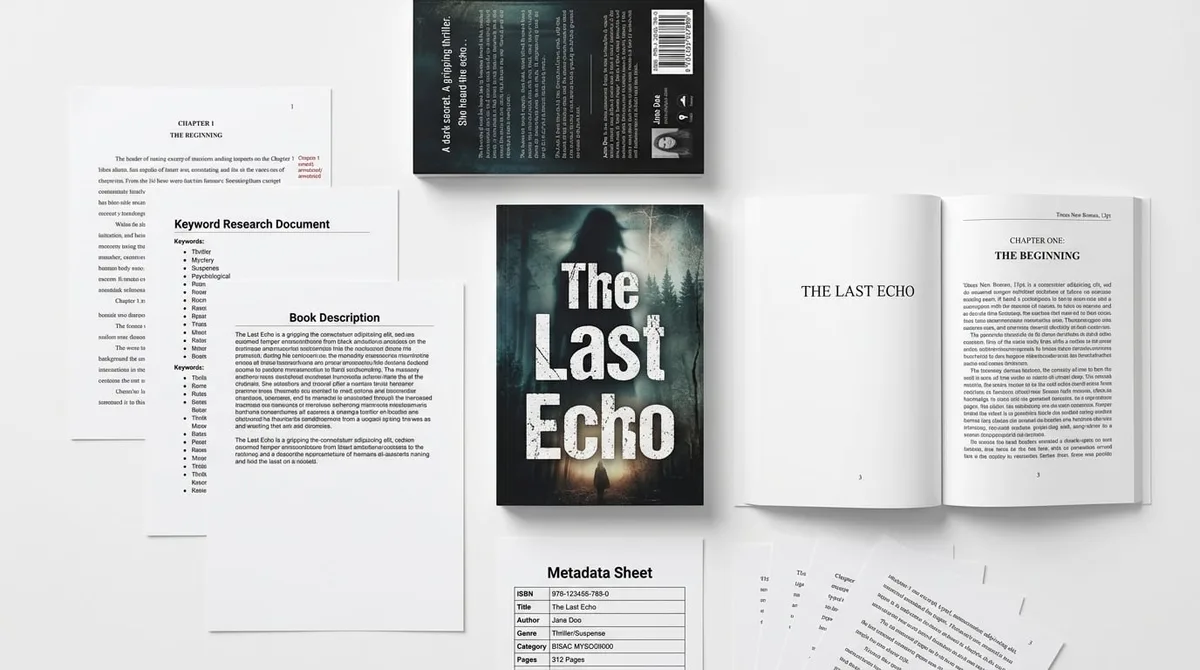
A professional workflow should produce a publish-ready book package, not just a manuscript. That means a validated concept, a structured outline, a fully edited manuscript, a cover brief or finished cover file, a formatted interior, title and subtitle options, metadata, and KDP upload assets.
A one-click AI book maker may generate pages, but pages alone do not meet reader expectations. Buyers notice category fit, formatting, cover quality, and whether the book delivers a clear promise. A book that looks assembled from raw output will usually feel thin, repetitive, or off-brand before the first chapter ends. For a side-by-side view of that difference, see AI Book Generator vs Publishing Studio: Before/After.
The better standard is simple: stop publishing books that look generated; start building books that look designed. Every stage needs a human decision attached to it.
Why workflow quality matters more than model choice
Many publishers obsess over which model to use, but model choice matters less than the production system around it. A strong ai assisted book writing workflow controls what gets generated, how it gets checked, and what gets rejected. The model is only one tool inside a larger studio process.
The important question is not: Can AI make pages? The question is: Can this workflow create a book that fits the market, prints cleanly, reads well, and uploads without avoidable problems? KDPBuilder runs every book through a six-phase studio pipeline — Discovery, Writing, Editing, Design, Covers, Publishing — instead of a single generate-and-dump step.
KDPBuilder uses a six-phase production pipeline — Discovery, Writing, Editing, Design, Covers, Publishing — so the manuscript, interior, cover, and listing assets are developed as one package. Walk through the pipeline free.
Step 1: Validate the Book Before You Generate Anything
Start with reader intent, competing titles, price bands, review patterns, category norms, and format expectations before drafting a single paragraph. This is where many AI book projects fail: they begin with content generation instead of market validation.
To avoid generic niche books, identify three things before you build anything: the specific reader segment, the promise the book makes, and the transformation it delivers. For example, stress management is vague; stress management for new managers leading remote teams is a sharper promise with a clearer buyer.
Use tools for keyword research, category review, royalty checks, and production planning, but pair them with judgment. A keyword list does not equal a good book idea. A category with weak competition does not automatically mean the interior format or content depth is right for that audience.
Different formats need different validation standards. A puzzle book needs proof that the puzzle mix and difficulty level fit the buyer. A journal needs the right prompts and page structure. A cookbook needs recipe usefulness, ingredient practicality, and interior layout planning. A nonfiction guide needs topic depth and a realistic buyer promise.
Reader promise
Write the promise in one sentence: who it is for, what result it helps them get, and why the book is different. If you cannot make that sentence specific, the market likely cannot tell what the book is for either.
Competitive gap
Review competing titles for format, length, cover style, subtitle patterns, and table of contents. Look for a gap you can fill with a more useful angle, better structure, or a more focused reader segment — not just a different title.
Format and production constraints
Before drafting, define the physical format: trim size, page count target, and whether the book needs full-bleed artwork, answer keys, tables, or image-heavy layouts. KDP paperback royalties are generally 60% of list price minus printing costs for standard distribution, with expanded distribution using a lower royalty calculation where available, so format and page count affect both production and pricing decisions.
If you are still deciding whether your topic is ready for a full build, review a staged example first. A Complete Sample Package shows the kind of output you should expect from a real production workflow, not just a text generator.
Step 2: Build a Human-Led Creative Brief
The creative brief is the control document for AI. It should define the audience, tone, exclusions, chapter logic, examples, evidence standard, formatting requirements, and brand-level quality bar. If the brief is weak, the output will drift.
A useful brief also includes series planning. If you want repeatable KDP assets, define what stays consistent across the series: title pattern, subtitle style, chapter structure, visual system, and interior logic. That makes future books faster to produce without letting quality slide.
Prompts without a brief usually create uneven chapters and obvious AI tells. One chapter sounds formal, the next sounds casual, and the structure changes because the model is improvising around your lack of direction. A brief prevents that by telling the model what not to do as clearly as what to do.
Audience and outcome
Document who the reader is, what they already know, and what they need by the end. Include the pain point, the desired outcome, and the level of detail expected. A beginner’s guide and a professional handbook should not read the same.
Voice and style rules
Set style rules in plain language: sentence length, use of examples, level of formality, whether first-person is allowed, and what kinds of phrases must be avoided. If you want the book to sound calm, practical, and direct, say so.
Source and fact standards
For nonfiction, specify what counts as acceptable support: firsthand expertise, cited sources, product testing, interviews, or external verification. For fiction or activity books, define originality rules, format rules, and what should never be copied or recycled. The brief should also include exclusions, such as no gimmicky filler, no motivational padding, and no unsupported claims.
Brief test: if another editor could not use your brief to reject weak output, the brief is not specific enough.
Step 3: Use AI to Draft, Not to Decide
How to use AI to write a book properly means using AI for structured assistance, not handing over authorial judgment. AI can help you move faster, but it should not decide the premise, audience fit, evidence standard, or final structure.
The safest sequence is controlled:
- Generate a working outline from the brief.
- Critique the outline for gaps, overlap, and weak chapter order.
- Draft one sample chapter to test voice and depth.
- Calibrate the voice based on that sample.
- Draft section by section, usually in 800- to 1,500-word units.
- Run a continuity pass after each major unit.
- Reject, revise, or expand sections before layout begins.
Do not generate an entire manuscript in one pass. That approach often creates repetition, shallow coverage, hallucinated facts, and a flat reader experience. It also makes it harder to detect when the model has drifted away from the original promise.
For nonfiction, every claim needs external verification. For activity books, every puzzle, answer key, or exercise should be tested. For books that rely on step-by-step instruction, verify the steps outside the model before the content moves into layout.
Outline first
Begin with a chapter map, not paragraphs. A solid outline should show the argument or progression of value, not just topic headings. If the outline does not already feel helpful, the draft will not magically fix it.
Draft in controlled sections
Keep drafts small enough to review. A section, subchapter, or 800- to 1,500-word unit is easier to evaluate than a whole manuscript dump. Controlled drafting also makes it easier to catch voice drift and structural weakness before they spread.
Review after every major unit
At the end of each unit, ask whether the reader learned something useful, whether the section advanced the promise, and whether anything sounds generic. If the answer is no, revise before moving on.
Step 4: The AI Book Editing Process That Separates Real Books From Slop
The ai book editing process should be multi-pass, not a single clean-it-up request. A proper system includes developmental editing, structural editing, line editing, fact checking, consistency checking, reader-value review, and final proofing.
AI can help identify repetition, weak transitions, unclear sections, tone drift, missing examples, and inconsistent terminology. That makes it useful as an editorial assistant. But humans must own taste, truth, positioning, sensitivity, originality, and final acceptance.
This is the point where a book becomes publishable or not. If the editing pass only removes grammar mistakes but leaves the content shallow, repetitive, or off-brief, the book still feels low value.
KDPBuilder books pass through automated quality gates, including grid and layout QA for puzzles, vision checks for covers, and formatting validation for interiors. Files that fail are repaired or regenerated before delivery. See gated output quality.
Developmental editing
Check whether the book’s core promise is actually delivered. Look at chapter order, missing topics, weak examples, and whether any section over-explains while another section under-delivers. Developmental editing answers the question: should this material exist in this form?
Line editing
Improve clarity, rhythm, and precision. Remove vague phrases, repeated openings, filler sentences, and too many similar examples. Line editing is where the book starts sounding intentional rather than machine-assembled.
Proofing and accuracy checks
Run a final pass for names, dates, terms, numbering, headings, and table consistency. For anything factual, verify externally. For any instructional material, test the steps. The book should read smoothly and also function correctly.
Insider pro-tip: ask AI to act like a hostile editor on one pass. Have it list the top 10 reasons a reader would stop reading, then fix those issues before you format anything.
| Editing pass | What it catches | What you should verify |
|---|---|---|
| Developmental | Missing ideas, weak chapter order, broken promise | Does the book solve the reader’s problem? |
| Structural | Duplicated sections, uneven pacing, missing bridges | Does each chapter earn its place? |
| Line | Repetition, awkward phrasing, flat rhythm | Does it sound intentional and readable? |
| Proof | Typos, headings, numbering, layout inconsistencies | Do the files match the final manuscript exactly? |
Step 5: Where a KDP Interior Generator Fits in the Workflow
A kdp interior generator can speed up layout, but it should not replace design judgment. Interior tools are most useful after the manuscript is structurally sound and edited, because layout problems are easier to solve when the content is already stable.
Check the interior for margins, bleed, trim size, page count, typography, spacing, puzzle answer keys, image resolution, and print-preview accuracy. KDP print files must meet trim, bleed, margin, and cover-size requirements; full-bleed interiors require an added 0.125 inch bleed on applicable edges, and cover files must account for front cover, back cover, spine, trim, bleed, and page count.
Low-content books, medium-content books, puzzle books, workbooks, cookbooks, and nonfiction paperbacks all have different interior needs. A cookbook may need image placement and legibility. A workbook may need writing space and clear instructions. A puzzle book may need answer placement and page flow. A nonfiction book may need tables, callouts, and stable heading styles.
Manuscript-to-interior handoff
Before sending content into layout, make sure all headings are final, page breaks are planned, and any repeated elements are consistent. The more stable the manuscript, the cleaner the interior build.
Print readability checks
Preview the book as if you were the buyer. Check font size, line spacing, page density, image placement, widow/orphan issues, and whether any page feels cramped or awkward. A good interior feels easy to read before the reader even starts.
Interior mistakes that make books look generated
Common problems include mismatched fonts, inconsistent heading styles, crowded margins, oversized whitespace in one section and dense text in another, and repeated elements that were not aligned across the file. These details make a book feel unfinished fast.
If your interior keeps failing basic layout checks, a studio workflow is usually the better fix than another round of raw generation. That is the problem a gated production process is built to catch before upload, and it is one reason a sample package is useful when you want to compare output quality.
Step 6: Package the Book Like a Publisher, Not a Generator
The commercial package includes the cover concept, title and subtitle, back cover copy, series branding, description, keywords, categories, author positioning, and, where relevant, A+ style thinking. Buyers judge perceived value before they read a sample, so the package is part of the quality workflow.
Think in terms of alignment. The cover should match the promise, the subtitle should clarify the promise, the description should support the promise, and the interior should deliver the promise. When these pieces conflict, the book feels unclear and harder to trust.
The best book builder is not the one that creates the most pages; it is the one that coordinates manuscript, cover, interior, and sales assets into one coherent product.
Cover and title alignment
Use the cover to signal genre, topic, and value level. A how-to book should not look like a romance novel. A workbook should not look like a memoir. The title and subtitle should make the benefit obvious without sounding stuffed with keywords.
Metadata and conversion
Keywords and categories should reflect what the book truly is, not what you hope it might rank for. Strong metadata helps the right reader understand the book quickly, but misleading metadata can damage trust and create compliance issues.
Series-ready assets
If the book will sit inside a series, build repeatable assets now: uniform title logic, coordinated cover spine treatment, and a style guide for future releases. That saves time and creates a more professional storefront over time.
Step 7: Compliance Check for Amazon KDP AI Generated Content Policy 2026
The amazon kdp ai generated content policy 2026 should be treated as a practical pre-upload checkpoint, not a rumor mill. Amazon KDP requires publishers to disclose AI-generated text, images, or translations during title setup. AI-assisted content that was substantially created or edited by a human is treated differently under KDP’s disclosure definitions, but publishers should verify the current KDP Help wording before upload because platform language can change.
That means you need a clear record of what AI did and what you did. It also means you should not treat AI as a workaround for originality, rights, or quality. Disclosure is only one part of publishability.
AI-generated vs AI-assisted
If the output was generated by AI and then posted as-is, you are in a different category than work that was substantially shaped, edited, and finalized by a human. Because platform wording can change, check the current KDP Help page before upload and do not rely on memory or old summaries.
Disclosure and rights
Before upload, confirm you have rights to everything in the book. No copied material, no unlicensed images, no reused interiors from another title, and no misleading author or content claims. If you used AI in the workflow, keep track of how it was used so your disclosure decision is consistent.
Quality review before upload
- Confirm the manuscript is fully edited.
- Check formatting, headings, page breaks, and images.
- Verify cover dimensions, spine width, and bleed.
- Review title, subtitle, keywords, and categories for accuracy.
- Make sure the book delivers real reader value and does not read like filler.
- Review current KDP requirements before publishing.
This is publishing hygiene, not legal advice. The goal is to reduce avoidable problems and publish a book package that reflects the current platform rules and a real editorial standard.
A Practical Workflow Template You Can Reuse
Use this reusable workflow as a production checklist. Each stage should have an acceptance criterion before you move on.
| Stage | Checkpoint | Acceptance criteria |
|---|---|---|
| Validate | Market fit and reader promise | Specific audience, clear transformation, viable format |
| Brief | Creative direction | Tone, exclusions, sources, chapter logic, standards documented |
| Outline | Structure and flow | No duplicated sections, clear progression, useful chapter order |
| Draft | Controlled AI drafting | Section-by-section output, no full-manuscript dump |
| Edit | Multi-pass revision | Structure, clarity, accuracy, and consistency checked |
| Design | Interior and cover prep | Trim, bleed, margins, typography, and cover specs correct |
| Package | Metadata and sales assets | Title, subtitle, description, keywords, categories aligned |
| Compliance | KDP review | Rights confirmed, disclosures reviewed, formatting verified |
| Upload | File submission | Preview looks clean, no broken elements, no last-minute surprises |
| Post-launch review | Retail presentation audit | Check listing, sample preview, and reader-facing clarity |
Use these quality gates to decide whether to regenerate or revise:
- Regenerate if the outline is weak, the chapter logic is broken, or the concept lacks a clear reader promise.
- Revise if the draft has repetition, weak transitions, or inconsistent tone but the underlying idea is solid.
- Redesign if the interior fails print checks, the cover no longer matches the promise, or the metadata misrepresents the book.
A better workflow is about more than text generation. It is about validated ideas, editorial control, design quality, and compliant files that can stand up as a complete product. If you want to test the process without committing to a full build, Try KDPBuilder Free (no signup) and see how the studio workflow handles each stage.
FAQ
What is the best ai assisted book writing workflow for KDP?
The best workflow starts with validation, then moves into a human-led creative brief, controlled drafting, multi-pass editing, design prep, packaging, and compliance review. The point is to create a complete book package, not just a manuscript. If one stage is skipped, the final book usually feels less useful or less polished.
How do you use AI to write a book properly without making it look generated?
Use AI for support tasks: brainstorming, outlining, draft assistance, revision suggestions, and consistency checks. Do not let it decide the premise, structure, or final wording without review. The book stops looking generated when a human sets the brief, verifies the content, and edits the final result carefully.
What should be included in an ai book editing process?
A solid ai book editing process should include developmental editing, structural editing, line editing, fact checking, consistency checks, reader-value review, and final proofing. AI can help spot repetition and weak transitions, but a human must handle judgment, accuracy, and final acceptance.
Can a kdp interior generator create publish-ready files?
It can help create layout files, but it should not be trusted to finish the job on its own. You still need to check trim size, bleed, margins, typography, spacing, image quality, page count, and print preview. The interior is only publish-ready when it reads well and prints cleanly.
What does the amazon kdp ai generated content policy 2026 require publishers to disclose?
Amazon KDP requires publishers to disclose AI-generated text, images, or translations during title setup. AI-assisted content that was substantially created or edited by a human is treated differently under KDP’s disclosure definitions, but you should verify the current KDP Help wording before upload. Keep a clear record of how AI was used so your disclosure choice is consistent.
Is an ai cookbook generator enough to publish a cookbook on Amazon KDP?
No. A cookbook needs tested recipes, practical ingredient choices, strong layout, and a design that supports usability. An ai cookbook generator may help organize ideas or speed up drafting, but the recipes, instructions, and interior still need human testing and editorial control before publication.
Ready to compare a guided workflow with raw generation? Start with Try KDPBuilder Free (no signup). When you want a concrete reference point, open See a Complete Sample Package. If you want more room to evaluate the platform after the initial trial, Create a Free Account (75 credits, no card).
Turn this idea into a book — free sample
Type a book idea and we'll generate a real cover preview in about a minute. No signup, no card.