AI Book Publishing Quality: Why AI Books Fail

Skip the theory? Generate a free book preview in about a minute — no signup, no card.
Try it freeMost AI books do not fail because a sentence sounds robotic. They fail earlier: the premise is too broad, the chapters repeat the same advice, the cover looks off-shelf, the interior was exported without print discipline, and the listing cannot tell a buyer why this book deserves trust. AI book publishing quality is the discipline of catching those failures before the file reaches Amazon KDP.
The fix is not a better prompt. It is a studio QA workflow: market positioning, human editorial review, genre-aware cover design, print-ready interior formatting, metadata alignment, KDP production checks, and a final reader-value audit. If the book looks assembled from tools, readers feel the shortcut. If every part of the package supports the same promise, the book looks designed.
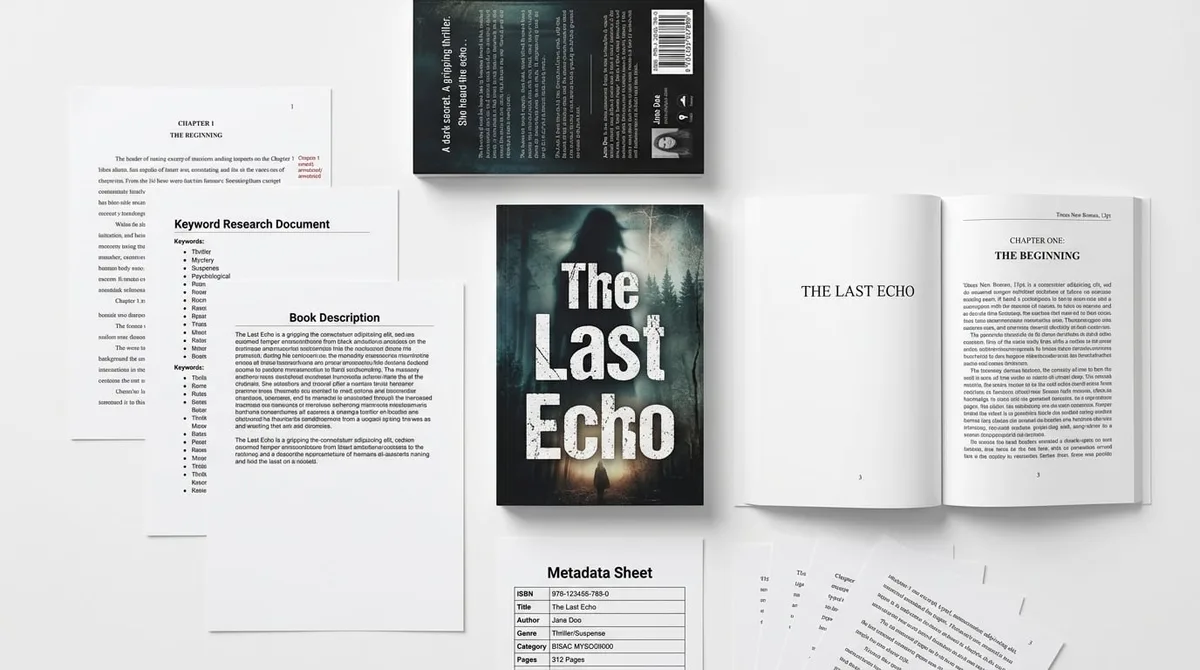
KDPBuilder’s standard is simple: stop publishing books that look generated; start building books that look designed. Our workflow uses editing, design, covers, publishing checks, and QA gates instead of a single generate-and-dump step. Judge the output in the Complete Sample Package.
What AI book publishing quality means in 2026
Quality is not the same as output
High output is easy. Quality is harder because it includes the entire buyer experience: the promise on the cover, the usefulness of the manuscript, the layout in the preview, and the confidence a reader feels before clicking purchase. A file can be technically exportable and still look obviously generated if the concept is generic, the chapters repeat themselves, or the design feels assembled from separate tools.
In 2026, AI book publishing quality means two things at once: the book must be readable by a human, and it must be producible in a way that fits KDP’s print and metadata requirements. The final standard is not “Did AI help make this?” The useful question is: “Would a real reader trust this book beside established titles on a crowded Amazon shelf?”
A useful way to think about quality is five layers:
- Idea validation — the book has a clear reader, promise, and angle.
- Manuscript depth — chapters build on each other with examples, not repeated filler.
- Visual design — the cover and interior match genre expectations.
- Production files — trim size, bleed, margins, and page structure are correct.
- Metadata — title, subtitle, description, keywords, and categories align with what the book actually delivers.
A good AI-assisted book still needs a publishing standard
The cheap-generator mindset treats AI as the whole process. The publishing-standard mindset treats AI as one production tool inside a larger system. That is the difference between a book that feels like a shortcut and a book that feels finished. If the manuscript is decent but the cover is off-genre, the interior is sloppy, and the metadata is vague, readers still sense low quality.
Quality is a system problem, not a single-tool problem. A strong publishing workflow protects the reader from inconsistency by making sure every part of the book says the same thing: this is intentional, useful, and professionally built. If you want to compare a generator-first workflow with a studio-first workflow, AI Book Generator vs Publishing Studio: Before/After is a useful side-by-side reference.
The most common AI-generated book problems
Manuscript problems
The most common failure starts with the premise. Many AI-generated books target a broad keyword but do not define a real reader. That leads to generic promises like “everything you need to know” or “the complete guide,” which usually hide a weak angle. A book about productivity, for example, becomes forgettable if it speaks to everyone instead of one clear reader such as new managers, remote workers, or first-time founders.
Thin manuscripts usually show the same symptoms: repetitive chapter openers, shallow advice, hallucinated facts, weak examples, and no editorial hierarchy. A chapter should have a purpose, a sequence, and a takeaway. If every section sounds like a paraphrase of the same prompt, the reader notices. A simple test is to skim the first sentence of each chapter; if they all sound interchangeable, the manuscript needs restructuring.
Another common issue is source quality. AI can produce confident text that is not accurate. For nonfiction, that means you need a factual review pass, especially for health, finance, legal, technical, or recipe-related content. A manuscript that looks polished but contains bad information creates review risk, refund risk, and reader trust problems.
Cover and interior problems
The cover is often where AI books lose trust fastest. AI art may look impressive at first glance, but if it does not fit the genre, audience, or trim size, it looks wrong in the Amazon thumbnail. A thriller cover needs a different visual system than a children’s activity book or a cookbook. A generic image may be technically attractive while still failing the most important job: making the right reader feel, “This is for me.”
The interior has its own failure pattern. Auto-exported interiors often show inconsistent headings, awkward page breaks, low-resolution images, too much white space, or margins that do not fit the selected trim. If the book uses print, the interior must be built for the page, not merely dumped into a PDF. Readers may not describe the problem in technical terms, but they can feel it when a book looks careless.
KDPBuilder runs books through a six-phase studio pipeline — Discovery, Writing, Editing, Design, Covers, Publishing — instead of a single generation step. Walk through the pipeline free, with no signup.
Metadata problems
Weak metadata is one of the fastest ways to bury a decent book. Keyword stuffing does not create clarity. A generic subtitle does not create a reason to buy. Categories that do not match the real content confuse both the shopper and the platform. Your metadata should help a buyer answer three questions in seconds: What is this book? Who is it for? Why should I trust it?
When metadata is sloppy, the book can be invisible even if the manuscript is acceptable. That is why AI book publishing quality includes the listing package, not just the text file. The title, subtitle, description, and categories should all point in the same direction.
| Quality checkpoint | Good sign | Bad sign |
|---|---|---|
| Concept | Specific reader and promise | Broad keyword with no audience |
| Manuscript | Distinct chapters and useful examples | Repeated points and filler |
| Cover | Genre-fit thumbnail and trim-aware design | Generic art or unreadable text |
| Interior | Correct margins, headings, and page flow | Off-trim layout or awkward breaks |
| Metadata | Title, subtitle, and categories align | Keyword stuffing and vague positioning |
Do AI books sell? Only when the reader value is real
The market does not reward AI output
Do AI books sell? Yes, but not because they are AI-generated. They sell when they solve a specific reader problem and look professionally packaged. Buyers do not purchase a file format or a workflow. They buy a result, a promise, or a transformation that seems credible from the cover, preview, and description.
Low-quality AI books can be uploaded quickly, but speed to upload is not the same as speed to trust. The market responds to the visible parts first: title, cover, description, preview pages, and early reader experience. If those elements feel rushed, the buyer moves on before caring how the manuscript was made.
A practical rule: if the book would not deserve a review without the AI novelty, it is not ready. Novelty can attract curiosity, but reader value creates the actual case for purchase. A book that exists only because the generator made it easy to produce is unlikely to create durable trust.
The market rewards useful books
Useful books do three things well: they answer a specific need, they stay organized, and they look like they were built by someone who understood the audience. That is why a focused book with a modest scope often feels more credible than a broader book with a vague promise. Specificity makes the offer believable.
For example, a cookbook aimed at “easy weeknight meals for two adults” is easier to judge and easier to trust than “the ultimate cookbook for everyone.” The same principle applies to business, self-help, journaling, and activity books. A clear promise plus polished execution beats a vague promise plus rushed production.
AI book publishing quality is really reader-value quality. If the reader feels the book solves a problem cleanly, the AI origin becomes secondary. If the reader senses the book was assembled without a standard, the AI origin becomes the first thing they blame. For more of the visual and structural red flags, see Why AI Books Look Generated: 12 Cheap Tells.
Why KDP tools and generators create uneven quality
When a KDP interior generator is enough
A KDP interior generator can be useful for one narrow task: creating a basic print structure when the book format is simple and the content is already finished. That can work for straightforward templates, but only if the layout is checked carefully and matched to the exact trim size and bleed settings you selected in KDP.
For print books, the file requirements matter. Cover and interior files must match the chosen trim size and bleed settings, or the preview will show alignment issues. Spine text is only allowed for books with at least 79 pages, so very short books should not be designed as if they were full-length print books. These are not style preferences; they are production constraints.
When you need a publishing studio instead
The problem with most generators is not that they are useless. The problem is that they optimize for output volume, while Amazon shoppers respond to specificity, design coherence, and reader experience. A book builder that creates a shell is not the same thing as a studio that manages the whole package.
Common generator failures look different by format:
- Cookbooks: generic recipes, inconsistent serving logic, unsafe or untested instructions, bland layout, and stock-looking cover art.
- Puzzle books: repeated layouts, no difficulty curve, weak answer-key QA, and interiors that feel templated.
- Guides and nonfiction: surface-level advice, repeated points, weak examples, and no editorial prioritization.
That is why the same automation that helps you draft a book can also hide weak decisions. If the production system does not include design standards and QA, the result can still look cheap. Compare publishing tools by asking a simple question: does the workflow build a finished book, or only generate pages?
Insider pro-tip: before you export anything, print the first 10 interior pages and the full front cover as a cheap proof. If the book feels generic in black and white on paper, it will feel generic on Amazon too.
The fix: a studio QA workflow for AI-assisted publishing
Idea-to-file quality control
The fix is to treat publishing as a studio workflow. That means one team mindset, even if one person is doing the work: idea, manuscript, cover, interior, metadata, and publish-ready files all need to be built against the same quality standard.
Here is a practical 4-step workflow:
- Define the book before generating it. Set the reader, promise, format, trim size, and competitive shelf. If you do not know which shelf the book belongs on, the content will drift.
- Draft with structure and originality checks. Use AI for speed, then edit for hierarchy, examples, factual accuracy, and duplication. Remove repeated ideas and add real value in each chapter.
- Design the cover and interior together. The book should look like one intentional product, not a text file with a separate art file attached later.
- Prepare metadata after the book is real. Write the title, subtitle, description, and keywords around the actual deliverable, not around what the prompt said you wanted.
This is where KDPBuilder’s approach differs from one-click generation. A publishing studio manages the package, not just the manuscript. Complete sample packages and real examples matter because they let you judge the standard before you build.
After you define your format and market, open the Complete Sample Package and real book examples. Compare your draft against a true before-and-after workflow, not just a text generator output. The goal is not to produce more files; it is to produce fewer weak files.
Why a studio beats a one-click generator
A one-click generator is attractive because it creates motion. But motion is not momentum unless the book passes a reader-value audit. A studio workflow creates checkpoints, and each checkpoint catches a different type of failure: concept drift, factual errors, design mismatch, file problems, and metadata confusion.
That is the key difference between a book builder and a publishing studio. A builder can create pages. A studio ensures those pages work together as a commercial product. If you want better AI book publishing quality, you need the second model.
A pre-publish quality checklist for Amazon KDP
Reader-value checks
Before upload, review the manuscript as if you were the buyer. Ask whether the book has a specific promise, whether the chapters build logically, and whether each section earns its place. If any chapter repeats the title page in different words, cut or rewrite it. If the examples are generic, replace them with concrete ones.
- Promise: Is the book specific enough that one reader group would choose it over a broader competitor?
- Depth: Does every chapter add something new?
- Evidence: Are facts, steps, and instructions checked?
- Originality: Does the book sound like a designed product, not a prompt response?
KDP file checks
Your interior and cover must fit the exact production setup. Confirm trim size, bleed settings, page count, margins, and image resolution before you upload. For print books, also confirm that spine text is only used when the book has at least 79 pages. A great cover file that is wrong for the trim size is still a failed file.
- Interior: correct trim, safe margins, page numbers, heading styles, and page breaks.
- Cover: readable thumbnail, genre-appropriate design, spine width accuracy, and no obvious AI artifacts.
- Images: high enough resolution for print and placed intentionally, not left at default size.
Marketplace checks
Metadata should help the book sell the truth, not exaggerate or hide it. The title and subtitle should match the book’s actual scope. The description should explain the outcome in plain language. Keywords should reflect buyer intent rather than stuffing every related phrase you can think of. Categories should match the content and audience.
KDP compliance also matters. Amazon KDP requires publishers to disclose AI-generated content during title setup or edits; AI-assisted content does not require the same disclosure if the human author created or substantially modified it. That means your process matters. If AI is only a tool inside a human-led workflow, you are in a different position than a fully generated manuscript.
For KDP print books, confirm the previewer before publishing. Review every page for cut-off text, inconsistent spacing, and cover alignment issues. If the previewer shows a problem, fix it before launch. A clean preview is not perfection, but a bad preview is a warning sign.
Once your draft survives this checklist, try KDPBuilder Free with no signup and compare it against a structured studio workflow. You get 75 free credits, so you can test the Discovery, Writing, Editing, Design, Covers, and Publishing phases before deciding whether the studio approach fits your next book.
FAQ
Do AI books sell on Amazon KDP?
Yes, AI books can sell on Amazon KDP when they solve a specific reader problem and are packaged professionally. The market does not reward AI by itself; it rewards useful, well-designed books that match a clear audience. If the cover, preview, and description feel weak, the book will usually struggle regardless of how fast it was made.
What are the biggest AI-generated book problems?
The biggest problems are generic premises, thin or repetitive manuscripts, mismatched covers, sloppy interiors, and weak metadata. In nonfiction, factual errors and shallow examples are especially risky. The fastest way to spot trouble is to compare the book against a real reader expectation: if it feels broad, templated, or unfinished, it needs more work.
Can a KDP interior generator create a quality book?
It can help with layout, but it cannot create quality by itself. A KDP interior generator only handles part of the process, and print quality still depends on trim size, bleed, margins, page count, and visual consistency. Use it as a tool, not as the whole publishing plan.
Is an AI cookbook generator enough to publish a cookbook?
No. A cookbook needs tested recipes, clear serving logic, safe instructions, and a layout that supports easy use in the kitchen. An AI cookbook generator may help draft structure, but the final book still needs recipe review, formatting control, and a cover that signals the right genre.
What is the difference between a book builder and a publishing studio?
A book builder creates content or page structures. A publishing studio manages the full package: idea, manuscript, cover, interior, metadata, compliance, and final QA. If you want the book to look designed instead of generated, the studio model is the stronger standard.
Is KDPBuilder a Book Bolt free alternative for quality-focused publishers?
If you are comparing tools, the real question is not only price; it is whether the workflow supports quality. A quality-focused publisher needs more than output generation, including design standards, file checks, and package-level QA. Evaluate any alternative by whether it helps you build a finished book, not just create pages quickly.
Try KDPBuilder Free, no signup required, to walk through the six-phase pipeline. Then use the Complete Sample Package to judge the design and QA standard before you build. The best time to catch a weak AI book is before upload — while the manuscript, cover, interior, and metadata can still be rebuilt into one coherent product.
Turn this idea into a book — free sample
Type a book idea and we'll generate a real cover preview in about a minute. No signup, no card.