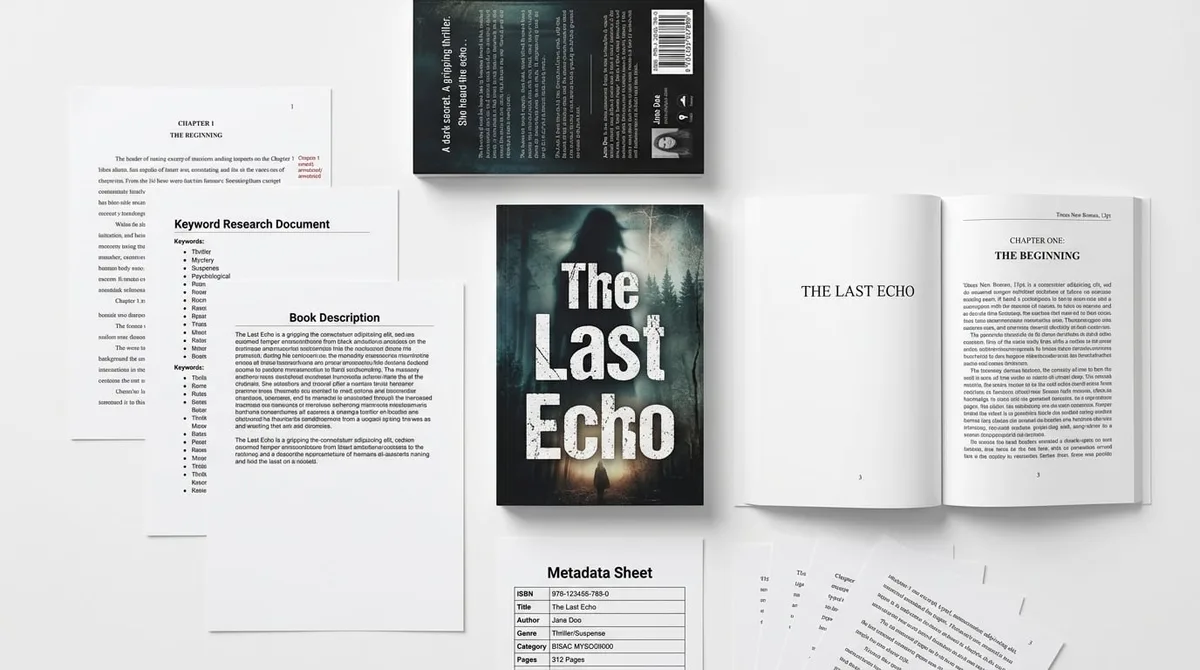
Why AI Books Look Generated: 12 Cheap Tells

Skip the theory? Generate a free book preview in about a minute — no signup, no card.
Try it freeAI books look generated when the reader can see the shortcut: a cover that could fit any niche, a title that sounds machine-made, an intro with no point of view, inconsistent art, repetitive prose, sloppy formatting, unverifiable facts, or metadata written like a keyword dump. The cure is not another prompt. The cure is a publishing workflow: editorial judgment, design rules, fact review, file QA, and a package that looks intentional from thumbnail to final page.
The fast test: do your AI books look generated?
Open your book the way a skeptical buyer would. Do not read it like the author. Scan the cover at thumbnail size, read the subtitle, open the first page, skim the table of contents, and glance at the product description. If the book feels broad, interchangeable, or assembled from disconnected parts, the reader will not care which tool you used. They will simply read it as cheap.
The fix is not “make the AI sound more human.” That is too small. Professional books are built around a reader promise, a category-aware cover, a controlled interior, verified information, and files that survive preview checks without visible production mistakes.
KDPBuilder’s standard is simple: stop publishing books that look generated; build books that look designed. That means editing, cover direction, interior formatting, metadata, and QA gates in one workflow. Open the sample package and judge the output yourself.
Generated is a look, not just a tool
AI can help draft, outline, summarize, and accelerate production. It does not automatically create a publishable product. The “generated” look usually comes from missing editorial decisions: no tight audience, no controlled tone, no visual system, no proofing pass, and no final file review.
That is why two AI-assisted books can launch with completely different signals. One looks like a product. The other looks like output.
If you need a visual benchmark, compare finished book examples and look for coherence: does the cover match the title, does the interior match the promise, and does the positioning feel specific enough for a real buyer?
The 30-second reader scan
Most buyers do not audit your process. They make a fast quality judgment. In 30 seconds, they can usually tell whether the book feels niche-specific and edited or broad and automated.
- Cover: Does it fit the category and read clearly at thumbnail size?
- Title and subtitle: Do they promise one clear outcome?
- First page: Does it sound specific, confident, and credible?
- Table of contents: Do the chapters build in a useful sequence?
- Sample chapter: Is there original structure, or only familiar advice?
- Product description: Does it sell a buyer outcome, or repeat keywords?
- Interior: Are margins, spacing, headings, and page breaks clean?
What readers notice first vs. what usually caused it
| What the reader sees | Common production cause | Best fix |
|---|---|---|
| Generic cover | No category brief or visual system | Design for the niche, not for a prompt result |
| Vague opening pages | No editorial positioning pass | Rewrite the intro around one reader promise |
| Messy interior | Default formatting and no PDF proof | Validate margins, hierarchy, breaks, and exports |
| Keyword-stuffed description | Metadata written for search only | Position for one buyer and one outcome |
The 12 cheap tells readers notice instantly
These are the visible problems that make AI books look generated before a reader finishes the preview. Fixing them will not guarantee sales, reviews, or approval from any platform. It will, however, remove the low-quality signals that make a book feel rushed.
Cover and visual tells
1. Generic cover art that looks like a template or unedited render. Stock-looking icons, floating objects, vague fantasy backgrounds, and symbolic mashups make a book feel disposable. A strong cover has one idea, one market, and one clear hierarchy.
2. Bad cover typography. Weak font pairing, cramped subtitles, poor contrast, and mismatched genre cues instantly lower trust. A business book, children’s book, workbook, and romance novel should not behave like they came from the same template.
3. Inconsistent image style. Changing character faces, mixed illustration styles, strange hands, mismatched backgrounds, and diagrams that do not share the same design language all make the book feel stitched together. Readers may not say “AI,” but they will feel inconsistency.
KDPBuilder uses automated and human quality gates across production: grid and layout QA for puzzle books, cover vision checks, interior formatting validation, and file review before delivery. Failed outputs are repaired or regenerated instead of passed through as “good enough.” See the gated output quality.
Writing and structure tells
4. A title that sounds like prompt output. Broad, bland, buzzword-heavy titles feel manufactured. A stronger title is narrow enough to mean something and commercial enough to attract the right reader.
5. A subtitle that promises everything. If the subtitle tries to include every benefit, audience, and keyword at once, it reads like metadata wearing a trench coat. Better: one reader, one transformation, one concrete result.
6. Repetitive AI prose. Watch for summary loops, filler transitions, repeated sentence shapes, and advice that stays safely vague. If a paragraph could appear in five other books without changing much, it is not doing enough work.
7. No original examples, exercises, or frameworks. A publishable nonfiction book should give the reader something specific: a checklist, worksheet, teardown, decision tree, case example, script, template, or scenario. Without those, the book feels like a surface summary.
8. Hallucinated facts or unverifiable claims. Fake citations, outdated platform details, invented statistics, and “sounds true” claims destroy trust. For factual material, verify names, dates, URLs, policy references, product details, and quoted material before publishing.
Interior and file tells
9. Sloppy interior design. Default spacing, weak headings, inconsistent bullets, awkward page breaks, widows, orphans, and no visual rhythm are obvious in preview mode. A clean interior should guide the eye without calling attention to itself.
10. Empty front matter and back matter. A book with no useful introduction, no author positioning, no resource page, and no next step feels unfinished. Front and back matter should explain why the book exists, how to use it, and what the reader should do after finishing it.
11. KDP file issues. Low-resolution images, missing bleed, poor trim choice, and elements too close to the edge are classic production tells. For print books, full-bleed interiors and covers require 0.125 inch bleed beyond the trim edge. KDP also only allows spine text on print books with at least 79 pages.
Metadata and positioning tells
12. Metadata that looks keyword-stuffed. If the title, subtitle, description, and keywords repeat the same broad phrase over and over, the book looks manufactured for search instead of positioned for a buyer. Strong metadata sounds commercial, specific, and human.
The deeper issue is editorial center. Readers can feel when a book has none. Before publishing, compare your package against real book examples and ask whether the cover, interior, title, and product promise work as one system.
AI book quality checklist before you upload
An AI book quality checklist should test the full package, not only the manuscript. A book can have decent chapters and still look generated because the cover, interior, metadata, or export files were rushed. Use this preflight before uploading to KDP.
Manuscript QA
- Unique angle: Can you explain the book’s promise in one sentence?
- Reader fit: Is the book written for one clear buyer, not a vague mass audience?
- Chapter logic: Do the chapters move in a useful sequence?
- Factual accuracy: Have you verified dates, claims, examples, sources, and names?
- Concrete examples: Does each major idea include a scenario, teardown, template, or demonstration?
- Reader action: Does the reader have something to do after each major section?
- Citation review: Are referenced claims traceable and current?
- Tone consistency: Does the voice stay stable across chapters?
- Repetition removal: Have you cut duplicated explanations, generic recaps, and filler transitions?
Cover QA
- Niche fit: Does the cover look like it belongs in the intended Amazon category?
- Thumbnail readability: Is the title readable when reduced to marketplace size?
- Typography: Do the fonts match the subject, price point, and audience?
- Contrast: Is the title clearly separated from the background?
- Author name placement: Is the author line balanced and deliberate?
- Image consistency: Do all visual elements feel like they came from one art direction?
- Series consistency: If this is a series, does the cover match the set?
- Print-safe layout: Are important elements inside safe margins?
Interior QA
- Trim size: Did you choose a trim that fits the book type and reading experience?
- Margins: Is the text area comfortable, even, and print-safe?
- Hierarchy: Are chapter titles, headings, subheads, tables, and callouts consistent?
- Tables and images: Are they sharp, readable, and placed with purpose?
- Page breaks: Are there no awkward widows, orphans, stranded headings, or blank gaps?
- Front matter: Does the opening establish the promise and how to use the book?
- Back matter: Does the ending direct the reader to a relevant next step?
- PDF proofing: Have you checked the final exported file, not just the manuscript document?
Metadata QA
- Title/subtitle clarity: Do they explain the book without stuffing keywords?
- Description: Does the product description sell the benefit clearly?
- Keywords: Are they relevant, varied, and not spammy?
- Categories: Are they aligned with the actual content and reader expectation?
- Author bio: Does it support trust and relevance?
- A+ content readiness: Do you have visuals and copy prepared if you plan to use A+ content?
- Sample readability: Does the preview hold up when a buyer opens it cold?
KDP file QA
- Upload-ready files: Are the cover and interior PDFs final, named, and organized?
- Cover dimensions: Do they match the exact template for your trim size, paper type, and page count?
- Bleed: If the design runs to the edge, did you add the required 0.125 inch bleed?
- Spine text: If it is a print book, does the page count meet the 79-page minimum for spine text?
- Image quality: Are images high enough resolution for the intended print size?
- Previewer review: Did you check every page in KDP’s previewer?
- Human QA: Did a person read the proof like a customer would?
How to make an AI book look professional
To make an AI book look professional, treat AI as production support, not the publisher. The difference between a generated-looking file and a credible book is a repeatable studio workflow with constraints, review, and design direction.
- Market brief: Define the niche, buyer, category expectations, and reader problem before drafting.
- Reader promise: Write one sentence that explains the outcome the book helps deliver.
- Structure map: Outline chapters so each one advances that promise.
- Editorial pass: Cut repetition, sharpen examples, verify claims, and remove generic filler.
- Design direction: Choose typography, imagery, color, and layout rules that fit the niche.
- Interior layout: Format the pages with clean spacing, hierarchy, and readable rhythm.
- Metadata alignment: Make the title, subtitle, description, categories, and keywords support the same buyer promise.
- Final QA: Review the proof like a buyer, not like the creator.
Insider pro-tip: Print the cover thumbnail and the first 10 pages in black and white. If the title page, intro, chapter opening, headings, and callouts still feel clear and intentional without color helping them, the structure is doing real work.
Professional books also need constraints. Pick one niche reader, one visual system, one tone, and one quality standard. When a manuscript tries to serve everyone, nothing is specific enough to anchor the design, so the book starts to feel generated even if individual sentences are readable.
That is where a studio workflow matters. KDPBuilder is built to produce a complete package: manuscript direction, cover, interior, metadata, and upload-ready files. It is not positioned as a magic button; it is a production system with quality gates.
If you want to inspect the deliverables before choosing a full build, see a complete sample package. If you want to test whether your current idea is worth developing, try KDPBuilder free with no signup and use the output as an evaluation pass.
Amazon KDP AI generated content policy: disclosure is not design
Policy matters, but it is not the same as quality. Publishers looking for Amazon KDP AI-generated content disclosure guidance should always check the current KDP Help pages inside their account. Platform wording can change, and official guidance should be treated as the source of truth.
At the time of this review, KDP requires publishers to disclose AI-generated text, images, or translations during title setup or when editing and republishing a title. AI-assisted content created by a human and refined with AI tools is treated differently from content generated by AI. Disclosure answers a title setup question; it does not make the book look professional.
Disclosure is required where applicable
If your book includes AI-generated material, use the disclosure step KDP asks for during title setup or when updating and republishing. Do not guess, hide, or treat disclosure as optional when the content falls under the requirement.
Compliance does not equal quality
Disclosure is one checkbox. It does not fix a weak cover, repetitive chapters, incorrect facts, sloppy formatting, misleading metadata, or low-resolution files. A properly disclosed book can still look generated if it lacks editorial control.
Quality failures still matter
Even when disclosure is handled correctly, poor-quality files, misleading metadata, infringing content, or unverifiable claims can create publishing risk and reader distrust. The practical goal is to publish responsibly: accurate content, clean formatting, honest positioning, and files prepared to platform specifications.
One production note: KDP’s 70% ebook royalty option generally applies to eligible Kindle books priced from $2.99 to $9.99 in eligible marketplaces, while the 35% option applies outside those pricing and marketplace conditions. Pricing should support the book’s positioning, not try to disguise a weak product.
Where KDPBuilder prevents the cheap tells
KDPBuilder is not a one-click generator. It is a studio workflow for turning AI-assisted output into a designed publishing package. That distinction matters because most cheap tells are not caused by AI itself. They are caused by missing packaging decisions.
| Cheap tell | What fixes it | KDPBuilder production gate |
|---|---|---|
| Generic cover art | Niche-specific cover direction | Cover concept and vision review |
| Bad typography | Controlled hierarchy and contrast | Cover design QA |
| Inconsistent visuals | Unified art and layout system | Style consistency checks |
| Prompt-like title | Clear market positioning | Title and subtitle refinement |
| Buzzword subtitle | One reader, one result | Metadata positioning pass |
| Repetitive prose | Structure cleanup and editing | Manuscript review |
| No examples | Frameworks, exercises, and scenarios | Content usefulness pass |
| Hallucinated facts | Verification and source review | Fact and citation QA |
| Sloppy interior | Professional formatting | Interior validation |
| Empty front/back matter | Author positioning and next step | Book package completeness review |
| Keyword-stuffed metadata | Commercial metadata set | Description and keyword review |
| KDP file issues | Correct trim, bleed, spine, and export setup | Final file QA |
The point is simple: a manuscript alone is not a book. A cover alone is not a book. A publishable package is the combination of manuscript, design, interior, metadata, and files working together.
If you want to see the package assembled, review the sample deliverables. If you are not ready for a full build, run the free workflow test first.
From AI output to publish-ready package
When the workflow is done well, the book stops looking like a prompt result and starts looking like a product. The signal changes from “generated quickly” to “built deliberately.”
The MOFU proof point
If you are already using AI, the next improvement is not more output. It is better production control: sharper structure, stronger design direction, cleaner metadata, and tougher QA. Those changes do more for reader trust than another round of prompt tweaking.
Next step
Use the free workflow test before you scale. A professional AI-assisted book is not the one with the most automation. It is the one with the most visible editorial and design control.
Try KDPBuilder Free with no signup. It includes 75 free credits, so you can evaluate the workflow before committing to a larger package.
FAQ
Why do AI books look generated?
AI books look generated when they show visible production shortcuts: vague writing, repeated phrasing, generic covers, inconsistent interiors, weak examples, unverifiable claims, and keyword-stuffed metadata. The issue is usually not the AI tool alone. It is the absence of editing, design direction, and file QA.
How do I make an AI book look professional before uploading to KDP?
Use a real publishing workflow: define the reader, tighten the promise, edit the manuscript, design the cover, format the interior, verify facts, align the metadata, and proof the final files. A professional look comes from consistency across the full package.
What should be included in an AI book quality checklist?
An AI book quality checklist should cover manuscript quality, cover design, interior formatting, metadata, and KDP file readiness. At minimum, verify factual accuracy, chapter flow, cover readability at thumbnail size, margins, bleed, spine rules, and whether the description sounds commercially positioned rather than keyword-stuffed.
What is the Amazon KDP AI-generated content disclosure rule?
At the time of this review, KDP requires disclosure of AI-generated text, images, or translations during title setup or when editing and republishing a title. AI-assisted content created by a human and only refined with AI tools is treated differently. Always verify the current wording in the official KDP Help pages before publishing.
Does Amazon KDP policy ban AI-generated books?
No. The practical issue is whether AI-generated content is disclosed correctly where required and whether the book meets content, metadata, and file expectations. AI use does not remove the need for originality, accuracy, rights compliance, and professional production.
Can readers tell if a book was made with AI?
Often, yes, if the book has visible signs of rushed production. Readers may not know the exact tool used, but they can spot generic language, repetitive structure, weak visuals, bad typography, and sloppy formatting quickly.
The safest approach is to produce the book like a real product: edited, designed, proofed, and positioned for one clear audience. If you want a low-friction way to test your idea, try KDPBuilder free with no signup and use the 75 free credits to judge the workflow first.
Turn this idea into a book — free sample
Type a book idea and we'll generate a real cover preview in about a minute. No signup, no card.