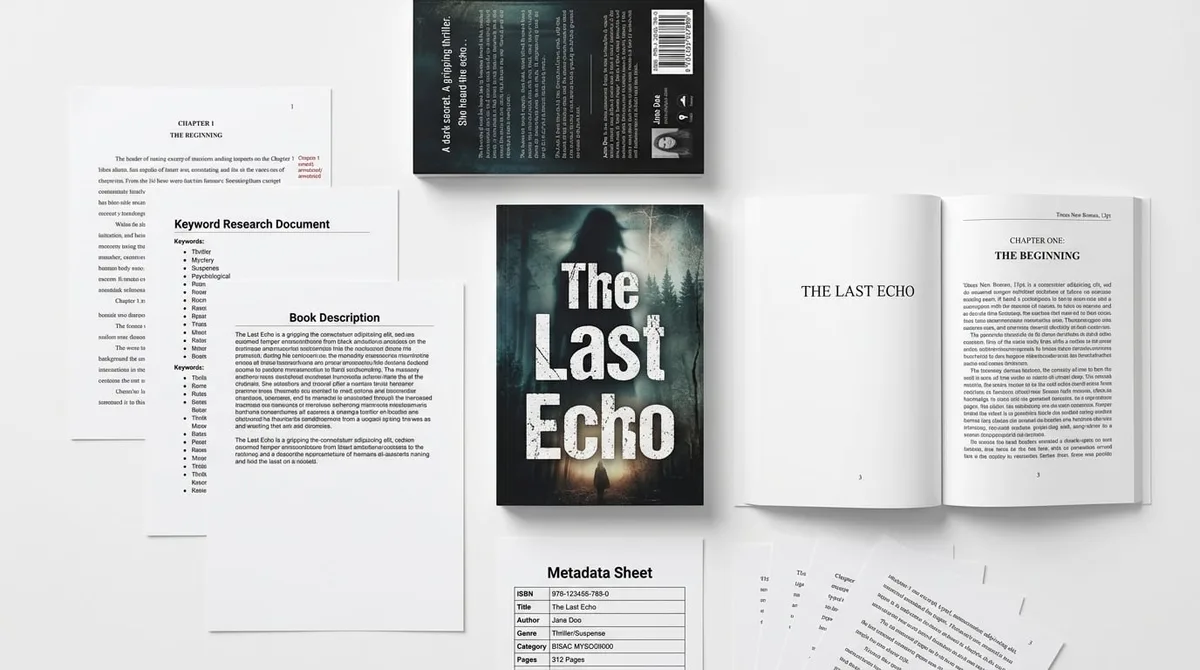
AI Book Generator vs Publishing Studio: Before/After

Skip the theory? Generate a free book preview in about a minute — no signup, no card.
Try it freeA one-click generator can produce a manuscript-shaped object. A publishing studio has to produce a book-shaped product. That is the real ai book generator vs publishing studio difference: not whether AI can create text, but whether the manuscript, cover, interior, metadata, rights notes, and KDP files survive a professional quality-control process before your name goes on the listing.
If a book looks generated, readers usually notice before they read page one: the title feels broad, the cover looks generic, the interior spacing feels off, and the description promises everything to everyone. A designed package does the opposite. It makes one clear promise to one clear buyer, then carries that promise through the book file, cover file, and listing assets.
KDPBuilder’s standard: stop publishing books that look generated; build books that look designed. The workflow uses editing, design, and QA gates instead of treating a bigger prompt as a publishing process. Judge the output in a complete sample package.
The short version: generated assets vs a publish-ready package
Think of this as a before/after comparison, not a tool review. A generic AI book usually starts with a prompt and ends with draft assets: manuscript copy, a cover concept, a rough interior, and guessed metadata. A designed publishing package starts earlier: idea validation, manuscript development, cover direction, interior layout, metadata planning, and files prepared for the final KDP format.
What a generator gives you
A generator is useful when you need speed. It can help with brainstorming, outline scaffolds, chapter prompts, image concepts, subtitle variations, or first-draft copy. For a private draft or early concept test, that can be enough to move.
But a generator is not a publishing decision-maker. It does not know whether your title matches the market, whether the interior flow supports printing, whether a cover reads at thumbnail size, or whether your metadata fits buyer intent. It outputs pieces, not a finished package. If you want to inspect what a gated package looks like, see a complete sample package.
What a publishing studio is responsible for
A publishing studio turns those pieces into a coherent product. The manuscript needs a reader path. The cover has to communicate genre and promise quickly. The interior must match the book type. The metadata has to support the listing instead of being tacked on after the book is done. Final files must account for KDP trim, bleed, margin, and cover-size requirements, which vary by trim size, page count, ink type, and paper type.
That is why KDPBuilder’s workflow uses editing, design, and QA gates instead of a one-step prompt. For a side-by-side view of how the workflow differs from lighter tools, compare publishing tools.
Before: what a generic AI book usually looks like
The before state usually has the same pattern: a generic title, a flat premise, repetitive chapters, inconsistent reader promise, vague audience targeting, and no market positioning. The book may technically exist, but it does not feel built for a specific buyer.
This is especially visible in categories where shortcuts are easy to spot. AI cookbooks, journals, workbooks, puzzle books, and low-content books often reveal the same problems: thin structure, repeated page logic, filler copy, weak typographic hierarchy, and a visual presentation that looks assembled rather than designed.
An ai cookbook generator may produce recipes quickly, but speed does not prove testing logic, nutritional consistency, ingredient discipline, formatting consistency, or a distinctive angle. A kdp interior generator may create pages, but not necessarily hierarchy, readability, spacing, bleed safety, or a premium print feel.
Real output needs real checks: books in a studio pipeline pass through automated quality gates, including grid and layout QA for puzzles, vision checks for covers, and formatting validation for interiors. Anything that fails is repaired or regenerated before delivery. See gated output quality.
Manuscript tells
- Chapter titles repeat the same idea in different words.
- The opening promise is vague, such as “simple ideas for everyone.”
- Sections drift away from the original topic.
- Examples feel interchangeable instead of specific to the reader.
- Front matter and back matter are thin, generic, or missing.
Cover tells
- The title is readable only at full size, not in a search-results thumbnail.
- The imagery looks generic, mismatched to genre, or disconnected from the promise.
- Typography has no hierarchy, so subtitle, author name, and title compete.
- The cover does not signal who the book is for.
Interior tells
- Heading styles change from page to page.
- Margins feel cramped or uneven.
- Tables, callouts, worksheets, or images break the page flow.
- Pages look like a raw export instead of a print-ready layout.
Metadata tells
- The subtitle does not match the book’s actual promise.
- Keywords are broad instead of category-specific.
- The description reads like a summary, not a sales argument.
- The category choice does not match buyer intent.
If you want a fuller diagnostic list, read Why AI Books Look Generated: 12 Cheap Tells.
After: what changes in a designed publishing package
The “after” is not just cleaner text. It is a coordinated package built around the buyer, niche, promise, and format. The manuscript, cover, interior, and metadata all support the same outcome instead of competing with one another.
Manuscript before/after
Before: The outline is loose, chapters wander, and the reader outcome is unclear. The book may contain enough words, but not enough progression.
After: The outline is tighter, chapter progression is intentional, filler sections are removed, and the front and back matter do real work. Every section answers: what does the reader know, do, or use next?
Use a three-pass outline repair before layout begins: 1) identify the buyer’s main question, 2) group related ideas into a clean sequence, and 3) remove any chapter that does not advance the promise.
Cover before/after
Before: The cover uses generic imagery and weak typography, which makes it blend into the category or look machine-made.
After: The cover uses market-aware genre cues, readable typography, visual hierarchy, and thumbnail testing. It communicates the category at a glance without looking like a generic AI image.
A strong cover is not just attractive. It is legible in search results, consistent with the promise, and built for the trim size you actually intend to publish.
Interior before/after
Before: The pages are technically present but not comfortable to read. Heading levels may be inconsistent, spacing may be cramped, and the file may ignore print layout rules.
After: The interior has consistent headings, margins, and page flow. Depending on the format, it may include callouts, tables, recipe cards, workbook sections, puzzle grids, or image placement that helps the reader instead of interrupting them.
This is where the difference between a raw export and a designed file becomes obvious. Good formatting does not call attention to itself; it makes the content easier to use.
Metadata before/after
Before: The title, subtitle, keywords, and description are assembled after the manuscript is done, so they do not always match the market.
After: Title/subtitle alignment is deliberate, keyword targeting fits the niche, category choice matches the reader, and the description is structured around benefits instead of vague summary language.
Insider pro-tip: Before you approve a final package, read the subtitle and the first paragraph of the description out loud together. If they do not make one clear promise in 10 seconds, the package is not aligned yet.
See the complete sample package before you decide whether a raw generator output is close enough.
AI book generator vs publishing studio: quality-control checklist
In the generic AI book vs professional package comparison, the question is not whether AI can produce words. The question is whether the output survives a quality-control process that makes it fit for publishing under your name.
| Area | Cheap generator | Publishing studio |
|---|---|---|
| Strategy | Idea-first, often broad | Buyer-first, niche-specific |
| Outline | Prompt-based scaffold | Structured progression tied to reader outcome |
| Manuscript | Draft text with repetition risk | Edited narrative flow and section balance |
| Originality review | Usually minimal | Rights, reuse, and overlap checks |
| Cover | Basic visual output | Genre-aware direction, typography, and hierarchy |
| Interior | Pages generated, formatting variable | Print-ready layout with margin and spacing control |
| Metadata | Guessed or generic | Aligned to title, category, and search intent |
| KDP compliance | Often left to the user | Built into the workflow |
| File preparation | May require rework | Prepared to KDP trim, bleed, and cover-size specs |
| Launch readiness | Draft stage | Publish-ready package |
Generators are useful for ideation or rough drafts. They are not the same as a publishing process. KDPBuilder uses AI inside a controlled workflow rather than selling a one-click output, because a publishable result depends on decisions, checks, and layout discipline, not just generation speed.
Where generators are useful
- Testing topic angles before you commit to a niche.
- Creating an initial chapter outline.
- Drafting alternate blurbs, titles, or subtitle options.
- Producing a rough concept for a cover brief.
Where generators fail
- They rarely evaluate market positioning.
- They do not reliably build a reader journey across the manuscript.
- They can miss print layout requirements.
- They often leave metadata too generic to be useful.
Where studio process adds value
- It checks whether the book matches a real buyer need.
- It aligns the manuscript, cover, and listing language.
- It documents rights, reuse, and file provenance.
- It prepares files for KDP formatting requirements before upload.
If you are trying to decide whether a rough draft is enough or whether the package needs a quality pass, compare publishing tools against the checklist above.
KDP compliance: AI-generated content and disclosure
Amazon KDP does not ban AI-generated books by default. Publishers are still responsible for rights, quality, and accurate disclosure. That is why compliance belongs inside the package workflow, not as a rushed checkbox at upload.
KDP’s AI-generated content disclosure asks publishers to identify AI-generated text, images, or translations during setup. Amazon distinguishes AI-generated content from AI-assisted content, but the practical requirement is the same for the publisher: know what was generated, what was edited, what was licensed, and what you are representing to readers. Always verify the current rule in Amazon KDP Help before publishing.
What must be disclosed
If the book includes AI-generated text, images, or translations, that usage may need to be disclosed in KDP setup according to Amazon’s current definitions. The goal is accuracy, not decoration. AI-assisted content may be treated differently, but the publisher still has to answer for the final result.
What a studio should document
- Where the manuscript came from and how it was revised.
- Whether any images were AI-generated or licensed.
- Whether the interior files were created from original templates or generated assets.
- Which metadata claims were verified before upload.
- Which final files were delivered for paperback, hardcover, ebook, or other formats.
What disclosure does not fix
Disclosure does not repair weak content, poor layout, or misleading packaging. A book can be disclosed and still be unready if the rights review is incomplete, the images are unprovenanced, or the interior files fail trim and bleed expectations.
Compliance also intersects with pricing and distribution. For paperbacks sold through Amazon marketplaces, KDP’s standard royalty is generally 60% of list price minus printing costs; Expanded Distribution is generally 40% minus printing costs. That is a format and channel issue, not a quality guarantee, so the package still has to justify itself visually and structurally.
Cost comparison: cheap generator, lifetime deal, or studio?
Most buyers are not asking whether AI is possible. They are asking whether the output is good enough to publish under their name. That is a total-cost-of-ownership question, not just a software question.
Searches like “book bolt free alternative” and “ai image recipe book lifetime deal” show budget sensitivity, but the cheapest option is not always the lowest-cost option once you count revision time, cover redesign, formatting fixes, compliance review, and the hours spent rebuilding a weak package.
When a cheap tool is enough
- You only need a topic brainstorm.
- You are testing audience demand with a rough outline.
- You are building a private draft, not a public release.
- You already have design, editing, and KDP formatting skills to finish the package yourself.
When a studio is the safer choice
- The book will be sold publicly under your brand.
- The format depends on print layout, recipes, tables, puzzles, images, or structured pages.
- You want the manuscript, cover, and metadata to work together.
- You need files prepared to KDP trim, bleed, margin, and cover-size requirements.
What you are really paying for
You are paying for decisions: how the book is structured, how the cover signals the category, how the interior reads on paper, how the metadata matches the promise, and how the files are packaged for upload. A studio is not a premium version of the same prompt. It is a different process.
Use KDPBuilder Pricing to compare the workflow against the amount of rework a weak package usually creates.
What to look for before you publish
Before upload, run a short pre-publish audit. This is the fastest way to separate a polished package from something that still looks generated.
The 10-minute quality audit
- Thumbnail test: Shrink the cover to search-result size and confirm the title still reads clearly.
- First 10 pages test: Check whether the opening pages establish the promise quickly.
- Print preview: Review page breaks, widows, spacing, image placement, margins, and bleed.
- Description test: Read the description and confirm it matches the book’s actual outcome.
- Reader promise test: Ask whether a buyer can tell who the book is for in one sentence.
- AI disclosure check: Confirm whether any AI-generated text, images, or translations need disclosure.
- File-name check: Make sure the final manuscript, cover, and metadata files are clearly labeled before upload.
Common mistakes to avoid
- Publishing before the subtitle and description make the same promise.
- Using a cover concept that looks good large but fails at thumbnail size.
- Letting headings, spacing, or images vary from section to section.
- Choosing broad keywords instead of buyer-specific phrases.
- Assuming disclosure replaces quality control.
- Skipping print preview, then discovering trim, bleed, or spacing issues after upload.
The publish-ready standard
Use a simple 1-to-5 score before you publish:
- Manuscript: 1 means scattered draft; 5 means clear progression and strong reader outcome.
- Cover: 1 means generic or unreadable; 5 means genre-aware and thumbnail-safe.
- Interior: 1 means raw export; 5 means print-ready layout with consistent spacing.
- Metadata: 1 means vague and mismatched; 5 means aligned and targeted.
- Compliance: 1 means uncertain; 5 means documented and verified.
If any category scores below 4, the package is probably not ready. Start with the sample package, then compare your options, then check whether the pricing makes more sense than rebuilding the book after upload.
FAQ
What is the difference between an ai book generator vs publishing studio?
An ai book generator usually produces draft assets: text, images, or layout suggestions based on prompts. A publishing studio develops those assets into a coordinated book package with strategy, structure, design direction, metadata, QA, and KDP-ready files.
What does a generic AI book vs professional publishing package look like?
A generic AI book often has a flat premise, repetitive chapters, weak cover hierarchy, and rough formatting. A professional package has a clear reader promise, a stronger outline, readable design, better metadata fit, and files prepared for the actual trim and print requirements.
Does Amazon KDP allow AI-written books?
Amazon KDP does not ban AI-generated books by default. The publisher is responsible for rights, quality, and any required disclosure of AI-generated text, images, or translations during setup.
How does Amazon KDP AI content disclosure affect my book package?
If AI-generated content was used, disclosure becomes part of the packaging workflow. You should know what was generated, what was edited, what was licensed, and what needs to be reported before upload.
Can a kdp interior generator create a professional print-ready book?
It can create pages, but not always a professional print-ready book. Print-ready files need controlled margins, bleed safety, spacing, hierarchy, and layout choices that match the specific book type.
Is an ai cookbook generator enough for an Amazon KDP cookbook?
Usually not on its own. A cookbook needs testing logic, consistent formatting, distinctive positioning, and an interior that supports recipes clearly, so a generator is only the starting point, not the finished package.
Next step: If you want to see the workflow before you commit, try KDPBuilder free with no signup, no card, and 75 free credits. Build a test asset, compare it against the checklist above, and decide whether your book needs draft speed or studio-level packaging.
Turn this idea into a book — free sample
Type a book idea and we'll generate a real cover preview in about a minute. No signup, no card.