AI Book Generator vs AI Publishing Studio

Skip the theory? Generate a free book preview in about a minute — no signup, no card.
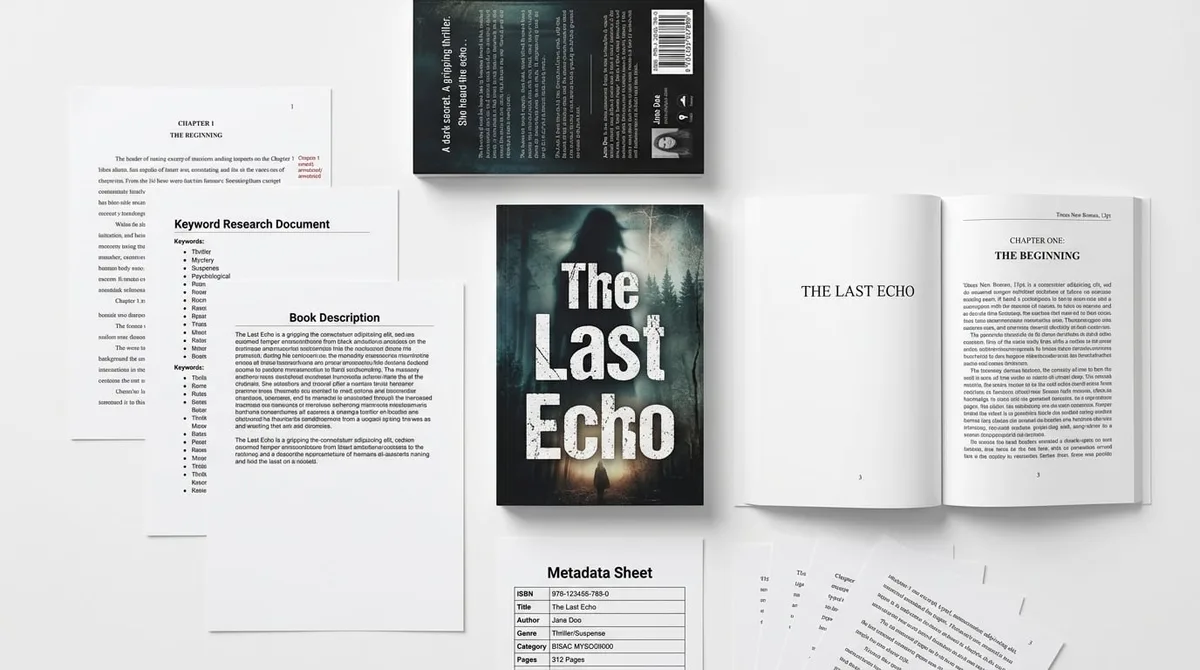
Try it freeAI book generator vs AI publishing studio is not a cosmetic distinction. A generator can give you a draft, a prompt list, or a stack of rough pages. A publishing studio gives you the operating system around the book: concept, manuscript, interior, cover, metadata, production checks, and files prepared for the KDP workflow. If the goal is a retail-ready book that looks intentionally built, the studio model is the stronger path.
AI book generator vs AI publishing studio: the short answer
The simplest way to separate the two is this: a generator produces output; a studio produces a coordinated book package. A generator may create text, worksheets, puzzles, images, or rough book components from prompts. A studio connects those pieces so the final product reads, looks, and exports like a book built for Amazon KDP instead of a document copied from a chat window.
That difference matters because readers do not buy prompts. They judge the title, cover, description, sample pages, layout, and reading experience before they ever care which tool helped you make it. Stop publishing books that look generated. Start building books that look designed.
Generator = output
An AI book generator is useful when you need speed. It can help you produce a chapter outline, a set of journaling prompts, a puzzle concept, a lesson idea, or a first-pass manuscript. But that is still only one layer of the publishing process. The words may exist while the actual product remains unfinished.
Studio = publish-ready system
An AI publishing studio is built around the full workflow: idea selection, niche fit, manuscript planning, interior structure, cover sizing, metadata, and final file export. Instead of asking, “What can this tool write?” the better question is, “Can this workflow help me produce a book that looks credible when a buyer lands on the Amazon page?”
If you want to inspect the difference instead of reading a sales claim, try KDPBuilder Free with no signup and walk through the studio flow yourself.
Where AI book generators usually break down
The common failure pattern is easy to spot: the draft is passable, but the title is generic, the interior has no hierarchy, the cover feels disconnected, and the metadata does not match the book’s actual promise. The tool created content, but it did not create a market-positioned book package.
Product proof: KDPBuilder’s position is simple: stop publishing books that look generated, start building books that look designed. The difference is a studio pipeline with editing, design, and QA gates — not a bigger prompt. Judge the output yourself.
Many tools market themselves as an ai book generator alternative, but still solve only one slice of the job. That is fine if you only need raw content. It is not enough if you need a book package where the manuscript, cover, interior, and listing all support the same promise.
The manuscript is not the product
A manuscript is one asset inside a larger publishing system. On Amazon KDP, the buyer sees a title, subtitle, cover, description, categories, and preview experience before judging the full writing. If those pieces do not align, the book feels unfinished even when the draft text is useful.
One-click output often looks one-click
A plain AI workbook generator can create exercises, but that does not automatically create lesson flow, page hierarchy, answer keys, front matter, or print-ready formatting. The same problem shows up in journals, coloring books, niche nonfiction, activity books, and puzzle books. Fast output is not the same as a product people will trust.
For a practical reference point, see a complete sample package and compare it to a raw generator draft.
The AI publishing platform difference: workflow, not prompts
The real ai publishing platform difference is coordination. A publishing studio is not a prompt box with extra buttons. It is a workflow that links concept, structure, design, formatting, metadata, and export so the book stays consistent from the first idea to the final file.
Here is the practical contrast:
| Prompt-to-text generator | KDPBuilder studio workflow |
|---|---|
| Writes content from a prompt | Builds around niche fit, outline, and production needs |
| May produce isolated assets | Coordinates manuscript, interior, cover, and metadata |
| Leaves formatting decisions to the user | Factors in trim size, page structure, and export logic |
| Useful for speed | Useful for publish-ready consistency |
A studio workflow is built around checkpoints, not guesses. You are not just generating content; you are moving through a sequence that supports commercial publishing.
- Confirm the niche, reader, and use case.
- Build the outline before drafting pages.
- Draft the manuscript with the final format in mind.
- Shape the interior layout for the chosen trim size.
- Check cover dimensions, spine math, and bleed needs.
- Align title, subtitle, description, keywords, and categories with the book’s promise.
- Export files that match the intended KDP submission workflow.
Content strategy
A generator can help you write chapters. A studio helps you decide which chapters belong in the book in the first place. That matters for formats with a clear reader outcome, such as guided journals, workbooks, educational books, devotional studies, and niche nonfiction.
Design system
Design is not decoration added after the manuscript is done. Design includes page hierarchy, spacing, front matter, back matter, section rhythm, and readability. A studio treats these as part of the book, not as cleanup work.
KDP production readiness
If the final goal is KDP, the workflow has to account for file specs, page count, trim size, cover sizing, and printing constraints. A studio brings those constraints into the build process early, which helps prevent the late-stage scramble of redesigning pages after the book is already written.
For a side-by-side workflow review, see Compare Publishing Tools before choosing between isolated apps and a studio pipeline.
Why KDP cover creator tools are not the same as a studio
Searches for a kdp cover creator or amazon kdp cover creator usually come from a real production need: the cover must look good and fit KDP’s file requirements. A cover tool can help with dimensions or design, but it cannot by itself make the cover promise match the manuscript, interior experience, keyword positioning, and reader expectation.
A studio approach connects the subtitle, cover hierarchy, interior page style, and Amazon metadata. That alignment matters because a cover is not just an image file. It is a sales promise.
Product proof: KDPBuilder runs every book through a six-phase studio pipeline — Discovery, Writing, Editing, Design, Covers, Publishing — instead of a single generate-and-dump step. Walk through the pipeline free.
A cover is a sales promise
If the cover says “practical workbook” but the interior reads like a loose text dump, the buyer feels the mismatch. If the subtitle promises a step-by-step plan and the pages are just generic notes, the disconnect damages trust. Strong covers are not only visually polished; they are conceptually accurate.
Cover quality must match interior quality
A polished cover wrapped around a weak interior still produces a weak book. A studio approach reduces that mismatch by treating the exterior and interior as one package. That is why a cover builder alone is not the same as a publishing workflow.
For a deeper comparison, see KDPBuilder vs Canva for KDP: Covers or Full Books.
KDP template generator, book size, and margin checks still matter
Many AI generators ignore production math. Amazon KDP does not. A kdp template generator, kdp book size calculator, and kdp margin calculator are not minor extras when you are building a print book. The same idea can require a different layout depending on trim size, bleed, paper type, and page count.
KDP supports multiple paperback trim sizes, with common options such as 6 x 9 inches and 8.5 x 11 inches. Cover dimensions depend on trim size, page count, paper type, and bleed. That means the file math changes the book itself, not just the final upload step.
Production choices also affect readability. A 6 x 9 workbook has a different feel from an 8.5 x 11 educational book. Black-and-white interiors, standard color, premium color, and bleed or no-bleed layouts all change the page experience and the final cover file requirements.
Trim size changes the book
Trim size is a design decision and a business decision. It changes how much content fits on a page, how large the writing space feels, and how the cover must be built. The same manuscript can require different pagination depending on the chosen trim size.
Margins affect readability and file review
Margins are not just a formatting preference. They affect how easy the book is to read and whether the file is print-friendly. If the gutter is too tight or safe zones are ignored, the interior can feel cramped and may trigger avoidable formatting revisions during file review.
KDPBuilder treats formatting and packaging as part of the creative process, not an afterthought. That is the difference between assembling pages and producing a book.
What a sellable AI-assisted book package should include
Buyers judge the finished product, not the tool used to make it. A sellable AI-assisted book package should include the full set of deliverables below, not just a manuscript draft.
- Manuscript with a clear topic, structure, and reader promise
- Front matter and back matter that support the reading experience
- Formatted interior PDF sized for the chosen KDP trim and print requirements
- Cover file with correct dimensions, bleed, and spine math
- Title and subtitle direction that match the content and market position
- Description that explains the book clearly without overselling
- Keywords and categories aligned with the audience and content
- Launch checklist for final review before upload
The goal is not to hide AI. The goal is to use AI inside a disciplined publishing process so the book looks intentional, consistent, and worth the buyer’s time.
Insider pro-tip: before you export anything, read the cover subtitle, the first interior page, and the product description out loud in one sitting. If they do not tell the same story, the market will feel the mismatch immediately.
For a concrete reference point, see a complete sample package and compare the consistency across cover, interior, and metadata.
When a simple AI book generator is enough
A simple generator can be enough for brainstorming, rough outlines, concept testing, short drafts, and internal projects that do not need a polished retail package. In those cases, speed may matter more than design discipline.
That said, a generator is usually not enough if you want to publish under a brand, run ads, build a catalog, or avoid the generic AI look. That is the point where creators move from draft-making into product-making.
Good for drafts
If you are testing an idea, a generator can help you get to version one quickly. It is useful when you want to explore ten concepts and keep only one. It is also helpful when you need placeholder content before a fuller build.
Risky for commercial publishing
If the plan is to sell the book publicly, publish repeatedly, or build a recognizable brand, the risk increases. A raw generator may save time at the start, but it can create more work during formatting, cover design, metadata writing, disclosure decisions, and final file review.
When you need an AI publishing studio instead
The studio path makes the most sense for creators building activity books, workbooks, guided journals, educational books, coloring books, niche nonfiction, and brand-backed KDP products. In those formats, consistency and presentation are part of the value.
If you are using a coloring book maker or trying to create puzzle books for free, a generator-style entry point may help you start. But a studio is better when final product consistency matters more than fast asset creation.
For KDP sellers
KDP sellers need files that are organized for upload, review, and retail positioning. That means the interior, cover, and metadata all need to support the same market message.
For brand builders
Brand builders need repeatability. A studio helps create a process so each book in the catalog feels like part of the same line instead of a random collection of AI outputs.
For repeatable catalogs
If you plan to publish multiple books, a studio becomes more valuable with every title. Repeatable structure saves time, but only if the template is strong enough to preserve quality across the series.
How KDPBuilder fits between ChatGPT, Book Bolt, and design tools
KDPBuilder is best understood as a studio layer, not just another writing tool, research tool, or cover design app. ChatGPT can help with writing. Design tools can help with visual work. KDPBuilder helps assemble the product so those pieces function as one coherent book package.
For a direct comparison, see KDPBuilder vs ChatGPT for KDP Publishing. If you are comparing workflow tools, you may also find KDPBuilder vs BookBolt: Workflow Comparison helpful.
ChatGPT helps write
Writing assistance is valuable, especially for drafts, prompts, outlines, and brainstorming. But writing alone does not solve sizing, formatting, cover assembly, or file packaging.
Design tools help design
Design tools are useful for covers, page graphics, and layout work. They are strongest when you already know exactly what the book package needs to look like.
A studio assembles the product
A studio is the layer that connects the content to the product. It is where the manuscript, cover, metadata, and file specs become one coordinated publishing package.
Must-remember KDP facts: Amazon KDP paperback royalties are generally 60% of list price minus printing costs for supported Amazon marketplaces, while Expanded Distribution uses a lower royalty rate. KDP also asks publishers to disclose AI-generated content during title setup, and Amazon distinguishes AI-generated content from AI-assisted content that has been substantially edited or reviewed by the publisher. Those rules make process, review, and disclosure part of the publishing decision, not optional extras.
Decision checklist: generator or studio?
Use this checklist before choosing your workflow:
- Do you need only text, or do you need files prepared for KDP upload?
- Do you already have cover sizing, spine width, and bleed handled?
- Have you checked trim size, margins, gutter, and page count?
- Do you have metadata written and aligned to the book’s actual promise?
- Does the book look designed, or does it look assembled from separate outputs?
If you only need rough text, a generator may be enough. If you need a complete retail package, a studio is the better fit.
| If you are trying to... | Better fit | Why it matters |
|---|---|---|
| Test ideas quickly | Generator | Fast output is useful before you commit to a full package |
| Publish a retail book on KDP | Studio | Cover, interior, and metadata need to work together |
| Build a repeatable catalog | Studio | Consistency matters across multiple titles |
| Only need drafting help | Generator | You can handle formatting and packaging separately |
Choose a generator if...
Choose a generator if you are brainstorming, testing concepts, or creating a rough draft for private use. It is also reasonable when you only need a starting point and plan to handle editing, design, formatting, and packaging manually.
Choose a studio if...
Choose a studio if you want a publish-ready workflow, a designed-looking book, and a repeatable process for KDP. That is the right path when presentation, consistency, and file preparation matter as much as the draft itself.
Next step: compare the workflow before you commit. Review the full tool comparison, see a complete sample package, or try KDPBuilder Free with no signup to test the studio experience against your current process.
FAQ
What is the difference between an AI book generator and an AI publishing studio?
An AI book generator creates content or components from prompts, such as text, worksheets, puzzle ideas, or images. An AI publishing studio manages the whole book package: concept, manuscript, cover, interior, metadata, and export-ready files. The first is about output; the second is about publish-ready coordination.
What is the best ai book generator alternative for Amazon KDP sellers?
The best alternative depends on whether you need only drafts or a full publishing workflow. If you are selling on KDP, a studio approach is often stronger because it accounts for formatting, cover sizing, metadata, and file preparation instead of stopping at raw text. Look for tools that support the full package, not just generation.
Can I use a kdp cover creator and an AI writer instead of a publishing studio?
Yes, you can combine separate tools, but then you become the workflow manager. You are responsible for making sure the manuscript, cover, interior, metadata, trim size, and disclosure decisions all line up. A studio reduces the number of disconnected steps by coordinating those pieces in one process.
Why do I still need a kdp template generator or kdp book size calculator?
Because KDP printing depends on measurements, not just content. Trim size, bleed, page count, paper choice, and margins all affect the final file. A calculator or template generator helps you avoid files that look fine on screen but require avoidable production fixes.
Does an AI publishing studio help with KDP metadata and publish-ready files?
Yes. That is one of the main reasons to use a studio instead of only a writing tool. Metadata, file specs, cover sizing, and export-ready formatting are part of the publishing package, and they need to work together if the book is going to feel complete.
Is an ai workbook generator enough to publish a workbook on Amazon KDP?
Sometimes for a draft, but usually not for the final product. A workbook needs structure, page flow, front matter, answer keys when relevant, and print-ready formatting. If you want the workbook to look professional, a studio workflow is the safer choice.
If you want to test the pipeline without commitment, try KDPBuilder Free with no signup. If you want proof before you decide, see a complete sample package and judge the output against your current workflow.
Turn this idea into a book — free sample
Type a book idea and we'll generate a real cover preview in about a minute. No signup, no card.