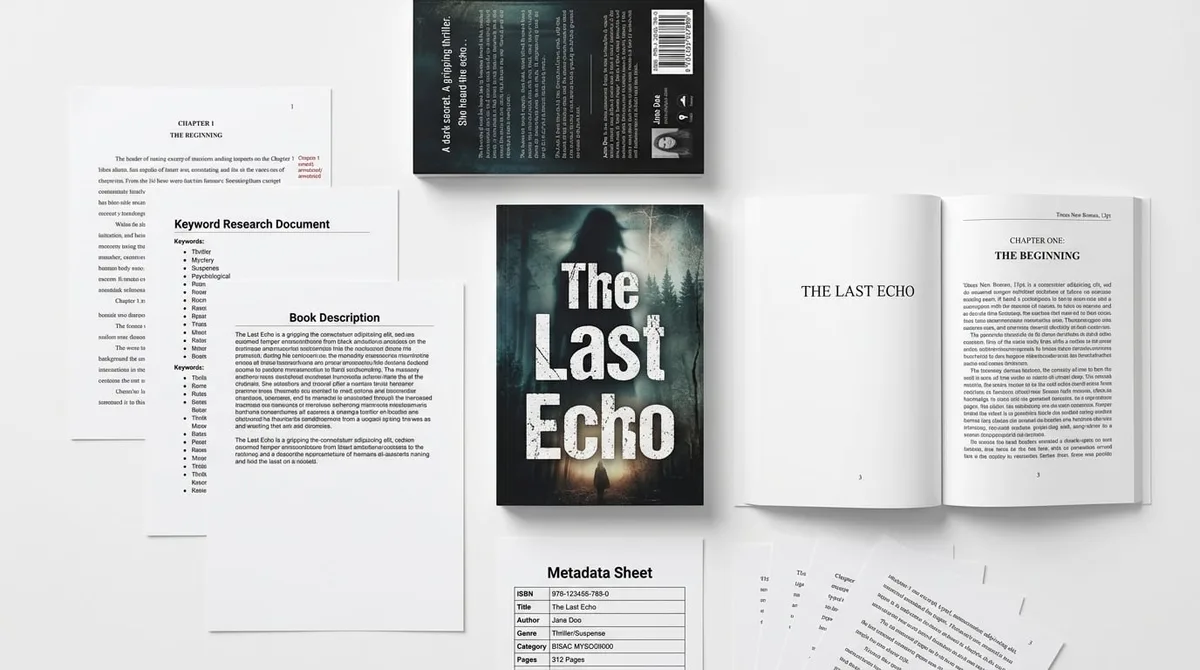
KDPBuilder vs ChatGPT for KDP Publishing

Skip the theory? Generate a free book preview in about a minute — no signup, no card.
Try it freeKDPBuilder vs ChatGPT is the wrong comparison if you only ask, ‘Which one writes faster?’ ChatGPT can help you think, draft, rewrite, and test angles. KDPBuilder is built for the part many DIY publishers underestimate: turning an idea into a coordinated KDP package with manuscript, cover, interior, metadata, and upload-ready files.
The practical question is not whether ChatGPT is useful. It is. The question is whether you want to be the writer, editor, formatter, cover coordinator, metadata strategist, and final QA manager yourself. If you do, ChatGPT can be a low-cost drafting engine. If you want the book assembled through a publishing workflow instead of a pile of disconnected prompts and files, KDPBuilder is the stronger BOFU choice.
Quick verdict: KDPBuilder vs ChatGPT
Use ChatGPT when the work is mainly language: ideation, outlines, rough chapters, rewrites, blurbs, and prompt-driven testing. Use KDPBuilder when the deliverable needs to be a complete book package prepared for Kindle Direct Publishing: manuscript, cover, interior, ebook file, metadata, and final production assets.
| Area | ChatGPT | KDPBuilder |
|---|---|---|
| Idea development | Strong for niche ideas, title angles, and chapter planning | Organizes the idea into a publishing workflow |
| Manuscript creation | Strong for drafting, expanding, and rewriting text | Moves the manuscript through a six-phase studio pipeline |
| Cover | Can suggest concepts, back-cover copy, and hierarchy notes | Includes a full-wrap cover in the publishing package |
| Interior | No built-in print-ready interior production | Includes print-ready interior PDF support |
| Metadata | Can draft descriptions, keyword ideas, and blurbs | Builds metadata into the full book package |
| KDP files | You still assemble, check, and upload them | Prepared as upload-ready publishing files |
| QA | You must check facts, formatting, originality, and compliance | Studio workflow is built around production review |
| Cost | Low entry cost, higher hands-on time | Higher upfront service value for finished output |
| Control | High control if you enjoy prompting and editing | High consistency if you want guided execution |
| Speed | Fast for drafting; slower for full production | Faster path to a complete package when you want less tinkering |
Best choice by user type
Choose ChatGPT if you are comfortable acting as writer, editor, formatter, designer, production manager, and final reviewer. That can work well for publishers who like to test ideas, iterate on prompts, and manage every file themselves. Choose KDPBuilder if you want the publishing work organized into one studio process instead of stitching together separate tools. If you want to compare the workflow tradeoffs before you commit, review the Compare Publishing Tools page alongside this guide.
Where both tools can work together
The strongest workflow for many publishers is not either/or. Use ChatGPT for the raw thinking, then use KDPBuilder for the production-grade package. For example, ChatGPT can help you draft a 12-chapter outline, test three subtitle directions, and tighten a rough book description. KDPBuilder can then turn the selected concept into a manuscript, cover, interior, metadata sheet, and upload-ready files. That pairing keeps the flexibility of AI drafting while reducing the late-stage production gaps that often make DIY books look unfinished.
What ChatGPT for KDP books does well
ChatGPT is excellent for the parts of publishing that begin with language. It can brainstorm niche ideas, generate title variations, build chapter outlines, draft blurbs, suggest keyword phrases, and produce editing passes that help a rough manuscript become readable. For a DIY publisher, it is a practical starting tool.
It works best when the operator brings constraints. A vague prompt like ‘write a book about budgeting’ usually leads to generic advice. A tighter prompt such as ‘create a 7-chapter beginner guide for first-time freelancers with one client-payment example per chapter and a friendly but direct tone’ gives you a more useful draft. The difference is not magic. It is editorial direction.
ChatGPT can also support planning. You can ask it to compare audiences, organize chapter logic, draft a book description, or refine tone for a niche. But the publisher still owns fact-checking, originality review, formatting, design direction, AI-content disclosure, and the final KDP upload decision. That division of labor matters because publishing success depends on more than readable paragraphs.
Good use cases for DIY publishers
ChatGPT is a strong fit for specific tasks:
- Brainstorm 10 niche angles for a low-content, activity, journal, or nonfiction book.
- Draft 3 title and subtitle combinations with different reader promises.
- Create a chapter outline with 5 to 12 sections.
- Rewrite a description into a clearer sales paragraph.
- Generate ad copy variants for testing.
- Improve a rough manuscript section by section.
- Create a revision checklist for repeated phrases, thin examples, and inconsistent tone.
If you already know how to format interiors, build a cover, check KDP specifications, and handle metadata, ChatGPT can save time without replacing your judgment.
Where human editing still matters
Human editing still matters in three places: accuracy, differentiation, and consistency. Accuracy means checking claims and making sure nothing is invented or misleading. Differentiation means making sure the book sounds like it belongs to a real niche, not like a generic AI draft. Consistency means making sure headings, chapter tone, terminology, and examples match from start to finish.
Practical manuscript checklist:
- Verify every factual claim before publishing.
- Read the full manuscript aloud for repeated sentence patterns.
- Check that chapter length and tone are consistent.
- Require every chapter to include at least one concrete example, decision rule, checklist, or worksheet-style step.
- Make sure the book description matches the actual content.
- Review for AI-like filler, broad advice, and vague generalities.
- Confirm whether your content must be disclosed as AI-generated or AI-assisted during KDP title setup.
ChatGPT book publishing limitations sellers discover late
The biggest limitation is simple: ChatGPT can produce text, but it does not automatically deliver a professionally designed cover, a print-ready interior, or a polished metadata package. Many first-time publishers discover this only after the manuscript feels ‘done.’ At that stage, the project still needs visual design, formatting, file preparation, metadata positioning, and quality control before it belongs in a KDP upload workflow.
Verified product fact: KDPBuilder runs every book through a six-phase studio pipeline — Discovery, Writing, Editing, Design, Covers, Publishing — instead of a single generate-and-dump step. Walk through the pipeline free.
Other late-stage problems are just as common: generic tone, thin differentiation, inconsistent formatting, unverified claims, weak positioning, and books that look generated rather than designed. None of those issues are solved by better wording alone. A book can be readable and still fail to feel like a credible product.
ChatGPT can explain KDP requirements, but explanation is not production judgment. It can tell you what bleed means or why a subtitle matters, but it does not coordinate your cover hierarchy, interior spacing, page count, spine, metadata, and reader promise as one product. That is why the safer comparison is not ‘Which tool writes better?’ but ‘Which workflow gets the book closer to a professional upload package?’
Stop publishing books that look generated. Start building books that look designed.
Generic content risk
When publishers rely on text generation without a strong editorial pass, the result often feels interchangeable. That happens when the manuscript repeats broad advice, uses the same sentence pattern too often, or lacks a clear reader promise. A generic book may be technically complete, but it still gives readers no reason to choose it over the next listing.
A useful safeguard is to require every chapter to include one concrete example, one step, or one decision rule. For a budgeting book, that means replacing ‘track your expenses regularly’ with a weekly 15-minute review method, sample categories, and a rule for what to cut first. Specificity is what separates a manuscript from filler.
Formatting and production gaps
Formatting is where many DIY projects slow down. You still need to manage headings, page breaks, margins, trim size, bleed, and page count. For print books, cover dimensions depend on trim size, page count, paper type, and bleed. Bleed typically adds 0.125 inches, and spine text is only supported for books with at least 79 pages. Those details affect the final file, not just the preview.
If the formatting is off, a book can look amateur even when the writing is solid. That is the difference between generating content and producing a product.
At this stage, many DIY publishers realize they need more than prompts. If you want to see what the finished output actually includes, see a Complete Sample Package and compare it against the files you would otherwise have to assemble one by one.
Metadata without market positioning
ChatGPT can draft a description and brainstorm keywords, but metadata still needs positioning. A decent description explains the book; stronger metadata signals who it is for, what problem it solves, and why it belongs in a specific category or niche. If the metadata is too broad, your listing can sound like every other AI-assisted book in the category.
Use the title, subtitle, description, and keywords as one system, not separate tasks. If your current process is producing decent text but weak packaging, the next step is usually not more prompting. It is a tighter publishing workflow and a clear plan for the upload assets, which is exactly where KDPBuilder Pricing becomes relevant.
Where KDPBuilder fits among KDP tools
Most KDP tools solve one slice of the workflow. One tool helps with covers, another with keywords, another with formatting, another with calculators. KDPBuilder is built around the full package instead of one isolated task. That matters because publishing is not a one-step problem.
KDPBuilder is not just an AI book maker. It is positioned as a publishing studio for idea, manuscript, cover, interior, metadata, and upload-ready files. The difference is bigger than software. A tool generates an asset. A studio workflow assembles assets into a coherent book product that looks intentionally built.
That studio approach reduces the number of handoffs you have to manage. Instead of moving from prompt to draft to formatting tool to cover tool to upload checklist, you can treat the book as one coordinated deliverable. If you want a no-pressure way to see the workflow in practice, you can Try KDPBuilder Free (no signup) before deciding whether to move forward.
Studio workflow versus single-purpose generators
Single-purpose generators can be useful, but they rarely solve the whole publishing problem. A cover generator may create a graphic, but it may not align with the interior or metadata. A text generator may create chapters, but it may not reflect the final book design or production constraints.
A studio workflow starts with the end product in mind. That means the manuscript, cover, interior layout, and metadata are developed with the same launch goal instead of being assembled from disconnected outputs.
Verified product fact: A KDPBuilder publishing package includes the print-ready interior PDF, full-wrap cover (front, spine, back) at 300 DPI, ebook file, and a metadata sheet with title, subtitle, description, 7 keywords, and category picks — the upload assets publishers commonly need when preparing a KDP title. See what is in a publishing package.
What a complete KDP package should include
A complete package should include at least these five parts:
- A manuscript that is edited and organized for the target reader.
- A cover concept and final cover file sized for the chosen format.
- An interior layout that matches trim size, bleed, and page count.
- Metadata that supports the title, subtitle, description, keywords, and category direction.
- Files prepared for KDP upload with final checks completed.
See a Complete Sample Package to understand how those pieces fit together in practice.
KDP design needs more than a kdp cover calculator
A kdp cover calculator, kdp calculator, or book cover size calculator is useful, but it solves only a math problem. It can help you determine dimensions, spine width, page count logic, and bleed. That is necessary, but it is not enough to make a book cover compelling.
ChatGPT can help at the concept stage. It can describe cover requirements, suggest imagery directions, or propose text hierarchy. But it does not own the final production-ready design workflow. It does not place the art, set the spine correctly, align the typography, or ensure the final file matches the rest of the package.
The real issue is product quality. If the cover, interior, and metadata are created separately without a shared standard, the book can look pieced together. KDPBuilder’s studio package is designed to account for cover sizing, interior layout, metadata, and design consistency before upload.
What a kdp cover calculator can and cannot solve
A calculator can answer ‘What size should this file be?’ It cannot answer ‘Does this cover look credible for this niche?’ or ‘Does the typography fit the promise of the book?’
That is why calculators are step one, not the full solution. They prevent technical mistakes, but they do not create market-ready design.
Why book cover size calculator math is only step one
Once you know the size, you still need to build the actual design system around it. That means choosing readable type, checking image safety zones, matching spine thickness correctly, and making sure the front, back, and spine work as one unit. If the interior page count changes, the cover often needs to change too.
This is where many DIY projects lose time: the math is correct, but the design still needs a second pass.
KDP design as a product quality problem
Design is not decoration. It is part of the product. If the cover looks generic, the interior looks default, or the metadata sounds off-topic, the whole book feels less credible. That is why the better comparison is not just ‘Can ChatGPT help?’ but ‘Can the workflow produce a book that looks designed instead of assembled from random outputs?’
Insider pro-tip: Before you upload anything to KDP, print one test copy or review a full-size proof PDF at 100% zoom. Most layout, spine, and spacing issues are easier to catch on a real page than in a thumbnail preview.
Cost, control, and speed: DIY prompting vs studio workflow
ChatGPT is inexpensive to start, but the visible price is not the full cost. The hidden cost is your time: prompt drafting, revision cycles, formatting cleanup, cover coordination, file conversion, metadata refinement, and final QA. If you enjoy those tasks, DIY can be a good fit. If you want to shorten the path from idea to finished book, the lower sticker price may not be the lower total cost.
KDPBuilder should be framed as a higher-leverage option for publishers who value finished output over tinkering. That does not mean it is always cheaper. It means the value comes from reducing production friction and helping the project arrive as a coherent package rather than a stack of separate files.
The real tradeoff is not just money versus software. It is control versus convenience, and drafting speed versus production completeness.
The hidden cost of DIY
DIY publishers often underestimate the number of small decisions required to finish a book. A single manuscript may need multiple prompt rounds, line edits, heading cleanup, cover sizing, file conversion, pricing checks, and upload checks. Each step is manageable, but together they create a long production chain.
If one step goes wrong, the time savings from ChatGPT can disappear into revisions.
When control matters more than convenience
Choose DIY when you want to make every editorial and design decision yourself. That is useful if you have a strong publishing process, enjoy full control, and are willing to manage the technical details. Some publishers prefer that level of hands-on oversight because it lets them fine-tune every page and phrase.
Just remember that control also means responsibility for every check.
When paying for a studio makes sense
Paying for a studio makes sense when the objective is to move from concept to complete book with fewer production gaps. If you want a manuscript, cover, interior, metadata, and files assembled in one workflow, a studio approach can be more efficient than stitching together multiple tools. If you want to compare options directly, review KDPBuilder Pricing or Try KDPBuilder Free (no signup).
That is especially useful when speed matters but quality still has to hold up under reader scrutiny.
| Decision factor | ChatGPT | KDPBuilder |
|---|---|---|
| Best for | Drafting, rewriting, ideation | Complete KDP package assembly |
| Production support | You manage the rest | Studio pipeline handles the workflow |
| Upload readiness | Manual | Built around upload-ready files |
| Design consistency | Depends on your process | Built into the package |
Decision checklist: use ChatGPT, KDPBuilder, or both
Use this checklist to decide whether ChatGPT, KDPBuilder, or a combination makes the most sense for your next KDP book.
Choose ChatGPT when...
- You want a drafting assistant for outlines, chapters, blurbs, or rewrites.
- You enjoy editing and can spot weak phrasing, repetition, and generic sections.
- You already know how to handle cover design and interior formatting separately.
- You are comfortable checking KDP requirements and making upload decisions yourself.
Choose KDPBuilder when...
- You want a complete package instead of isolated prompts and files.
- You need the manuscript, cover, interior, metadata, and KDP-ready files to work together.
- You want less guesswork around production, design consistency, and final QA.
- You care more about a finished, coherent book product than tinkering with each step.
Use both when...
- You want to brainstorm with ChatGPT first.
- You want to validate a topic, outline, or title before moving forward.
- You want to turn the best draft into a studio-built book package.
- You want the flexibility of DIY ideation plus the structure of a publishing workflow.
Step-by-step decision path:
- Use ChatGPT to test the idea with an outline and chapter map.
- Check whether the topic has enough differentiation for a real book.
- Draft or refine the reader promise, title, subtitle, and description together.
- Decide whether you can personally handle cover, interior, metadata, file checks, and upload prep.
- If not, move to KDPBuilder for the full production package.
- Before publishing, review KDP AI-content disclosure and upload requirements.
One important compliance note: Amazon KDP requires publishers to disclose AI-generated text, images, or translations during title setup. AI-assisted content that is substantially created or edited by a human is treated differently from AI-generated content. For eBooks, royalties are generally 35% or 70%, and the 70% option has eligibility requirements, including supported territories and typical list-price limits of $2.99 to $9.99. For print books, cover dimensions depend on trim size, page count, paper type, and bleed; bleed typically adds 0.125 inches, and spine text is only supported for books with at least 79 pages. Those are publishing details, not optional extras.
If you are comparing workflows side by side, inspect a sample package, review pricing, or test the free workflow before you commit. If you are ready to choose a path, start with KDPBuilder Pricing for plan details and then register if the studio workflow fits how you publish.
FAQ
Is KDPBuilder better than ChatGPT for KDP publishing?
It depends on what you need. ChatGPT is better for brainstorming, drafting, rewriting, and testing ideas quickly. KDPBuilder is better when you want a complete KDP publishing package with manuscript, cover, interior, metadata, and upload-ready files assembled as one workflow.
Can I use ChatGPT for KDP books without violating Amazon rules?
Yes, you can use ChatGPT as part of your publishing process, but you must follow Amazon KDP’s AI-content disclosure rules during title setup. AI-generated text, images, or translations must be disclosed, and AI-assisted content that is substantially created or edited by a human is treated differently from fully AI-generated content. Do not publish unedited AI output or skip disclosure.
What are the biggest ChatGPT book publishing limitations?
The biggest limitations are production-related. ChatGPT does not automatically give you a professional cover, a print-ready interior, or a polished metadata package. It also does not replace your responsibility for fact-checking, formatting, design decisions, compliance, and final QA.
Do I still need a kdp cover calculator or book cover size calculator?
Yes, if you are handling production yourself, calculators are still useful for dimensions, spine width, page count, and bleed. But they only solve the technical sizing part. They do not create the concept, typography, or layout quality that makes a cover feel designed.
Does ChatGPT include a kdp calculator for royalties and print cost?
No, ChatGPT does not include a built-in KDP calculator. You can ask it to explain royalty structures or walk through examples, but you still need to use KDP’s own tools or your own calculations for pricing and print cost decisions. For eBooks, remember that the 70% royalty tier has eligibility rules and price limits.
Is KDPBuilder just an AI book maker?
No. KDPBuilder’s strategic position is publishing studio, not commodity generator. KDPBuilder is meant to package the full book workflow, not just produce raw text. That is the difference between generating words and delivering a book prepared for KDP publishing.
Ready to decide? Review pricing to see what each plan includes, then register if you want the studio workflow to handle the manuscript, cover, interior, metadata, and publishing files as one package. If you want to understand the pipeline first, you can also Try KDPBuilder Free (no signup) and walk through the process before you commit.