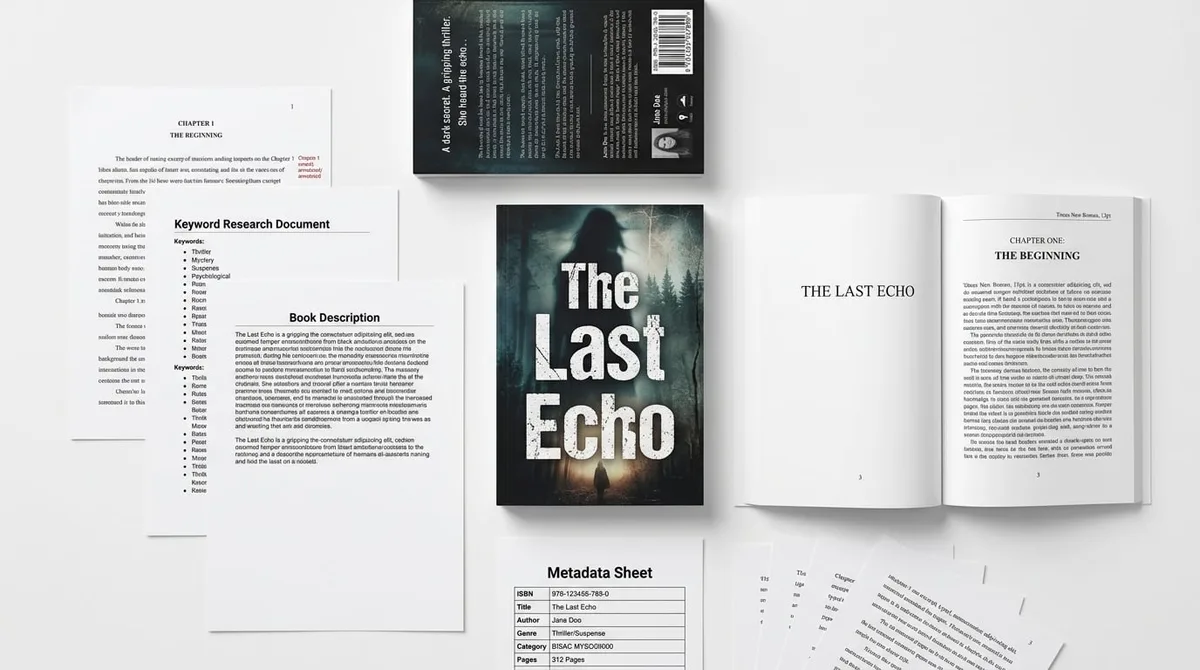
Low Content Books in 2026: What Still Works

Skip the theory? Generate a free book preview in about a minute — no signup, no card.
Try it freeHere is the 2026 reality: low content books are not failing because the format is obsolete. They fail when the book has no job. A plain notebook with a pretty cover is now competing against thousands of similar uploads, free printables, and digital templates. A guided log, puzzle book, workbook, or planner with a precise buyer and a visible outcome still has a reason to exist.
The winners in low content books now look less like uploads and more like small publishing products: a clear use case, a cover that explains the value at thumbnail size, an interior that earns every repeated page, correct KDP files, and pricing that still makes sense after print costs.
Low content books in 2026: the short answer
The short answer is simple: the format still works, but mass-uploaded blank books do not. Amazon KDP has not killed low content books; shoppers have simply become less tolerant of books that look generated, repetitive, or interchangeable.
Low content books are books with repeated, minimal, or templated interiors. That includes journals, planners, trackers, puzzle books, handwriting practice books, sketchbooks, logs, and activity books. The category is broad, but the market now rewards books that feel intentional, useful, and visually finished.
The best mindset for 2026 is this: stop publishing books that look generated; start building books that look designed.
What counts as a low content book?
A low content book is usually defined by the amount of reusable structure inside it. Common examples include lined journals, daily planners, meal trackers, budget logs, habit trackers, dot-grid notebooks, crossword collections, sudoku books, handwriting practice books, and activity books with repeated page patterns.
The key detail is not page count alone. A 120-page guided planner can be more valuable than a 200-page blank notebook if the planner helps the buyer complete a task faster, with less friction, and with a clearer result.
Why the old blank-journal strategy stopped working
The old strategy depended on two assumptions: that buyers would accept almost any notebook, and that broad keywords would carry the sale. Neither assumption is reliable now. Buyers browse thumbnails more carefully, compare interiors more quickly, and notice when a book feels like a template with a cover on top.
Blank journals still exist as a product type, but they are the hardest low content books to differentiate. If the only feature is a color swap, quote change, or slightly different cover pattern, the book usually loses to a sharper alternative. The category did not disappear; the bar moved up.
Low content book publishing guide: what still works
A useful 2026 filter is to score each concept on five points: buyer intent, differentiation, production difficulty, repeat purchase potential, and cover-driven appeal. If a concept scores well on all five, it deserves real design work. If it scores low on differentiation and buyer intent, fix the angle before you build the interior.
| Filter | Question to ask | What good looks like |
|---|---|---|
| Buyer intent | Is there a clear reason to buy this now? | A specific outcome, deadline, routine, or gift situation |
| Differentiation | Why this book instead of a generic competitor? | Unique page structure, theme, use case, or difficulty level |
| Production difficulty | Can you make it accurately? | Repeatable pages, clean layout, simple proofing, no filler |
| Repeat purchase potential | Could one buyer need more than one? | Series, seasonal use, professional use, classroom use, or gift sets |
| Cover-driven appeal | Will the cover explain value fast? | Clear niche cues and strong thumbnail readability |
In practice, the strongest 2026 candidates are niche puzzle books, guided planners, specialized logs, educational activity books, structured wellness trackers, handwriting books, music practice books, habit systems, and hobby-specific workbooks. These products work because they offer more than blank space. They create a small system.
Puzzle books often have better defensibility than blank journals because they provide more interior value, a clearer promise, and a stronger preview experience. They also gift well, which matters when the buyer is shopping for someone else rather than for themselves.
For creators building puzzle products, a dedicated workflow helps. A focused Puzzle Book Generator can save time on format decisions, structure, and page repetition without turning the book into a clone of every other puzzle title in the category.
Puzzle interiors are built by dedicated generators — sudoku with verified unique solutions and symmetric givens, crosswords constrained to professional 13×15 grids, mazes rendered as clean line art — then laid out as print-ready PDF spreads with answer keys. Generate a sample puzzle page
Puzzle books
Puzzle books remain one of the better low-content directions because each page has a function. A strong puzzle book is not just more pages; it is a set of pages that match the reader’s attention span, skill level, and preferred puzzle type.
Examples that can work include large-print logic puzzles for seniors, travel puzzle books for adults, themed word searches for a hobby audience, and mixed puzzle collections for a clear age range. A good puzzle book wins on structure, not on volume alone.
Guided logs and trackers
Logs and trackers can still work when they are built around a real routine. A diabetic food log, RV maintenance log, wedding vendor planner, caregiver medication log, or sleep tracker has a clearer use case than a general life tracker with no audience.
The strongest guided logs include enough prompts to reduce blank-page friction, but not so many that the user feels boxed in. If each repeated spread helps the buyer make one better decision, the book feels useful instead of generic.
Educational workbooks
Educational books do well when they match a specific level and outcome. A homeschool multiplication practice book, phonics workbook, handwriting practice set, or music theory drill book gives the buyer a reason to choose it over a blank notebook.
These books work best when the pages are ordered intentionally. A child, parent, or tutor should be able to open the book and know what to do on page one without extra explanation.
Specialized planners
Specialized planners are still viable when they are built for a real schedule, real pressure, or real workflow. A 12-week planner for night-shift nurses preparing for certification exams is stronger than a plain daily planner because the buyer can see themselves in the product immediately.
Specificity is the advantage. The more the planner reflects the user’s calendar, stress points, or milestone, the less it feels like a generic template and the more it feels like a tool.
What is saturated: journals planners KDP reality check
The most saturated formats in low content books are plain lined journals, gratitude journals with no unique structure, password logs, generic to-do lists, basic meal planners, undifferentiated budget planners, and quote notebooks. These categories are not impossible to publish, but they are crowded enough that weak positioning usually loses.
The problem is not the product type itself. The problem is the lack of audience specificity and design quality. Daily planner is a commodity phrase; 12-week planner for night-shift nurses preparing for certification exams is a product with a buyer in mind.
A practical rule helps here: if the book can be described in three generic words, it probably needs a stronger angle before production.
Blank journals
Blank journals are the easiest format to imitate and the hardest to defend. If the interior is just lined or dot-grid pages, the book must win on cover design, trim choice, audience fit, and perceived quality. That is a difficult position unless you have a clearly defined buyer.
Better versions of the same idea add use-case structure, such as travel reflections, faith-based prompts, project notes, field notes, or profession-specific logs. The point is not to abandon journals; it is to make them serve a purpose.
Generic planners
Generic planners fail because they promise organization without revealing the organizing logic. Buyers want to know what the planner helps them accomplish, what time period it covers, and how the pages support the workflow.
When the planner is too broad, the user has to invent the system themselves. That is where a free printable or a digital app often beats the printed book.
Me-too trackers
Trackers become saturated when they repeat the same boxes with no context. A sleep tracker, habit tracker, or mood tracker needs a reason to exist beyond its category label. The stronger version ties the tracker to a goal, condition, or routine.
For example, a hydration tracker for endurance athletes or a medication log for caregivers has more practical value than a simple daily tracker with no use case.
Quote notebooks
Quote notebooks are one of the easiest ways to create a low-value book because the interior contribution is minimal and the message is usually vague. Unless the notebook is tied to a very specific audience or purpose, it tends to feel like a decorative placeholder rather than a product.
When buyers see a quote notebook, they often ask whether a standard journal would do the same job. That is usually a sign the concept needs repositioning.
The 2026 test: does the book solve a real job?
Before production, ask five questions: who is the buyer, what situation are they in, what outcome do they want, what pages help them get there, and why would they choose this over a free printable? If the answers are vague, the book is probably keyword-driven instead of product-driven.
This matters because keyword volume by itself does not create a good book. Search demand without a product reason usually produces commodity books that are easy to copy and hard to defend.
Build the page promise before you build the interior. Every repeated page should earn its place. If a page exists only to increase page count, it weakens the book.
- Buyer: define exactly who the book is for.
- Use case: name the situation or routine the buyer is managing.
- Outcome: state the result the buyer wants after using the book.
- Interior value: match the pages to the outcome, not just the keyword.
- Competition: explain why the buyer would prefer this format over a printable or app.
Examples of strong use-case books include a diabetic food log, homeschool multiplication practice book, RV maintenance log, wedding vendor planner, or large-print maze book for seniors. Each one offers a visible function and an obvious audience.
Insider pro-tip: If you can explain the book in one sentence that includes the buyer, the problem, and the result, you are probably ready to design. If you can only describe the niche keyword, you are not.
Design quality now matters more than niche hacks
Design quality is no longer a finishing touch; it is a competitive advantage. Covers, typography, interior hierarchy, spacing, and paper or ink choices now affect whether a low-content book feels like a product or a placeholder.
A professional low-content book should feel deliberate from the first thumbnail to the last interior page. The book should look designed, not batch-generated. That means readable typography, a clear visual hierarchy, margins that breathe, and a cover that signals the niche instantly.
There is a difference between using KDP Cover Creator for basic layout help and producing a cover that sells the book. The first can help with technical assembly; the second requires genre cues, strong hierarchy, and thumbnail readability. If the title disappears at small size, the cover is not doing its job.
Searchers often compare KDP Cover Creator with a professional cover workflow because they want to know whether a built-in tool is enough. In some cases it is fine for basic formatting, but it will not solve positioning, visual contrast, or market fit. That is why creators still need to think like designers, not just uploaders.
For precise cover setup, an Amazon KDP cover calculator or KDP book size calculator is useful when you need to confirm exact dimensions before exporting the print file. Paperback cover dimensions depend on trim size, page count, paper type, and ink type, so spine width must be calculated from the final print specifications before uploading the cover PDF.
- Make the title readable at thumbnail size.
- Use one clear niche signal instead of several competing ideas.
- Keep the interior clean, aligned, and consistent from page to page.
- Match the cover style to the buyer’s expectation for that format.
- Check that the spine width matches the final page count and paper choice.
If you want to see the difference between a file generator and a publishing workflow, use Try KDPBuilder Free before you build the full book. The no-signup test is useful for checking whether your concept can become a finished cover and interior package, not just a loose idea.
Cover design
A cover for a low-content book should communicate the use case in seconds. For a planner, that may mean a clear time period and audience. For a puzzle book, it may mean the puzzle type, difficulty, or target age. For a logbook, it may mean the activity being tracked.
Good cover design is less about decoration and more about clarity. If the buyer has to guess what the book does, the cover is failing.
Interior hierarchy
Interior hierarchy is the order and emphasis inside the book. A strong planner or workbook uses headings, prompt placement, spacing, and repeat structure to guide the user through the page. A weak one feels like a copy-paste grid with no rhythm.
The best low-content interiors make the next action obvious. That is what turns a template into a tool.
Trim size and bleed
Trim size affects how the book feels in hand, how much content fits per page, and how expensive the book is to print. Bleed matters when pages extend to the edge. If the dimensions are wrong, the book can look amateur before the buyer even opens it.
Choose the trim size early, not after the interior is finished. It changes the layout logic, the cover math, and the proofing process.
Thumbnail readability
Most shoppers see the thumbnail before they see the book. That means the title, subtitle, and core message must survive small-screen viewing. A cluttered cover can hide the entire value proposition.
If the cover only works when it is large, it is not ready for marketplace browsing.
Templates, cover math, and KDP setup mistakes
Many low-content failures come from technical sloppiness: wrong trim size, incorrect margins, unreadable interiors, misaligned covers, poor bleed, and inconsistent page counts. These are not niche problems; they are setup problems.
A KDP template generator can help with dimensions, but it cannot decide whether the book is commercially differentiated. Likewise, useful KDP tools should support publishing decisions, not replace product thinking. The template is the frame, not the strategy.
Use a clean checklist before upload:
- Choose the trim size.
- Confirm the final page count.
- Calculate spine width from the exact print specs.
- Design the cover to the correct template.
- Export a print-ready PDF for both interior and cover.
- Review the proof carefully for margins, bleed, and alignment.
One common mistake is building the interior first and discovering later that the final page count changes the spine. Another is creating a cover from a generic template without checking the final dimensions. Both mistakes can make a book look unprofessional even if the idea itself is good.
KDP low-content books are not eligible for a free KDP ISBN. Publishers can use their own ISBN or publish without one and receive an Amazon ASIN. That matters because the administrative path should be decided before upload, not after the files are ready.
Use a KDP Royalty Calculator before you finalize the book so you can see whether the chosen trim size, ink type, and page count leave enough room for a sensible list price. Pricing should be validated before you invest in a full interior, especially for puzzle books, coloring books, and guided planners.
| Mistake to avoid | Why it causes trouble | Better approach |
|---|---|---|
| Wrong trim size | Breaks layout, cover math, and print fit | Choose size before designing the interior |
| Generic cover template only | Weak positioning and poor thumbnail clarity | Match the cover to the niche and buyer intent |
| Filler pages | Raises page count without adding value | Use fewer pages with a clearer page promise |
| Ignoring spine width | Can create misalignment in the final PDF | Calculate from final specs before export |
| Pricing after design is done | May leave no room for competitive positioning | Check print cost and royalties early |
Pricing and royalties: why cheap books can lose
Low-content publishing is not just about making a book quickly; print cost, page count, ink choice, marketplace, and list price decide the margin. The same concept can work at one price point and fail at another if the print cost leaves no room to price competitively.
For KDP paperbacks sold through Amazon, the standard royalty is 60% of list price minus printing costs; Expanded Distribution uses a 40% royalty rate minus printing costs where eligible. That means the list price is only one side of the equation. The other side is what KDP deducts before the royalty is paid.
This is why high-page planners or color interiors can become difficult to price competitively. More pages or color print usually increases production cost, which can force a higher retail price. If the market for that format does not support the price, the book becomes hard to position.
Before you build a full book, check the economics. A puzzle book with a simple black-and-white interior may be easier to price than a color-heavy activity book. A planner with too many pages may feel premium to make, but the market may not reward it if the category expects a lower price.
| Pricing factor | Effect on the book |
|---|---|
| Page count | Higher page counts usually raise print cost |
| Ink type | Color interiors generally cost more than black-and-white |
| Trim size | Larger formats can change paper usage and cover dimensions |
| Marketplace royalty | Amazon and Expanded Distribution use different royalty rates |
Validate the economics first, then design. That order prevents you from spending time on a product that cannot be priced well enough for its category.
Paperback royalty math
Royalty math should be part of the concept stage, not the last step. If the book’s expected retail price has to be pushed too high just to cover printing, the product may be misaligned with its market.
This is especially important for low-content books because many buyers compare similar items quickly. A book that looks more expensive without delivering more value can be easy to skip.
Black-and-white versus color interiors
Black-and-white interiors are often better for logs, planners, and practice books where color does not add essential value. Color should be used when it genuinely improves the user experience, such as in certain activity books, structured guides, or art-led products.
The goal is not to choose the cheapest production method. The goal is to choose the format that fits the buyer and the economics together.
Page count tradeoffs
Page count is a design decision and a pricing decision at the same time. More pages can make a book feel substantial, but they can also push it beyond what the customer expects to pay.
For many low-content products, a leaner interior with better structure is more competitive than a longer interior with filler pages.
Low content books versus coloring and puzzle books
Puzzle books and coloring books are often grouped with low-content books, but they require more original interior value than blank journals. The buyer is not just purchasing paper; they are purchasing an activity.
A coloring book is a better product when the art style is clear, the audience fit is obvious, the print quality is strong, and the theme is not generic. A puzzle book is a better product when the puzzle mix, difficulty, and user experience are tuned to a specific reader.
For coloring projects, creators searching for an AI coloring book generator, coloring book maker, or coloring book creator still need to care about line quality, theme consistency, and print readability. The tool does not replace the need for original, clean, publish-ready pages.
Coloring and puzzle books are closer to activity products than to blank notebooks. That makes the interior more important and the proofing more demanding.
Puzzle books
Puzzle books work well when they offer structured engagement and a clear solve experience. Word searches, mazes, logic puzzles, and mixed activity packs can all work if the audience and difficulty are chosen deliberately.
A good puzzle book gives the reader enough variation to stay interested while keeping the system simple enough to produce cleanly. For a deeper production walkthrough, see the Puzzle Book Publishing: Complete KDP Guide 2026.
Coloring books
Coloring books can still work when the artwork is coherent and the pages are printable at a clean line weight. The theme should be specific enough that buyers know exactly who the book is for.
A generic coloring book usually struggles, but a tightly themed book for a defined audience can still be a solid low-content product. If you are comparing activity formats, the companion guide on Coloring Book Publishing: Line Art & Print Quality is useful for page clarity and line reproduction.
Activity books
Activity books sit between puzzles and workbooks. They need enough internal structure to keep the buyer engaged while still being simple enough to print and navigate.
They are strongest when the activities support a known age group, skill level, or hobby.
A practical 2026 workflow for better low content books
Use a workflow that treats the book like a product launch, not a file upload. The process should begin with the buyer and end with a proofed, print-ready listing package.
- Validate the buyer, niche, use case, and competing alternatives.
- Design the page promise and at least three sample spreads before building the full interior.
- Price the book using real print costs, page count, ink type, and the expected list price range.
- Produce the cover, interior, answer keys if needed, and print-ready PDF files.
- Publish only after the metadata, preview, cover math, and proof review are ready.
KDPBuilder is best thought of as a publishing studio for idea, manuscript or interior, cover, metadata, and publish-ready files. It is not a cheap generator for flooding KDP with near-duplicate books. That distinction matters in 2026 because the market rewards better products, not more uploads.
The strongest recommendation is straightforward: publish fewer, better low-content books with stronger use cases and better design. A carefully built niche workbook, log, planner, or puzzle book is more defensible than a stack of generic interiors.
Start with a concept that solves a real job, build the pages to support that job, and check the economics before you commit. Then use the right tools to produce a professional result rather than a disposable template.
If your next idea is more than a blank journal with a new cover, take it through a professional workflow before you spend hours polishing the wrong files. Try KDPBuilder Free and test whether your concept can become a finished, print-ready book package.
FAQ
Are low content books still profitable on Amazon KDP in 2026?
They can be, but only when the book solves a real use case and is designed well enough to compete. Profit depends on print cost, list price, trim size, page count, and how differentiated the book is from similar titles. A generic blank journal is far less defensible than a targeted puzzle book or niche planner.
What types of low content books are too saturated now?
Plain lined journals, generic gratitude journals, basic password logs, quote notebooks, and undifferentiated planners are among the most saturated formats. The issue is usually weak audience specificity, not the format alone. If the concept sounds generic in three words, it probably needs a sharper angle.
Is KDP Cover Creator enough for a professional low-content book cover?
It can be enough for basic assembly, but not always for strong market positioning. A professional cover needs clear hierarchy, genre cues, and thumbnail readability. If the cover does not communicate the buyer and use case quickly, a more deliberate workflow is usually better.
Do I need an Amazon KDP cover calculator or KDP book size calculator?
Yes, when you need exact dimensions for spine and bleed. Paperback cover dimensions depend on trim size, page count, paper type, and ink type, so the final print specs should be calculated before the cover PDF is uploaded. Getting this wrong can create alignment and proofing problems.
What is the best KDP template generator for journals and planners?
A template generator is useful for dimensions and formatting, but it is not a complete publishing strategy. The best workflow is one that helps with trim size, margins, spine width, and export settings while still requiring you to make real product decisions. A template cannot decide whether the book is actually differentiated.
Are puzzle books better than journals for low content book publishing?
Often, yes, because puzzle books have more interior value and a clearer buyer promise. That does not make journals useless, but it does make puzzle books easier to defend when the puzzle type, audience, and difficulty are specific. The best choice depends on whether your concept solves a real job better than a blank or lightly structured notebook.
Turn this idea into a book — free sample
Type a book idea and we'll generate a real cover preview in about a minute. No signup, no card.