How to Validate KDP Niche Demand Before You Build

Skip the theory? Generate a free book preview in about a minute — no signup, no card.
Try it freeMost failed KDP projects do not fail at upload. They fail earlier, when the publisher mistakes an interesting topic for a buyable niche. To validate kdp niche demand, collect proof before you build: shoppers use specific buyer-language phrases, comparable books are selling across more than one listing, the review wall is enterable, and the format can still produce a workable royalty after print costs. Start with Amazon autocomplete, BSR patterns, review gaps, price bands, trim/page-count math, and keyword intent. If you want a faster way to clean up the keyword side of that research, run your seed terms through the KDP Keyword Research Tool before you commit to production.
What It Means to Validate a KDP Niche
To validate kdp niche demand means proving that real buyers want a specific book type, not merely that a phrase sounds searchable. A valid niche has three things at the same time: demand, manageable competition, and a production path that leaves room for profit after Amazon printing costs.
This is not the same as spotting a low-competition phrase and jumping straight into a manuscript, cover, or template. A keyword can look easy while the market is too small, too crowded, or too expensive to produce well. KDPBuilder’s standard is simple: do not publish books that look assembled from a template before the market was understood. Validate before you design, write, or upload.
Demand is not the same as curiosity
Curiosity is when a phrase gets searched. Demand is when shoppers repeatedly buy books in that topic, format, and price band. For example, “bird journal” may be interesting, but “birdwatching journal for beginners” signals a clearer buyer use case. The more specific the use case, the easier it is to judge whether the niche is real.
Use three separate tests:
- Demand: Are buyers already searching for and purchasing books in this topic?
- Competition: Is there room to enter without facing a wall of entrenched, high-quality competitors?
- Production feasibility: Can you make the right format at a cost that still works with Amazon pricing?
A niche is valid only if you can make a better book
A valid niche is not just one with traffic. It is a niche where you can improve on existing books in a way buyers will notice: clearer structure, stronger design, more useful prompts, better interior usability, better age fit, or a format that matches the reader’s actual intent. If every competitor already looks polished and complete, your idea needs a specific edge or a different angle.
Validation is the gate before production, not a box to check after you have already built a generic manuscript, cover mockup, or template-based interior. If the niche fails demand, differentiation, or profit, pivot before wasting time on files, metadata, and launch assets.
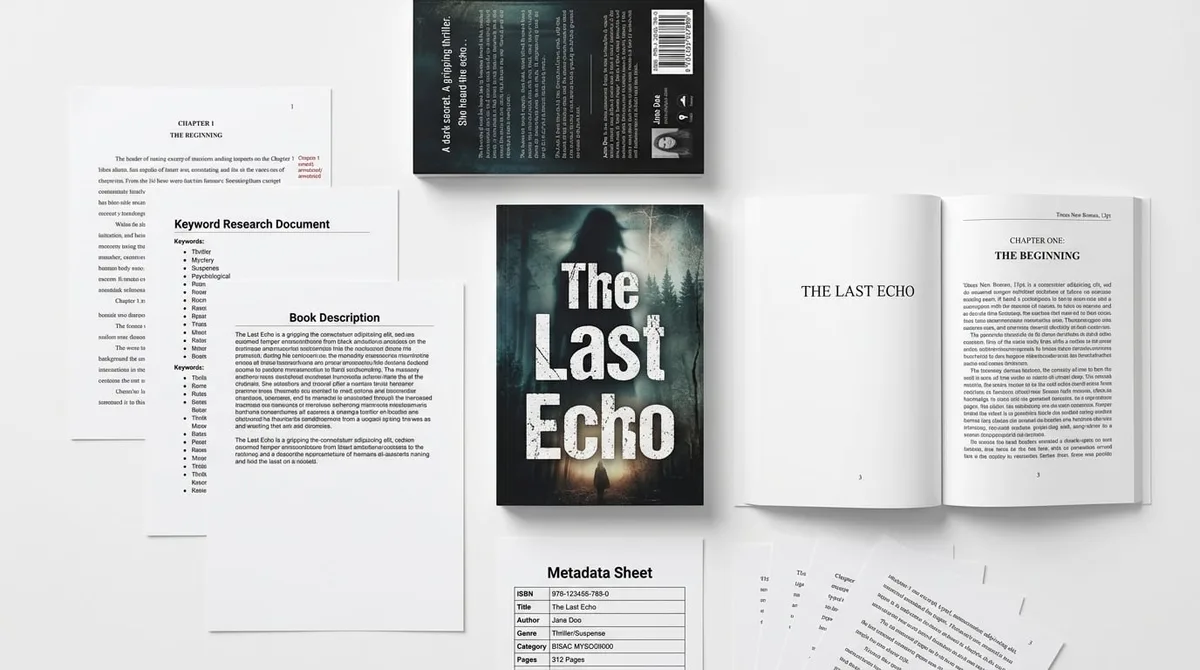
Product proof: KDPBuilder’s metadata step produces a filled-in KDP listing, including the title, subtitle, HTML-formatted description, all 7 backend keyword slots, and category recommendations—not just a blob of text. See a finished metadata sheet.
Start With Buyer Intent, Not a Book Idea
The fastest way to validate kdp niche demand is to start with buyer language. Amazon autocomplete shows phrases shoppers type into the store, which is more useful than brainstorming broad topics. You want to discover what the reader is trying to solve, gift, track, learn, organize, or enjoy.
Begin by typing a seed phrase into Amazon search and noting the suggestions that appear. Then group those phrases by intent instead of treating every variation as a separate opportunity. A strong niche usually includes a problem, a format, and a buyer context.
How to read Amazon autocomplete
Autocomplete is most useful when you look for modifiers that change the purchase intent. Common examples include workbook, journal, planner, coloring book, for beginners, for kids, large print, gift, and activity book. Each modifier can point to a different book type, page count, or audience.
For example, “gardening journal” and “gardening journal for beginners” may share a theme, but they do not always share the same buying motive. One reader may want a simple log. The other may expect instructions, seasonal prompts, planting trackers, and beginner explanations. That difference affects your interior, metadata, trim size, and price.
Practical step list:
- Type a seed topic into Amazon search.
- Write down the first 10-20 autocomplete phrases.
- Mark any phrase that includes a clear format or audience modifier.
- Group phrases into four buckets: problem, age, format, or occasion.
- Delete phrases that do not suggest a book someone would actively buy.
- Keep 3-5 strongest phrases for deeper competitor research.
You can also run those seed phrases through the KDP Keyword Research Tool to compare related buyer terms and tighten your research list. Use it as a filter, not as a decision-maker.
How to avoid false-positive keywords
False-positive keywords sound promising but do not support a realistic book concept. A phrase may have interest yet fail to indicate a clear product, a clear audience, or a clear reason to buy. If you cannot describe the interior in one sentence, the keyword is probably too vague.
- Good signal: “large print crossword puzzles for seniors”
- Weak signal: “crossword puzzles”
- Good signal: “habit tracker planner for ADHD”
- Weak signal: “planner ideas”
- Good signal: “road trip activity book for kids ages 6-8”
- Weak signal: “kids travel”
The goal is to find phrases that tell you what the buyer expects to receive. If the phrase does not suggest a format, audience, or use case, keep it on the research list, not the production plan.
Check Book Niche Demand With BSR and Search Results
Once you have buyer-intent phrases, search the exact phrase on Amazon and inspect the top 20-40 organic results. You are looking for evidence that the niche is not a one-book anomaly and that multiple books are active enough to show real demand.
Best Sellers Rank, or BSR, is directional evidence. It can help confirm that books in a niche are moving, but it is not a precise sales guarantee. Use it to compare patterns, not to promise outcomes. A single high-ranking book does not prove the whole niche is healthy.
What a healthy demand pattern looks like
A healthier demand pattern usually has several signs at once:
- More than one relevant book in the results has an active BSR.
- Different publishers or independent authors show up, not just one dominant brand.
- Covers vary, which suggests the niche is not locked to one visual formula.
- Formats vary, such as paperback, workbook, journal, hardcover, or coloring book.
- Prices cluster in a range rather than sitting at one odd outlier price.
- The same buyer phrase appears naturally in multiple titles, subtitles, or descriptions.
If you see books selling across several design styles and publishers, that is often a better sign than seeing one highly ranked title surrounded by dead listings. You want a market with enough motion to prove demand, but not so much control by one brand that entry becomes unrealistic.
| Signal | What to check | How to read it |
|---|---|---|
| Active listings | Top 20-40 organic results | Several relevant books suggest market depth; one isolated winner is weaker proof. |
| BSR pattern | Multiple comparable books with current ranks | Use as directional demand evidence, never as a sales forecast. |
| Price band | Common list prices for similar formats | Your planned price should not sit far above the market without a clear premium reason. |
| Format match | Paperback, hardcover, journal, workbook, coloring book | The format buyers already accept should guide your production plan. |
Red flags that the niche is too thin
Thin niches often show one or more of these patterns:
- Only one or two relevant books appear in search results.
- Most results are unrelated, meaning the keyword does not map cleanly to a book category.
- The books that do appear are old, inactive, or poorly maintained.
- There is no clear price band, which can indicate weak buyer expectations.
- The phrase looks searchable but does not appear in real book listings.
If the search results are sparse, you may not have a niche at all. You may have a topic that sounds good in brainstorming but lacks enough purchase intent to support a book project.
Measure the Competition Wall
Validation is not just about whether books sell. You also need to understand the competition wall: how hard it will be to stand out with a new, better book. Track review counts, average ratings, publication dates, cover quality, interior previews, page counts, trim sizes, and price bands.
A niche with many 4.8-star books and thousands of reviews may be valid, but it can be expensive to beat. In that case, your book needs a real differentiator, not a small cosmetic variation. On the other hand, a niche with weak covers, thin interiors, poor metadata, or repeated buyer complaints can signal a useful opening.
Review count thresholds are not universal
Review counts are useful, but they do not create a universal go/no-go number. Fifty reviews in one niche might be a lot if the topic is narrow; five hundred may be normal in a broad, evergreen topic. The key is to compare review density to the number of books in the niche and the quality of the result pages.
When you compare competitors, ask three questions:
- Are the top books heavily reviewed because they truly satisfy buyers?
- Are the books dated, generic, or visually weak despite those reviews?
- Can you make a book that solves the same need with better design, structure, or usability?
Do not copy bestseller covers, interiors, titles, or review-driven content. That is not validation; it is imitation. Your research should reveal where the market is underserved, not how closely you can replicate the current leader.
Find quality gaps in negative reviews
Negative reviews are one of the best sources of niche opportunity when you read them for patterns instead of isolated complaints. Look for repeated issues such as flimsy paper, confusing instructions, too few pages, hard-to-use layouts, poor binding, tiny print, misleading age fit, or weak organization. If the same complaint shows up across multiple books, that may be a real quality gap.
Use this quick checklist while reviewing competitors:
- Are buyers asking for more room to write, draw, solve, or track?
- Do they complain about missing instructions or unclear prompts?
- Are there complaints about page count, binding, or print quality?
- Do reviewers mention that the book feels generic or repetitive?
- Are there comments about cover mismatch or misleading metadata?
- Do buyers mention that the book is too easy, too hard, or wrong for the stated age?
Insider pro-tip: The best opening is often not “no competition.” It is a repeated complaint that says, in effect, “I would buy this again if it had X.” That is a stronger signal than a quiet niche with no visible buyers.
Paid tools can speed up this process, but they should not replace judgment. Book Bolt-style workflows can help collect data, yet validation still depends on whether the niche shows a real quality gap and a practical way to improve on what already exists.
Validate the Product Format Before You Build
Format validation matters because KDP paperback and hardcover production choices such as trim size, bleed, color ink, paper type, and page count affect print cost and cover dimensions. That means the format is not a cosmetic decision you make at the end; it changes your economics and your files from the start.
Before you open a KDP template generator, KDP cover creator, or Amazon KDP cover creator, confirm that the market actually supports the format you want to produce. A niche can be real while the wrong format makes it unprofitable or mismatched to buyer expectations.
Format-market fit matters
Some niches clearly want a paperback workbook, while others need a hardcover gift book, a coloring book, a journal, or a children’s book. If the niche is visual or activity-heavy, validate that readers expect original layouts, illustrations, prompts, or designed interiors—not filler pages.
For example, a “for beginners” workbook usually needs structured teaching and practice pages. A planner niche may require dated or undated page systems. A coloring book needs original art and enough variation to justify the purchase. A children’s book depends on story rhythm, page turns, age fit, and production quality rather than text volume.
If your niche overlaps children’s books, read the sibling guide on Childrens Book Niches on KDP: Quality Wins before committing to a concept. That category is especially sensitive to design, age fit, and production polish.
Why templates can create lookalike books
Templates are useful only after validation. If you start with a generic template, you can easily create a book that looks like every other low-effort entry in the niche. That is risky because buyers can sense when a book was assembled before the market was understood.
Think of templates as a production tool, not a research method. The research stage should answer: what does the buyer need, what format do they expect, and where is the quality gap? Only then should you build the designed book.
Run the Profit Test
A niche can have demand and still fail financially. The profit test checks whether the book’s format, price, and print cost leave enough room for a workable royalty. For KDP print books sold on Amazon marketplaces, the standard paperback royalty is 60% of list price minus printing costs; expanded distribution uses a lower royalty rate. That matters because a niche that looks attractive at retail can shrink quickly after production costs.
Estimate trim size, page count, color versus black-and-white interior, list price, and print cost before committing to production. Then compare the projected royalty against the effort required for manuscript, cover, interior, metadata, and launch assets. A fast way to sanity-check the numbers is the KDP Royalty Calculator, which helps you compare format options before you build files.
Price tolerance by niche
Every niche has a rough price tolerance based on buyer expectations. Some buyers expect a low-cost workbook. Others accept a higher-priced hardcover gift item. If your intended format forces a price above the niche’s normal range, the book may technically be possible but still remain impractical to build.
Use the KDP Royalty Calculator to test your pricing assumptions before you produce files. Change one variable at a time: trim size, page count, color versus black-and-white, and paperback versus hardcover. The point is to see whether the market can support the production choice, not to optimize a fantasy version of the book.
When a niche sells but still is not worth building
Sometimes a niche has evidence of demand, but the economics are poor. This happens when the expected format is expensive to print, the buyer expects a low price, or the content requires significant design time to do well. In those cases, the niche may be valid in a commercial sense but still not worth your production effort.
Examples include:
- Color-heavy interiors with low price tolerance.
- High-page-count books where paper and trim choices drive cost too high.
- Highly designed activity books that require extensive layout work but sit in a bargain-price niche.
- Hardcover gift concepts where buyers in the niche usually purchase inexpensive paperbacks.
If the math does not work, the answer is no-go even if the search results look promising. Profit feasibility is part of validation, not a separate afterthought.
Use a Simple Go/No-Go Scorecard
A scorecard keeps excitement from overriding evidence. Score the niche from 1-5 on demand, buyer intent, competition, quality gap, production difficulty, profit, and brand fit. You are looking for a balanced case, not a perfect score in every category.
Require evidence for each score. Demand might be supported by autocomplete phrases, active search results, and multiple BSR-validated competitors. Quality gap might be supported by repeated complaints in negative reviews. Profit should be supported by a calculator check at realistic page counts and formats.
| Factor | Score 1-5 | Evidence to collect |
|---|---|---|
| Demand | Autocomplete, search results, active BSRs | |
| Buyer intent | Format and audience modifiers | |
| Competition | Review counts, ratings, publisher spread | |
| Quality gap | Negative review patterns | |
| Production difficulty | Trim, bleed, color, page count | |
| Profit | Royalty calculator test | |
| Brand fit | Fits your catalog and design style |
How to interpret the score
| Total score | Decision | What to do next |
|---|---|---|
| 28-35 | Strong candidate | Move into concept development and metadata planning. |
| 21-27 | Needs revision | Pivot the angle, format, audience, or price before building. |
| Under 21 | No-go for now | Archive the research and test a more specific buyer phrase. |
Do not let one strong factor rescue a weak niche. A high demand score cannot fix bad profit math. A good royalty cannot fix unclear buyer intent. A visible review gap cannot fix a market with no buyers.
Green-light criteria
Recommend a go decision only when demand, differentiation, and profit all pass. In practical terms, that means the niche has buyer intent, a visible quality gap, and a format you can produce without breaking the math. If one of those pillars is missing, the niche needs revision.
A green light does not mean “build fast.” It means you may now move into concept development with confidence. If the niche passes, test a publish-ready concept using Try KDPBuilder Free (no signup) before you invest in full production.
When to pivot the niche instead of abandoning it
Not every weak result means the topic is dead. Sometimes the niche is right, but the angle is wrong. You may be able to pivot from broad to specific, from paperback to hardcover, from adult to kids, or from generic workbook to guided activity book.
Pivot when the evidence says buyers want the topic but the current concept is too crowded or too expensive. Abandon when demand is thin, buyer intent is unclear, or the format economics cannot be made reasonable.
Common KDP Niche Validation Mistakes
The most common mistakes come from starting production too early. If you validate poorly, you can end up with a book that has the wrong format, the wrong metadata, or the wrong level of design for the market.
BSR tunnel vision
One bestseller rank does not prove a niche. It only proves that one book is moving. You need a cluster of evidence: search intent, multiple relevant results, and enough competition to show a real market. Otherwise, you may chase a one-off success that cannot be replicated.
Keyword stuffing
KDP metadata must accurately represent the book. Titles, subtitles, keywords, and categories should not include misleading or irrelevant terms or keyword stuffing. Stuffing a title with every phrase you found in research may create relevance problems instead of helping discovery.
Keep metadata aligned with the actual book. If the interior is a guided journal, do not label it like a workbook if that is not what buyers receive. If the audience is adults, do not add irrelevant child-focused terms just because they appear in search suggestions.
Generated-looking interiors
Using generic AI content to enter a niche where buyers expect crafted design is a common mistake. If the market rewards structure, clarity, or visual polish, a thin or repetitive interior will likely underperform. Validate the expected quality level before you build, and do not let a low-effort interior masquerade as a complete product.
Another mistake is starting with a cover, template, or manuscript generator before confirming market economics. That reverses the correct sequence. Research first, format second, production third.
Validation sequence in one line: buyer intent, search results, competition wall, format fit, profit test, then design.
Mistakes to avoid at a glance
- Do not treat one strong listing as proof of a whole niche.
- Do not choose a format before checking buyer expectations.
- Do not assume a keyword is valid if it cannot map to an interior.
- Do not build around a template that forces lookalike output.
- Do not skip the royalty check just because demand looks promising.
- Do not write metadata that promises a different book than the one you made.
FAQ
How do I validate KDP niche demand without paid tools?
Start with Amazon autocomplete, then search the exact buyer phrase and review the top results. Look for repeated phrases, active BSRs, multiple publishers, and consistent buyer complaints. You can also compare price bands, page counts, trim sizes, formats, and cover quality manually before deciding whether the niche deserves production.
What BSR range shows that a KDP niche has real demand?
There is no universal BSR range that guarantees demand. Use BSR as directional evidence: if multiple relevant books in the niche show active ranks and appear across several result pages, that supports demand more than a single isolated rank. Always pair BSR with search intent and competition checks.
Do I need Book Bolt or other KDP tools to validate a niche?
No. Tools can speed up keyword discovery and competitor research, but they are not required to judge whether buyers want the book. The real decision comes from evaluating demand, quality gaps, format fit, and profit math. Use tools as helpers, not as substitutes for market judgment.
Should I use a KDP template generator before validating the niche?
No. A template generator should come after validation, not before it. If you build the interior first, you risk creating a book that matches the template instead of the market. Validate the niche, confirm the format, then design the book around the actual buyer need.
When should I use KDP Cover Creator in the niche research process?
Use a cover creator only after you have confirmed the niche, format, and market positioning. The cover should be based on validated buyer expectations, not on a guess. If the niche is children’s books or another design-sensitive category, final cover choices should be informed by the market’s visual standards.
How many competing books and reviews are too many for a new KDP book?
There is no fixed number because competition depends on niche size, format, and quality. A niche with many books can still be enterable if the quality gap is clear and the format economics work. The better question is whether the top results already satisfy buyers so well that you cannot create a meaningfully better book at a workable cost.
Next Step: Validate One Niche Before You Build
Do not validate ten ideas halfway. Pick one buyer phrase, run the intent check, inspect the top results, document the review gaps, test the format economics, and score the niche. If it passes, move into concept development. If it fails, pivot before you make files.
To move from research to a clearer next step, use the free KDP tools and test one niche at a time. If you are ready to check a concept without creating an account, Try KDPBuilder Free (no signup) and use the validation workflow before you build production files.
Turn this idea into a book — free sample
Type a book idea and we'll generate a real cover preview in about a minute. No signup, no card.