How to Validate KDP Niche Demand Before You Build

Skip the theory? Generate a free book preview in about a minute — no signup, no card.
Try it freeA KDP niche is not validated because it sounds searchable. It is validated when Amazon shows buyer intent, the current books leave a visible opening, and your planned format can make sense after printing costs. Before you build the manuscript, use niche validation to answer one hard question: would a shopper on page one have a clear reason to choose your book instead of the books already there?
To validate KDP niche demand, check Amazon autocomplete, page-one book results, bestseller rank signals, review patterns, competitor quality, price points, page counts, and royalty potential before you design the cover or interior. The strongest niches have three things at once: visible demand, imperfect competition, and a product angle you can execute better than what buyers already see.
Start With a Simple KDP Niche Research Method
The fastest way to validate KDP niche demand is to use a pass/fail scorecard before you design a cover, draft an interior, or buy a batch of generated pages. Beginners often stop after finding a phrase with search interest, then assume that phrase is a book opportunity. That is where weak projects start: they validate a keyword but never validate the book.
Use a five-part scorecard and rate each category from 0 to 2:
- Demand — Are real buyers searching for and buying books in this topic?
- Competition — Is page one crowded with strong books, or are there weak openings?
- Design gap — Can you make the cover, interior, and listing look more intentional?
- Production fit — Can you create the book well without forcing the format?
- Profit — Does the price, page count, and printing cost leave usable margin?
A niche can have demand and still be a poor choice if the top books are polished, the format is expensive to produce, or the royalty math is too tight. If you want to sanity-check the economics while you research, use the KDP Royalty Calculator before you commit to a page count or trim size.
Demand
Demand means there is evidence that buyers are already looking for and purchasing books in this category. For KDP, demand is stronger when you can see actual Amazon book results, not just creators talking about the idea in keyword tools, forums, or videos.
Competition
Competition is not just the number of books that exist. It is whether the top results are strong enough that a new book would need a real advantage in design, usefulness, positioning, or audience specificity to get chosen.
Design gap
The design gap is the space between what is currently ranking and what a better book could look like. If page one is full of generic covers, bland interiors, unclear subtitles, or vague promises, that is an opening only if you can produce something clearly better.
Production fit
Production fit asks whether the niche matches your capabilities. A journal is easier to produce than a photo-heavy cookbook; a workbook may require instruction and structure; a puzzle book may require clean formatting and consistent difficulty. If the format fights your workflow, the niche is weaker than it first appears.
Profit
Profit is a validation filter, not an afterthought. A niche can look attractive and still be poor if printing costs and market expectations leave no room for a realistic royalty.
Worked example: broad idea vs buildable niche
| Idea | Validation problem | Better research angle |
|---|---|---|
| Gratitude journal | Too broad; page one may be crowded with polished books | Gratitude journal for teen girls, moms, teachers, or recovery |
| Sudoku book | Easy to generate, hard to differentiate | Large print sudoku for seniors, travel sudoku, or themed difficulty packs |
| Meal planner | Demand exists, but many interiors are similar | Meal planner for busy families, diabetic meal planning, or budget grocery planning |
The point is not to make the niche smaller for its own sake. The point is to make the buyer, promise, design style, and interior structure specific enough that the book can compete as a product.
Check Book Niche Demand on Amazon
Amazon is the first place to validate whether a niche has buyer demand because it shows both search behavior and purchasing behavior. Start with autocomplete, then inspect page one carefully. You are looking for proof that people search the topic naturally and that Amazon already surfaces books buyers can choose from.
Follow these steps:
- Type the seed phrase into Amazon search and note autocomplete suggestions.
- Add modifiers such as age, skill level, season, format, use case, and audience.
- Open page one and review sponsored and organic results separately.
- Check bestseller rank signals, publication dates, review counts, and recurring subtopics.
- Compare broad phrases with buyer-specific phrases to see which one is more buildable.
Amazon autocomplete
Autocomplete tells you how real users phrase a topic. If Amazon suggests modifiers like for kids, for teens, beginner, large print, summer, or for women, that is useful because it reveals audience and format intent. A broad phrase may be interesting, but a buyer-specific phrase is often easier to design for.
Bestseller rank signals
Do not look for one lucky book with a strong rank and call the niche validated. Instead, check whether multiple books on page one have credible bestseller rank signals. Repeated signs of purchase activity across several listings are more useful than one accidental outlier.
Review velocity and freshness
Review count matters, but so do publication date and freshness. A niche with older books that still attract reviews may indicate lasting demand. A niche with many recent releases but little review activity may still be early, but it can also signal weak buyer pull. You need both sides of the picture.
Buyer-specific modifiers
Broad demand is not enough if the product is too generic. For example, gratitude journal is broad, but gratitude journal for teen girls is more buildable because the audience, voice, prompts, and visual style can be designed more precisely. Buyer-specific demand usually gives you a clearer product brief.
Quick field test: write down the first 10 books on page one, then mark each as strong, average, or weak for cover, title promise, interior preview, and review complaints. If you cannot find at least one meaningful weakness you can improve, keep researching before you build.
Do not treat keyword volume as proof of book demand unless Amazon results show buyers are already purchasing similar books. Search interest without purchase evidence is only a signal, not validation. If you need a faster first-pass way to check topic phrasing, the KDP Keyword Research Tool can help you compare broad and buyer-specific terms before you open competitor listings.
Separate Real Demand From Saturated KDP Tool Niches
Searches around KDP tools often attract creators, not necessarily book buyers. That distinction matters because creator interest and end-customer demand are not the same thing. A phrase like kdp puzzle generator or free puzzle generator for kdp may prove that publishers want a fast workflow, but it does not prove that shoppers are buying a specific puzzle book idea.
This is where many people choose the wrong opportunity. They build what a tool can generate instead of what a reader wants to buy.
Use this distinction:
- Creator keyword: a phrase used by someone making books.
- Buyer keyword: a phrase used by someone shopping for a book.
- Validation keyword: a phrase that appears in Amazon book results, purchase signals, and buyer-focused search behavior.
Creator keywords vs buyer keywords
If your research starts and ends with creator-facing terms, you may validate the wrong market. A search for a puzzle generator tells you there is interest in making puzzles. It does not tell you whether there is demand for a specific puzzle book, audience, or use case.
When a puzzle generator for KDP is not enough
Even if a puzzle generator helps you produce content quickly, the market still evaluates the finished book. Buyers do not purchase a generator output; they buy a cover, a promise, a format, and an interior that feels useful. The better opportunity is often not make another generated puzzle book but make a better-designed puzzle book for a specific audience.
Why generated-looking books lose trust
Books that look assembled instead of designed often signal low effort. Weak covers, repetitive interiors, and vague metadata can make buyers hesitate, especially when the niche already has several polished options. In other words, the tool may help you create faster, but speed alone does not validate the niche.
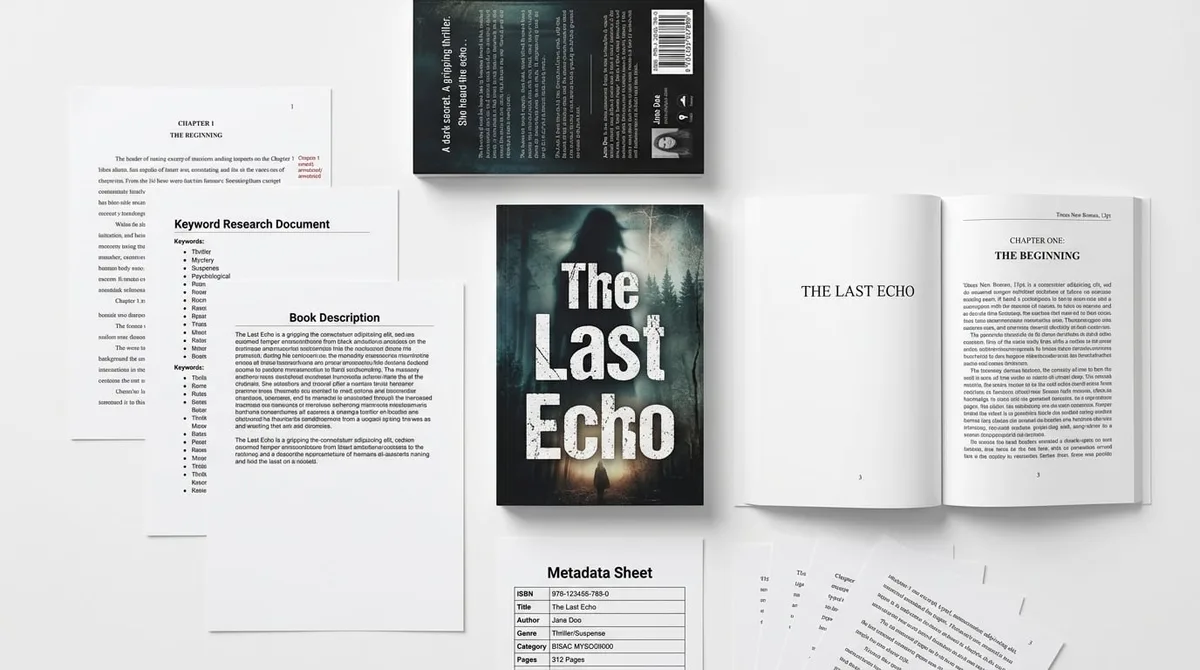
Product proof: the metadata step in KDPBuilder produces a filled-in KDP listing: title, subtitle, HTML-formatted description, all 7 backend keyword slots, and category recommendations — not just a blob of text. See a finished metadata sheet.
Insider pro-tip: when a niche seems crowded, compare the first five thumbnails at phone size. If your concept cannot be instantly clearer, cleaner, or more specific than those five, you probably do not yet have a publish-ready angle.
Analyze Competition Like a Publisher, Not a Scraper
Competition analysis should be a manual review of actual books, not a surface scan of keyword metrics. Open the top 10 to 20 competing books and evaluate them the way a buyer would: cover quality, title clarity, subtitle promise, sample pages, interior polish, and common complaints in reviews.
Look for these gaps:
- Cover gap: ugly, dated, cluttered, confusing, or low-contrast covers.
- Interior gap: repetitive pages, poor spacing, weak formatting, or confusing instructions.
- Metadata gap: vague titles, muddy subtitles, or misaligned audience promises.
- Review complaint gap: buyers saying the book is too easy, too repetitive, poorly formatted, or missing variety.
Cover gap
A cover gap exists when the niche is active but the visual standards are weak. If the top books look generic or outdated, a stronger cover can improve click appeal. But a better cover only helps if the interior and promise match it.
Interior gap
Interior polish matters because the book is the product. In puzzle books, workbooks, journals, and cookbooks, a weak interior can create bad reviews even if the cover gets the click. Review sample pages and preview images to see whether the inside feels intentional or stitched together.
Metadata gap
Metadata should explain the book clearly and honestly. If competitors use vague titles or overloaded subtitles, that may be an opening for sharper positioning. However, Amazon KDP prohibits misleading metadata, keyword stuffing, and content that creates a poor customer experience, so your advantage must come from clarity, not tricks.
Review complaint mining
Review mining is one of the most useful validation steps because it tells you what buyers actually disliked. Look for repeated complaints such as too easy, not enough variety, binding issues, poor instructions, or misleading title. Those complaints can become your product requirements.
Create a competition threshold before you commit. If every top result has thousands of reviews, strong branding, fresh publication dates, and excellent interiors, the niche may be too expensive to enter unless you have a very different angle. In that case, the better move is to pivot to a narrower audience or a more specific format.
If competitors look generated, KDPBuilder should not encourage you to match them with more generated content. The stronger move is a designed product system: better concept, structured manuscript, polished cover, formatted interior, and metadata that reads like a real publishing decision.
Run the Profit Test Before You Build the Book
Profit testing should happen before production, not after. For KDP paperbacks sold on Amazon marketplaces, the standard royalty is 60% of list price minus printing costs. For Expanded Distribution, the royalty rate is 40% of list price minus printing costs. That means you must check the economics of the format, not just the topic.
Before you build, list these five items:
- Format: paperback, workbook, journal, cookbook, puzzle book, or other.
- Trim size: the physical book size you plan to use.
- Page count: because printing cost rises as pages increase.
- Ink type: black-and-white or color.
- Marketplace and price: where you plan to sell and what buyers are paying now.
KDP paperback printing cost depends on marketplace, trim size, page count, and ink type, so page count and format must be validated before choosing a niche. A niche that works at 80 pages may not work at 180 pages if the cost structure becomes too tight. If you want to see how format choices affect the math while you research, the KDP Royalty Calculator can help you test list price against printing cost before you start building.
Compare competitor prices and page counts side by side. If the market expects a low price and short book, a more expensive version may be hard to position. If the market expects a longer, more useful book, a thin interior may look weak even if the price is acceptable.
Use this practical test: if you cannot estimate a royalty scenario without guessing, the niche is not ready. Profit validation requires enough clarity to understand whether a book can compete after printing costs and still leave margin worth publishing.
| Validation item | What to check | Why it matters |
|---|---|---|
| Price range | Top competitor list prices | Shows what buyers are used to paying |
| Page count | Common lengths in the niche | Drives printing cost and perceived value |
| Printing cost | Based on trim size and ink | Affects royalty directly |
| Royalty margin | List price minus print cost, then royalty rate | Tells you whether the book is economically viable |
Validate Production Fit: Can You Build a Better Book?
Production fit is where niche validation becomes a studio decision. Ask whether the niche requires original writing, illustrations, puzzles, recipes, worksheets, photography, expert input, or strict formatting. If it does, you need to know whether you can produce that standard without cutting corners.
For cookbook, puzzle, workbook, and journal niches, production quality is part of validation because weak interiors can increase returns, complaints, and negative reviews. A niche is not truly buildable if the final book would feel rushed, generic, or incomplete.
Use this practical checklist before you commit:
- Can I create content that feels original, useful, and clearly structured?
- Can I design a cover that looks more intentional than the current results?
- Can I format the interior so it feels polished on preview pages?
- Can I meet the quality standard without relying on repetitive generated content?
- Can I keep the book within a viable page count and cost structure?
Content complexity
Some niches need expert-level content; others need careful formatting. A workbook may need step-by-step instruction. A cookbook may require recipe testing and clear ingredient presentation. A puzzle book may need variety and balanced difficulty. Validation should include whether you can actually deliver the required content level.
Design complexity
Design complexity includes cover layout, interior spacing, section breaks, illustration consistency, and overall readability. A book can be simple and still feel designed, but it cannot feel accidental. That distinction matters in crowded niches.
Originality requirements
Originality is not just a legal concern; it is a market advantage. Amazon KDP prohibits misleading metadata, keyword stuffing, and content that creates a poor customer experience, so your niche validation should also include trademark, originality, and policy-risk checks. Avoid celebrity, brand-name, trademarked, or copyrighted angles that create avoidable risk.
Quality control
When you use kdp interior generator tools, treat automation as a starting point, not a final product. The final book must still feel intentional, edited, and designed. That means checking alignment, spacing, page flow, recurring elements, and preview quality before publishing.
If you want to test a studio-style workflow, the point is not to publish faster at any cost. The point is to see whether you can produce a book that looks publish-ready from the first preview page to the last. If you are still deciding between formats or trying to map a production workflow, the KDP Keyword Research Tool is a useful companion for narrowing the topic before you design the inside.
Use a Pass, Pivot, or Kill Decision
Once you have demand, competition, profit, and production notes, make a decision. Do not leave the niche in a gray zone. Use a simple scoring model: give each category 0 to 2 points for demand, competition, design gap, profit, and production fit. That gives you a total out of 10.
Pass means the niche has clear demand, weak or uneven competition, a visible design gap, viable royalty math, and realistic production scope. A pass does not guarantee sales; it only means the niche is strong enough to build.
Pivot means the topic has some demand, but the current angle is too broad, too crowded, or too expensive to produce. You may need a narrower audience, a different format, or a better design direction.
Kill means weak demand, no viable profit, trademark risk, policy risk, or competition that cannot be beaten with better design. If the niche cannot be improved without copying or cutting corners, it is not worth building.
Here is a practical rule: if your score is 8 to 10, move forward with a publish-ready concept. If it is 5 to 7, pivot the audience or format. If it is 0 to 4, kill it and move on.
| Score | Decision | What it usually means |
|---|---|---|
| 8–10 | Pass | You have demand, a design gap, and workable economics |
| 5–7 | Pivot | The niche has promise, but the angle or format needs tightening |
| 0–4 | Kill | The niche is too weak, too risky, or too expensive to build well |
The real goal is to stop publishing books that look generated and start building books that look designed. Validate demand first, then create a book with stronger cover logic, interior structure, metadata, and profit math than the results already on page one.
Next step: take one niche idea and score it before you build anything. Start with KDPBuilder’s free tools to compare keyword angles and royalty scenarios, then use Try KDPBuilder Free when you are ready to turn a validated idea into a structured publishing workflow.
FAQ
How do I validate KDP niche demand before creating the book?
Start with Amazon autocomplete, then check page one for real book results, review counts, publication dates, and buyer-specific modifiers. After that, compare competitor quality and run the royalty test so you know the topic is both wanted and buildable. The strongest validation comes from combining demand signals with production and profit checks.
What is the best KDP niche research method for beginners?
Use a five-part scorecard: demand, competition, design gap, production fit, and profit. Rate each category from 0 to 2 and total the results before you write or design anything. This keeps you from choosing a keyword that looks promising but is weak as a product.
How can I check book niche demand on Amazon without paid tools?
Use Amazon search autocomplete, page-one book results, review counts, publication dates, and recurring subtopics. You do not need paid software to see whether multiple books are ranking, whether the market is fresh, and whether buyers are actually purchasing similar titles. Paid tools can help later, but they are not required for the first pass.
Does a keyword like kdp puzzle generator prove a puzzle book niche is profitable?
No. That phrase shows creator interest, not buyer demand. To validate the actual niche, look at Amazon book results, competitor quality, and whether you can make a puzzle book with better design, better variety, and a viable page count.
How many reviews are too many when validating a KDP niche?
There is no single review number that makes a niche impossible. The better question is whether the top 10 to 20 books all have strong reviews, fresh branding, and polished interiors. If every result is heavily reviewed and professionally executed, the niche may be expensive to enter unless you have a clearly better angle.
Should I use a Book Bolt free alternative for niche validation?
You can start without paid tools if you know how to read Amazon signals. Free research is enough to validate demand, competition, and basic profit potential. Tools can speed up the process, but they should support your judgment, not replace it.
Ready to compare ideas before you build?
Use the free KDPBuilder tools to check demand, keywords, and royalty math first, then decide whether the niche is worth developing. You can browse the free tools here or try KDPBuilder Free if you want to explore the workflow before committing to a full project.
Turn this idea into a book — free sample
Type a book idea and we'll generate a real cover preview in about a minute. No signup, no card.