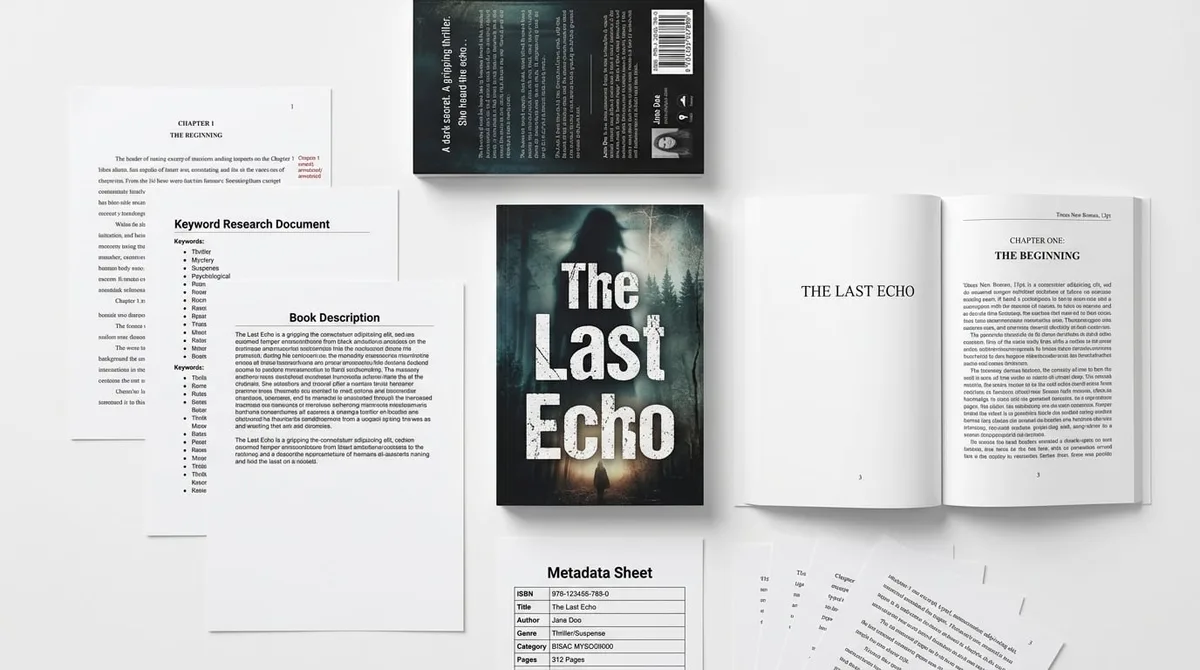
How to Publish AI-Generated Books on KDP in 2026: Step-by-Step Guide
Skip the theory? Generate a free book preview in about a minute — no signup, no card.
Try it freeAI has become a normal part of self-publishing — but the rules around it are specific, and getting them wrong can get your book blocked. This guide explains how Amazon KDP treats AI-generated versus AI-assisted content in 2026, exactly what you must disclose, the quality risks to manage, and a safe, repeatable workflow that keeps you compliant while still publishing fast. For data on how publishers are actually using AI this year, see the State of AI Self-Publishing 2026 report.
This is general guidance, not legal advice. Amazon's policies can change — always confirm the current rules in the official KDP Help Center before you publish.
AI-Generated vs. AI-Assisted: The Distinction That Matters
Amazon draws a clear line between content an AI created and content an AI merely helped you create. This single distinction determines whether you need to disclose anything.
AI-generated (must disclose)
- •Text, images, or translations created by an AI tool based on your prompts
- •Content where AI produced the material, even if you edited it substantially afterward
- •AI-generated cover art or interior illustrations
AI-assisted (no disclosure needed)
- Brainstorming ideas, titles, and outlines
- Editing, refining, fact-checking, or improving your own writing
- Grammar, spelling, and style suggestions on text you wrote
The practical takeaway: if an AI produced the words, pictures, or translation in your book, treat it as AI-generated — even if you polished it heavily. If you wrote the work and AI only refined or suggested, it's AI-assisted. For a deeper breakdown, see our guide to KDP AI disclosure rules.
What Amazon Requires at Upload
During the publishing flow, KDP asks whether your book contains AI-generated content. Here's what you need to know:
- You must answer honestly. Disclose AI-generated text, images, or translations.
- The disclosure is internal. It is not shown on your product page or to buyers.
- It does not affect royalties or ranking. Amazon uses it for its own records, not as a penalty.
- You are fully responsible. Quality, accuracy, and intellectual-property compliance are entirely yours, regardless of how the content was made.
What KDP Builder Helps You Create
KDP Builder uses AI-assisted workflows to speed up the slow parts of book creation — outlining, interior layout, metadata, and cover design — while keeping you in control of the final product. These formats are especially well suited to a compliant, AI-assisted approach:
Low-content & journals
Trackers, planners, and guided journals where AI helps with prompts and structure while you control the layout.
Low-Content Book CreatorPuzzle & activity books
Sudoku, word search, crosswords, and mazes generated with answer keys — then verified for accuracy.
AI Puzzle Book CreatorWorkbooks & educational
Practice workbooks and unit studies where AI accelerates drafting and you ensure pedagogical accuracy.
Workbook CreatorCookbooks
Recipe formatting and structure, with you testing and verifying every recipe before publishing.
Cookbook CreatorWant to compare options first? Read the best AI tools for Amazon KDP and how an AI KDP book generator fits your workflow.
The Human Quality-Control Checklist
AI handles the heavy lifting; you guarantee the quality. Run every book through this checklist before you hit publish:
Before you publish
- Read the full manuscript end to end — never publish text you haven't reviewed.
- Verify every fact, statistic, date, and name against a reliable source.
- Check for repetition, filler, and 'hallucinated' claims AI sometimes invents.
- Confirm you hold the rights to all content and that nothing infringes copyright or trademarks.
- Ensure puzzles, recipes, and instructions actually work and are tested.
- Format the interior to your trim size with correct margins, bleed, and page count.
- Answer the KDP AI-content question honestly during publishing.
Best Book Types for AI-Assisted Publishing
Some formats are far more forgiving and profitable for AI-assisted creation than others. The best fits are structured, template-friendly books where accuracy is easy to verify: low-content journals and trackers, puzzle and activity books (with verifiable answer keys), workbooks, and well-tested cookbooks. These pair naturally with the niche ideas in our best KDP niches for 2026 guide. Long-form narrative nonfiction in sensitive areas — medical, legal, financial — demands the most human verification and carries the highest risk if you cut corners.
If you already know which format you want, each creator page below walks through exactly what the AI produces, what stays in your control, and what the finished KDP package contains: coloring books, children's picture books, guided journals, planners, nonfiction, and fiction. Every one of them exports the same compliant, disclosure-ready package described above.
Risky AI Publishing Mistakes to Avoid
A Safe, Repeatable Workflow
- Validate the niche using our niche validation checklist.
- Draft with AI assistance — outline, interior, and cover — then treat the output as a first draft, not a final book.
- Run the human QA checklist above: read, verify, and confirm rights.
- Format to your trim size with correct margins, bleed, and page count.
- Disclose AI-generated content truthfully at upload.
- Optimize metadata and keywords so the right readers can find it.
Frequently Asked Questions
Does Amazon KDP allow AI-generated books in 2026?
Yes. Amazon KDP permits books that include AI-generated content, but you must disclose AI-generated text, images, or translations when you publish, and you remain fully responsible for the book's quality, accuracy, and compliance with content guidelines and intellectual-property rights.
What is the difference between AI-generated and AI-assisted content?
Amazon defines AI-generated content as text, images, or translations an AI tool creates based on your prompts — even if you edit it substantially. AI-assisted content is your own work that AI merely helped refine, such as brainstorming, outlining, editing, or grammar checks. AI-generated content must be disclosed; AI-assisted content does not.
Do I have to tell readers my book used AI?
No. The AI-content disclosure you make during publishing is for Amazon's internal use. It is not shown on your product page, and Amazon has stated it does not affect royalties or ranking. You simply answer the AI question truthfully when uploading.
Will disclosing AI use hurt my sales or rankings?
Amazon has stated that the AI-content disclosure is informational and is not displayed to customers. What affects your sales and rankings is the same as always: book quality, relevance, reviews, and keyword targeting. Focus on producing a genuinely useful, well-made book.
What happens if I don't disclose AI-generated content?
Failing to disclose AI-generated content violates KDP's terms and can lead to your book being blocked or removed and, in repeated cases, account termination. Enforcement has tightened through 2025 and 2026, so always answer the AI question honestly.
Can I use AI tools to publish faster and stay compliant?
Yes — AI-assisted tools can speed up outlines, interiors, and covers so you can test more ideas at low cost. Stay compliant by reviewing everything a human should review: read the full text, verify facts, confirm rights, and disclose any AI-generated material at upload.
Start Publishing the Right Way
AI doesn't replace good publishing — it removes the busywork so you can focus on quality and niche fit. Pick a format, validate the niche, draft with AI assistance, verify everything, and disclose honestly. Start free and create your first KDP-ready book — no credit card required — or grab a free sample package to see the output first.
Turn this idea into a book — free sample
Type a book idea and we'll generate a real cover preview in about a minute. No signup, no card.