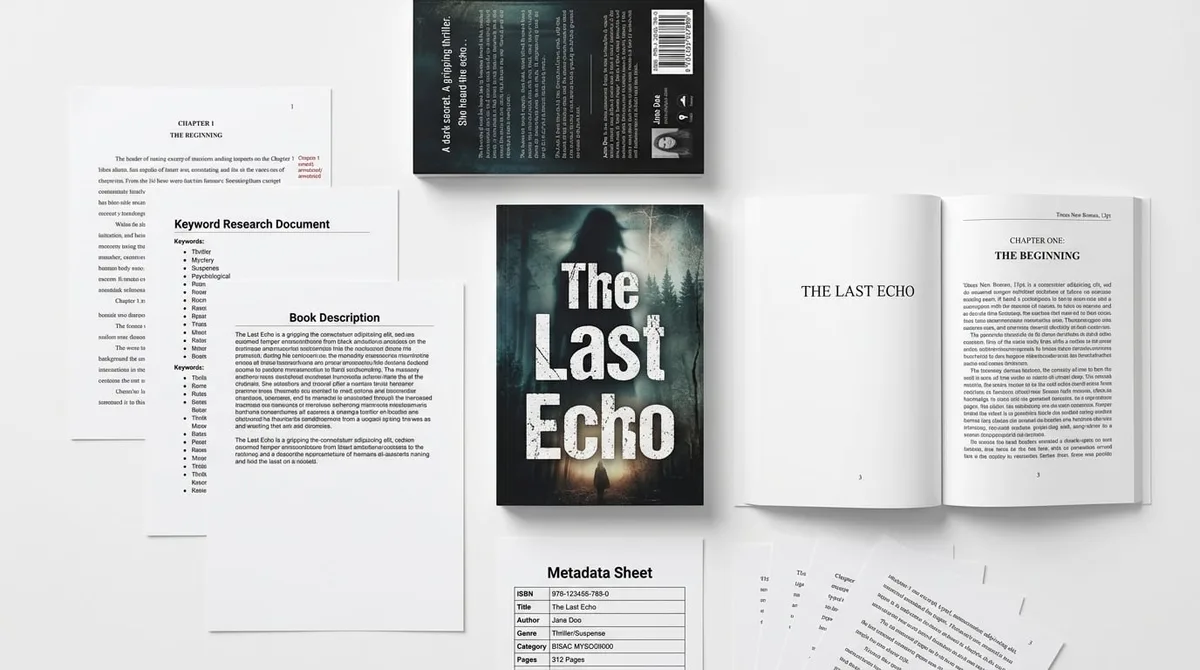
Picture Book Self Publishing 2026: KDP Guide
Skip the theory? Generate a free book preview in about a minute — no signup, no card.
Try it freeA 32-page picture book can lose money before it ever sells a copy. In picture book self publishing 2026, the books that win are not just charming - they are engineered for KDP file checks, thumbnail browseability, and a market flooded with weak AI art.
If you want the direct answer, picture book self publishing 2026 means building a print-ready, image-led children's book for Amazon KDP with a tight reading age, 24-32 pages, original or heavily art-directed illustrations, accurate cover wrap math, and metadata built around real search demand.
As of June 2026, KDP still pays 60% of list price minus print cost on paperback and hardcover sold on Amazon stores, ebook royalties are 70% or 35% depending on price and territory, and your setup gives you 7 keyword fields plus 2 browse categories by default. One more fact that trips up new publishers: KDP paperback interiors must use an even page count, which is why picture books usually land on 24, 32, or 40 pages.
What changed in 2026 for children's book publishing
The market is not dead; it is stricter. Parents and gift-buyers are seeing more low-effort AI books, so weak covers, repetitive concepts, and generic interiors are getting ignored faster. That is good news for serious publishers because clean positioning now beats noisy competition.
In practice, this means three things:
- Thumbnail clarity matters more than ever. A picture book cover must read at phone size. If the character face, title, and promise are not instantly obvious, you lose the click.
- Search intent is narrower. Generic titles like 'A Lovely Adventure' are weak. Specific phrases like bedtime, preschool, emotions, dinosaurs, potty training, or sibling adjustment perform better when they match parent intent.
- Production errors are more expensive. KDP is less forgiving with image resolution, bleed, and spine width. A file that looks fine on your laptop can still fail preview or print.
That is exactly why KDP Builder matters in 2026: its Amazon Intel layer helps you mine real keywords and competitor patterns before you commit to art or layout. If you are still deciding what kind of children's book to make, start with Children's Book Creator and move from idea to a usable page plan instead of guessing.
Another market reality: picture books are no longer just about story quality. They are about market-fit plus production fit. A great manuscript in the wrong trim size, with a weak cover and no keyword strategy, is still a weak launch.
Self publish children's book on KDP: the 7-step workflow
Here is the workflow I use when I want a children's title to be publish-ready without wasting weeks on avoidable fixes. This is the fastest way to self publish children's book projects that actually survive KDP review and look professional on Amazon.
- Choose the reading age first. Decide whether the book is for 2-4, 4-6, or 6-8. That choice changes sentence length, visual density, and page count. A 2-4 book needs more repetition and fewer words per page; a 6-8 story can carry more narrative and more scene changes.
- Pick one emotional promise. Parents buy picture books that solve a tiny problem or deliver a repeatable experience: bedtime calm, first-day nerves, big feelings, sibling jealousy, potty training, kindness, bravery, or animal humor. Pick one promise and keep every spread pointed at it.
- Validate demand before writing. Search Amazon for your target topic and look at the first page of results, not just the top title. You want repeatable demand with weak-to-medium competition, not a random bestseller that will bury you. If the top results are all nearly identical, you need a sharper angle.
- Write for page turns. Picture books are not mini chapter books. Every spread should carry a visual beat, a rhythm shift, or a punchline. If you are writing a 32-page book, plan roughly 14 to 16 interior spreads plus front matter and end matter, depending on layout.
- Plan illustrations before final text lock. In children's publishing, art and pacing are inseparable. A line that works on paper may fail once you see the illustration space. Keep page text short enough that the art can do the heavy lifting.
- Format the interior to KDP rules. Export a print-ready PDF, embed fonts, use 300 DPI images, and set bleed correctly. For full-bleed art, KDP requires the artwork to extend beyond the trim edge by 0.125 inch on all sides.
- Upload, preview, and proof. Use KDP Previewer, but do not trust only the on-screen preview. Download the proof PDF and inspect every spread on a larger monitor. Look for text close to trim, page numbering mistakes, and any image that softened during export.
If your concept is still fuzzy, let KDP Builder handle the front-end thinking. The Children's Book Creator fits naturally into this workflow because it helps you structure the story, pacing, and book type before you spend money on illustration or formatting.
Kids book illustration ai: where it helps and where it fails
Kids book illustration ai can be useful in 2026, but only as a production tool, not as a substitute for art direction. The winning books use AI for speed, exploration, or mockups, then refine with a human eye so the final result feels cohesive and ownable.
Use AI for:
- Mood boards and style exploration before you hire or draw.
- Rough thumbnails to test layout and pacing across spreads.
- Color studies to see how warm, cool, or high-contrast palettes read at thumbnail size.
- Background variation when the character lineup is already locked and consistent.
Do not rely on AI for:
- Character continuity across 24 to 32 pages.
- Readable facial emotion on small interior illustrations.
- Clean hands, props, and pose consistency in scenes with interaction.
- Unedited final art that goes straight into print without a human pass.
Why this matters: children's books sell on emotional recognition. If the hero changes from spread to spread, parents feel the book is cheap even when the story is good. AI art can accelerate the process, but the final product still needs an art director's judgment.
Pro tip: In KDP, regenerate your cover wrap any time page count, trim size, or bleed changes - even two extra interior pages can shift the spine enough to fail preview or print.
Children's book KDP formatting details most people miss
Most KDP rejections in children's publishing are not about the story. They are about mechanics. If you want your upload to pass cleanly, treat file prep like a production checklist, not a creative afterthought.
- Keep page count even. KDP paperback interiors must be even-numbered. For picture books, 24, 32, and 40 pages are common because they fit standard print planning better than odd counts.
- Use the right trim size. Square formats like 8.5 x 8.5 are common for playful stories, while 8.5 x 11 works better when you want bigger art and more room for text. Choose the format that supports your illustration style, not the one that simply looks trendy.
- Respect bleed and safe zones. Full-bleed art should extend 0.125 inch past trim. Keep text and important details away from the edge so nothing gets clipped.
- Export at 300 DPI. Anything lower can look blurry in print, especially on full-page artwork and cover art.
- Embed fonts. If the PDF substitutes fonts during export, your line breaks can shift and your carefully placed text can move on upload.
- Proof the spine. The KDP cover preview can look acceptable even when the spine is slightly off. A downloaded proof is the real test.
Common rejection reasons I see again and again are low-resolution art, text too close to the trim, a cover that does not match final page count, and a file that mixes margins from one spread to the next. The fix is boring but effective: use one master template and never eyeball the math.
When you are ready to package the book, use Cover Designer to generate a full cover wrap for paperback, ebook, and hardcover at 300 DPI. That matters because most first-time publishers lose time redoing the spine after the manuscript is already finalized.
How to price a picture book without killing your royalty
Price is one of the few levers that affects both conversion and margin. In 2026, the sweet spot for many 24-32 page picture books on KDP is often $9.99 to $12.99, but only if your print cost leaves room for a healthy royalty.
Here is the simple math KDP uses for paperback and hardcover on Amazon stores: 60% of list price minus print cost. So if you price a book at $9.99 and your print cost is $2.60, your royalty is roughly $3.39 before any ad spend. If you drop the list price too low, you can erase your margin fast.
- Price too low: You may look cheap and lose royalty room for ads.
- Price in the middle: Usually the strongest balance of perceived value and margin.
- Price too high: You can stall conversion unless the niche is highly specific or premium.
The mistake I see most often is pricing like an eBook author. Picture books are physical products with real production costs, so the price should reflect size, page count, ink coverage, and the reader's expectation of giftability.
Metadata and categories that move the book
KDP gives you seven keyword fields for backend search terms, and that is where many children's books waste their best chance to rank. Do not fill those slots with adjectives like 'fun', 'cute', or 'amazing'. Use phrases a parent would actually type into Amazon.
Better keyword examples:
- bedtime story for 4 year old
- children's book about sharing
- picture book about dinosaur friendship
- preschool emotions book
- sibling jealousy children's book
For categories, choose one broad children's category and one niche that matches the promise of the book. A bedtime title should not waste a category slot on generic juvenile fiction if the real buyer is searching by problem, emotion, or age band.
This is where KDP Builder's SEO mindset helps. Instead of stuffing metadata after the fact, start with a keyword-informed concept. The stronger the keyword-product fit, the easier every other part of the launch becomes: title, subtitle, description, and ad targeting all line up.
If your title is still undecided, let the idea flow through KDP Builder's research stack before you commit to the cover. That is the difference between publishing a book that looks nice and publishing one that is built to be found.
Before vs. after: manual work or KDP Builder workflow
Here is the real difference between doing everything by hand and using a structured platform in children's publishing.
Manual workflow:
- Search Amazon by guesswork and screenshot competing covers.
- Brainstorm a title in a notes app and hope it sounds searchable.
- Write the manuscript first, then discover the pacing does not fit the page count.
- Hire or create art without a clear spread plan.
- Build the cover wrap separately and discover the spine is wrong.
- Guess at categories, keywords, and price.
- Fix KDP preview errors one by one after upload.
With KDP Builder:
- Discovery uses Amazon Intel to surface real keyword demand and competitor patterns.
- Writing and editing happen with the page count already in view.
- Design and covers stay aligned with the final trim, bleed, and format.
- Publishing is supported by SEO-optimized metadata and backend keyword planning.
- You spend time on story quality instead of repeatedly repairing production mistakes.
The practical win is time. Manual picture-book production often turns into a week of back-and-forth. A structured workflow can cut that into a focused build session because each decision is made in the right order.
If you want that order to be built into the process, start the book in Children's Book Creator and then finish the visual packaging in Cover Designer. That combination is especially useful when you want to move from idea to upload without bouncing between half a dozen tools.
The 2026 launch checklist for picture book self publishing
Use this checklist before you click publish:
- Confirm the age band and emotional promise.
- Check that your page count is even and your spreads are balanced.
- Export the interior at 300 DPI with embedded fonts.
- Verify bleed and safe margins on every art-heavy page.
- Regenerate the cover wrap after the final page count is locked.
- Load seven keyword phrases that reflect actual parent search intent.
- Choose two categories that match the book's real buyer, not just its genre label.
- Set a price that leaves margin after print cost.
- Preview the files on a large screen and download the proof PDF.
- Only then publish.
That sequence sounds simple, but it is exactly what keeps children's books from getting stuck in preview loops or returning with expensive file errors.
If you want a faster path, KDP Builder gives you the infrastructure without the learning curve: discovery, writing, editing, design, covers, and publishing in one AI-assisted pipeline. You also get 75 free credits on signup with no credit card required, which is a low-risk way to test your first concept.
Ready to build your first picture book the right way? Create it with KDP Builder, then use your 75 free credits to map the concept, format the pages, and package the cover - start here: https://kdpbuilder.com/register.
Turn this idea into a book — free sample
Type a book idea and we'll generate a real cover preview in about a minute. No signup, no card.