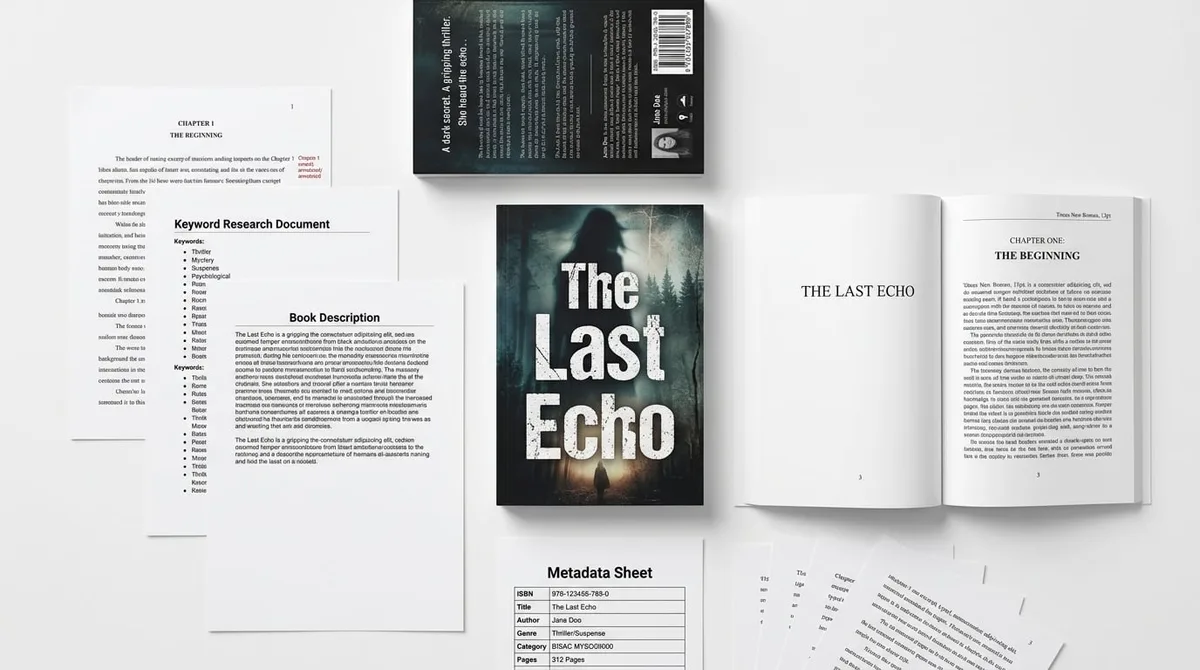
KDP Free ISBN: Own ISBN vs ASINs Explained

Skip the theory? Generate a free book preview in about a minute — no signup, no card.
Try it freeShort answer: a kdp free isbn is usually enough for an Amazon-only paperback or hardcover when you do not need your own publisher imprint. Buy your own ISBN when the book is part of a serious imprint, bookstore or library outreach plan, or multi-channel catalog.
The mistake is treating ISBNs and ASINs like small upload-screen details. They are not. They decide which imprint appears on the publishing record, which edition a retailer is identifying, and whether that identifier can follow the book outside Amazon. Choose too casually, and you may end up rebuilding a print edition later instead of simply editing a listing.
This guide gives you the practical decision: when the free KDP ISBN is fine, when your own ISBN is worth buying, and what ASINs actually change for Kindle, paperback, and hardcover editions. If you want the deeper Amazon-record view after this, read KDP Free ISBN vs Own ISBN: What ASINs Change.
What is a KDP free ISBN?
A KDP free ISBN is Amazon KDP’s no-cost ISBN option for eligible print books, including many paperback and hardcover editions. It identifies one specific print edition. It does not identify your copyright, your manuscript, your brand, or every possible version of the book.
An ISBN is a book-industry identifier. Modern ISBNs are 13 digits, and each ISBN is tied to a specific format and edition. A paperback, hardcover, audiobook, revised edition, or externally distributed version may need its own identifier depending on how it is published and distributed.
What the free ISBN does
The free ISBN lets you publish an eligible KDP print book without buying ISBNs before upload. That is useful if you want to launch a simple paperback, test a book concept, or keep the first version of a project inside Amazon’s publishing system.
It also gives the print edition a formal identifier inside KDP’s workflow. The paperback record is not the same as the hardcover record, and the ISBN helps distinguish that exact print product from other editions.
Before assigning an ISBN, use the KDP Upload Checklist to confirm title, subtitle, author name, trim size, page count, cover file, and interior file. Identifier mistakes are easier to prevent before upload than to untangle after publication.
What the free ISBN does not do
A free KDP ISBN does not mean Amazon owns your book. It does not transfer copyright, does not replace your author rights, and does not stop you from publishing other formats under the terms you choose.
It also does not give you a portable ISBN you can reuse outside KDP. If you publish the same print edition through another publishing or distribution platform, the KDP-provided ISBN is not the identifier to use there.
The imprint is the biggest practical difference. With a free KDP ISBN, Amazon’s default publisher imprint is used on the record, commonly displayed as “Independently published.” If you want your own imprint or publishing company name to appear, you need your own ISBN assigned under that imprint.
KDP free ISBN vs your own ISBN
The free option solves one problem: getting an Amazon print edition published with minimal setup. Your own ISBN solves a different problem: controlling the publishing record for a book or catalog that may outgrow one Amazon listing.
| Category | KDP free ISBN | Your own ISBN |
|---|---|---|
| Upfront cost | No cost through KDP | Purchased from your national ISBN agency |
| Publisher imprint | Amazon default imprint, often shown as “Independently published” | Your imprint, publishing company, or registered publisher name |
| Use outside KDP | No, it is tied to the KDP edition | Yes, when assigned correctly to that edition |
| Best for | Amazon-only paperback or hardcover launches | Professional catalogs, broader distribution, libraries, bookstores, and imprint building |
| Catalog control | Limited to the KDP publishing record | Controlled through your own publishing workflow |
| Long-term flexibility | Good for simple projects | Better for multi-title or multi-format plans |
In the United States, ISBNs are purchased from Bowker. In other countries, the official ISBN agency varies, and some national agencies provide ISBNs differently. The important point is the same: the registrant and imprint attached to the ISBN become part of the book’s bibliographic record.
When the KDP free ISBN is enough
Use the free ISBN when the book is intentionally Amazon-only and the imprint does not matter to your strategy. For example, a consultant publishing a paperback workbook only for Amazon buyers may reasonably choose the free ISBN. The book can still have a polished cover, clean interior, and strong metadata. The tradeoff is that the publishing record sits inside Amazon’s default imprint structure.
The free ISBN is also a practical choice for a test title. If your goal is to validate positioning, collect reader feedback, or learn the KDP workflow before building a full catalog, paying for identifier infrastructure may not be necessary yet.
When your own ISBN is the better choice
Buy your own ISBN when the book is part of a publishing brand. That includes authors building an imprint, coaches publishing a branded curriculum, studios managing multiple books, or publishers planning external distribution.
Your own ISBN is also the cleaner route when you care about bookstore and library metadata. Owning an ISBN does not guarantee bookstore placement or library purchasing, but it gives you the right publishing record structure for those conversations. A book listed under your imprint looks more deliberate than one attached to a default marketplace imprint.
If you are still mapping the workflow, start with the KDPBuilder free tools before you buy anything. The goal is not to spend more. The goal is to choose the identifier path that matches the book’s actual future.
Do I need my own ISBN?
No, not always. You need your own ISBN when the imprint, edition control, and channel flexibility matter. You probably do not need one when the book is a simple Amazon-only print edition and the default KDP imprint is acceptable.
| Decision point | Choose the free KDP ISBN if... | Choose your own ISBN if... |
|---|---|---|
| Sales channel | Amazon is the only planned print sales channel | You may use bookstores, libraries, wholesalers, or other platforms |
| Imprint | “Independently published” is acceptable | Your own publisher or imprint name should appear |
| Catalog plan | This is a one-off, test, or small personal project | You are building multiple titles under one brand |
| Edition strategy | You only need one simple print edition for now | You expect paperback, hardcover, revised editions, or channel-specific editions |
| Professional positioning | Speed and simplicity matter most | Catalog consistency and trade metadata matter most |
Use a free ISBN if...
- You only plan to sell the print edition through KDP and Amazon.
- You want the lowest-friction route to publication.
- You are testing a title, niche, workbook, or first print launch.
- You do not need your own imprint on the publisher record.
- You understand that the free ISBN cannot be reused outside KDP.
Buy your own ISBN if...
- You want your imprint name on the publishing record.
- You plan to distribute beyond Amazon now or later.
- You are building a professional catalog, studio, coaching brand, or small press.
- You need clean edition control across paperback, hardcover, and future revisions.
- You want the book’s metadata to support bookstore, library, or trade workflows.
A 4-step decision test
- Name the channel: Amazon only, or Amazon plus other retailers and distributors?
- Name the imprint: Is Amazon’s default imprint fine, or should your publisher name appear?
- Name the formats: Kindle only, paperback, hardcover, revised edition, or multiple formats?
- Name the future: Is this a one-off upload, or the first book in a serious catalog?
If two or more answers point beyond Amazon-only publishing, buy your own ISBN before upload. If every answer points to a simple Amazon print launch, the free ISBN is likely enough.
Warning: changing ISBN strategy after publication may require creating a new print edition rather than editing the old record. Run the KDP Upload Checklist before you assign identifiers so your files, format, metadata, and imprint decision match.
ISBN vs ASIN on KDP: what changes?
An ISBN and an ASIN are different identifiers used by different systems. An ISBN is a publishing-industry identifier for a specific book edition and format. An ASIN is Amazon’s internal catalog identifier for products sold on Amazon.
What an ISBN controls
An ISBN helps identify a particular book edition in publishing, retail, library, and distribution workflows. It is format-specific. A paperback ISBN is not the same as a hardcover ISBN, and a revised edition may need a new ISBN if it is treated as a materially different edition.
ISBNs matter most when a book needs to exist outside one retailer’s system. They support bibliographic records, catalog management, and edition clarity. They do not prove quality, guarantee sales, or make a book accepted by stores. They simply give the edition a recognized publishing identifier.
What an ASIN controls
An ASIN is Amazon’s catalog identifier. It organizes products inside Amazon and is used for product pages, retail tracking, advertising systems, reviews, and Amazon’s internal catalog relationships.
For Kindle eBooks published through KDP, Amazon assigns an ASIN. KDP does not require an ISBN for Kindle eBooks. If you publish a Kindle-only edition, the ASIN is the normal Amazon identifier for that digital listing.
An ASIN is not a replacement for an ISBN in external publishing systems. A bookstore, library, or non-Amazon distributor will not treat an Amazon ASIN as the same thing as a book-industry ISBN.
What ASINs change for Kindle, paperback, and hardcover
Amazon may show Kindle, paperback, and hardcover formats together on one product page, but those formats are not one single edition behind the scenes. Each format has its own files, metadata, production details, and identifier relationship.
Kindle ASINs
Kindle eBooks use Amazon-assigned ASINs inside the Amazon catalog. You do not need to buy an ISBN just to publish a Kindle eBook on KDP. Some publishers still assign ISBNs to eBooks for their own cataloging or external distribution, but it is not required for a Kindle upload.
This is where many authors overbuy. If the project is Kindle-only and Amazon-only, an ISBN may add no practical value. Spend your attention on metadata, cover positioning, categories, description quality, and a clean manuscript file instead.
Paperback and hardcover identifiers
Paperback and hardcover editions are separate physical products. If you use ISBNs, each print format generally needs its own ISBN. The paperback’s ISBN should not be reused for the hardcover because the binding, production details, and edition record are different.
KDP may also organize those products inside Amazon’s catalog structure, but the ISBN remains the publishing identifier for the print edition. Think of it this way: the ISBN describes the book edition to the publishing world; the ASIN helps Amazon organize the product in Amazon’s store.
Linked editions on one Amazon page
Amazon may link related editions so shoppers can choose Kindle, paperback, or hardcover from one product page. That linked shopper experience does not merge the editions into one identifier. Your files and metadata still need to match each specific format.
If the editions do not link correctly, authors sometimes assume the ISBN is the issue. Often the problem is metadata consistency: title, subtitle, author name, series, or format details do not match closely enough. Before upload, make sure the book family is intentionally aligned.
Format rules to know before you publish
Do not choose identifiers before you choose the edition structure. Confirm the title, subtitle, author name, trim size, paper type, cover dimensions, interior file, and format plan first. The ISBN should be assigned to a finished edition, not a moving target.
Paperback vs hardcover
A paperback and hardcover are different formats. If you publish both and use ISBNs, plan separate ISBNs. Even when the text is identical, the physical product is not identical.
This matters for branding and recordkeeping. A clean catalog might have one ISBN for the paperback and another for the hardcover, with consistent title, subtitle, author name, imprint, and description across both records.
Kindle eBook
A Kindle eBook does not require an ISBN on KDP. Amazon assigns the ASIN for the Kindle catalog record. If you are also publishing print editions, keep the visible metadata aligned so the Kindle, paperback, and hardcover look like one professional book family.
Low-content books
Low-content books require extra care. KDP’s ISBN rules for journals, notebooks, planners, and similar products are not always the same as rules for standard text-heavy books. KDP has treated many low-content books as ineligible for a free KDP ISBN, so check current KDP help before assuming the free option applies.
For low-content publishing, the decision is often not just “free ISBN vs own ISBN.” It may be “publish without an ISBN on Amazon, use your own ISBN where appropriate, or rethink the distribution plan.” Confirm the rule for your exact product type before upload.
Pre-upload identifier checklist
- Confirm the final title and subtitle exactly as they will appear on the cover and metadata.
- Decide whether the book is Kindle-only, paperback, hardcover, or multiple formats.
- Choose Amazon-only publishing or broader distribution before assigning ISBNs.
- Decide whether your own imprint name needs to appear on the record.
- Assign separate ISBNs to separate print formats when needed.
- Check whether the project is low-content and subject to special KDP ISBN rules.
- Keep author name, series name, description, and cover branding consistent across formats.
For a guided pre-publication pass, use the KDP Upload Checklist. It is the easiest way to catch identifier, file, and metadata mismatches before you publish.
Pro tip: if a hardcover or revised edition is even a realistic possibility, plan the identifier structure now. It is cleaner to publish each format correctly from the start than to repair a confusing catalog later.
KDPBuilder recommendation
Use the free KDP ISBN for simple Amazon-only testing. Use your own ISBN for a serious publishing brand. That is the cleanest decision rule.
KDPBuilder’s editorial standard is that a publish-ready book is not just a manuscript with a cover. It is a system: files, metadata, categories, description, imprint, identifiers, and edition structure all working together. ISBNs and ASINs are part of that system.
If you are still early, do not overcomplicate the first step. Start with the free KDPBuilder tools, run the upload checklist, and decide whether your book is a simple Amazon product or the first asset in a broader catalog. If you want to see the larger workflow after that, you can try KDPBuilder free before committing to a paid plan.
FAQ
Do I need my own ISBN for KDP?
No, not always. If you are publishing an eligible paperback or hardcover through KDP and only selling that print edition on Amazon, the free ISBN may be enough. If you want your own imprint, external distribution options, or professional catalog control, your own ISBN is usually the better choice.
What is the difference between ISBN vs ASIN on KDP?
An ISBN is a publishing identifier for a specific book format and edition. An ASIN is Amazon’s internal catalog identifier for a product listing. Kindle eBooks on KDP use ASINs, while print books can use ISBNs.
Can I use a KDP free ISBN outside Amazon?
No. A KDP free ISBN is tied to the eligible print edition published through KDP. It cannot be reused to publish the same edition through another platform or distribution system.
Can I change from a KDP free ISBN to my own ISBN later?
Do not assume it will be a simple edit. Changing identifier strategy may require creating a new edition or republishing under a different record. Choose the right ISBN path before the first upload whenever possible.
Does a KDP free ISBN mean Amazon owns my book?
No. A free KDP ISBN does not mean Amazon owns your copyright or manuscript. It identifies the print edition inside KDP’s publishing system. Your rights are governed by the publishing terms you accept, not by the ISBN alone.
Do Kindle eBooks need an ISBN on KDP?
No. KDP does not require an ISBN for Kindle eBooks because Amazon assigns a Kindle ASIN for the Amazon catalog. If you are publishing only a Kindle edition on Amazon, the ASIN is normally sufficient.
Does owning an ISBN guarantee bookstore or library distribution?
No. Your own ISBN helps create the right publishing record, but it does not guarantee placement, ordering, reviews, or sales. Bookstores and libraries still make their own acquisition decisions.
Next step: before you publish, run your files and metadata through the KDP Upload Checklist. It is free, practical, and built for exactly the point where ISBN, ASIN, format, and upload decisions start to overlap.
Turn this idea into a book — free sample
Type a book idea and we'll generate a real cover preview in about a minute. No signup, no card.